
WITCH HAZEL - HAMAMELIS VIRGINIANA Ophthalmic
 (PDF Version - 109 KB)
This monograph is intended to serve as a guide to industry for the preparation of Product Licence Applications (PLAs) and labels for natural health product market authorization. It is not intended to be a comprehensive review of the medicinal ingredient.
Notes
- Text in parentheses is additional optional information which can be included on the label at the applicant's discretion.
- The solidus (/) indicates that either term and/or statement may be selected on the label.
Date
February 27, 2026
Proper name(s), Common name(s), Source information
| Proper name(s) | Common name(s) | Source information | ||
|---|---|---|---|---|
| Source material(s) | Part(s) | Preparation(s) | ||
| Hamamelis virginiana | Hamamelis virginiana | Twig dormant | Dry2 | |
References: Proper name: USDA 2025; Common names: Gardner and McGuffin 2013; Bradley 2006; ESCOP 2003; Source information: Bradley 2006; ESCOP 2003.
1See dose section below for information on the method of preparation required to obtain Hamamelis/Witch hazel water. 2Dry = partially dried as per the USP preparation.
Route of administration
Ophthalmic
Dosage form(s)
The following dosage forms are acceptable when used according to the requirements indicated in this monograph: Liquid; Solution.
Use(s) or Purpose(s)
(Traditionally) used in Herbal Medicine for the temporary relief of eye discomfort due to dryness of the eye or to exposure to wind or sun (EMA 2009; Bradley 2006).
Notes
- For multi-ingredient products:
- To prevent the product from being represented as a "traditional medicine", any indicated traditional use claim must refer to the specific medicinal ingredient(s) and recognized traditional system of medicine from which the claim originates when 1) both traditional and modern claims are present or 2) when claims originate from multiple systems of traditional medicine (e.g., Witch hazel water is traditionally used in Herbal Medicine for the temporary relief of eye discomfort due to dryness of the eye or to exposure to wind or sun).
- When ALL of the medicinal ingredients (MIs) in the product are used within the SAME identified system of traditional medicine AND the product makes ONLY traditional claims, listing of MIs in the traditional claim(s) is not required.
Dose(s)
Subpopulation(s)
Adolescents 12-17 years; Adults 18 years and older (EMA 2009)
Quantity(ies)
Method of preparation: Distillation
10% of distillate (hamamelis water) in the finished product (EMA 2009)
Notes:
- Hamamelis/Witch hazel water is prepared by macerating in water recently cut and partially dried dormant twigs of Hamamelis virginiana in a ratio of 1:2 w/w (twigs:water) for 24 hours, and distilling twigs to a ratio of 1:0.80-0.85 w/v (twigs:distillate). To the distillate, 15% of ethanol (% of volume of finished product) is added. For example, 150 mL ethanol must be added to 850 mL distillate (USP-NF 2024).
- One part Hamamelis water diluted with 10 parts sterile water (EMA 2009).
Direction(s) for use
Put 2 drops of diluted hamamelis water in each eye, 3-6 times per day (EMA 2009).
Duration(s) of use
Use for a maximum of 4 days (EMA 2009)
Risk information
Caution(s) and warning(s)
- Ask a health care practitioner/health care provider/health care professional/doctor/physician if symptoms worsen or persist (for) more than 2 days (EMA 2009).
- Stop use and ask a health care practitioner/health care provider/health care professional/doctor/physician if you experience eye pain, changes in vision, continued redness, or irritation of the eye (EMA 2009).
Contraindication(s)
No statement required
Known adverse reaction(s)
No statement required
Non-medicinal ingredients
Must be chosen from the current Natural Health Products Ingredients Database (NHPID) and must meet the limitations outlined in the database.
Storage conditions
Must be established in accordance with the requirements described in the Natural Health Products Regulations.
Specifications
- The finished product specifications must be established in accordance with the requirements described in the Natural and Non-prescription Health Products Directorate (NNHPD) Quality of Natural Health Products Guide.
- The medicinal ingredient must comply with the requirements outlined in the NHPID.
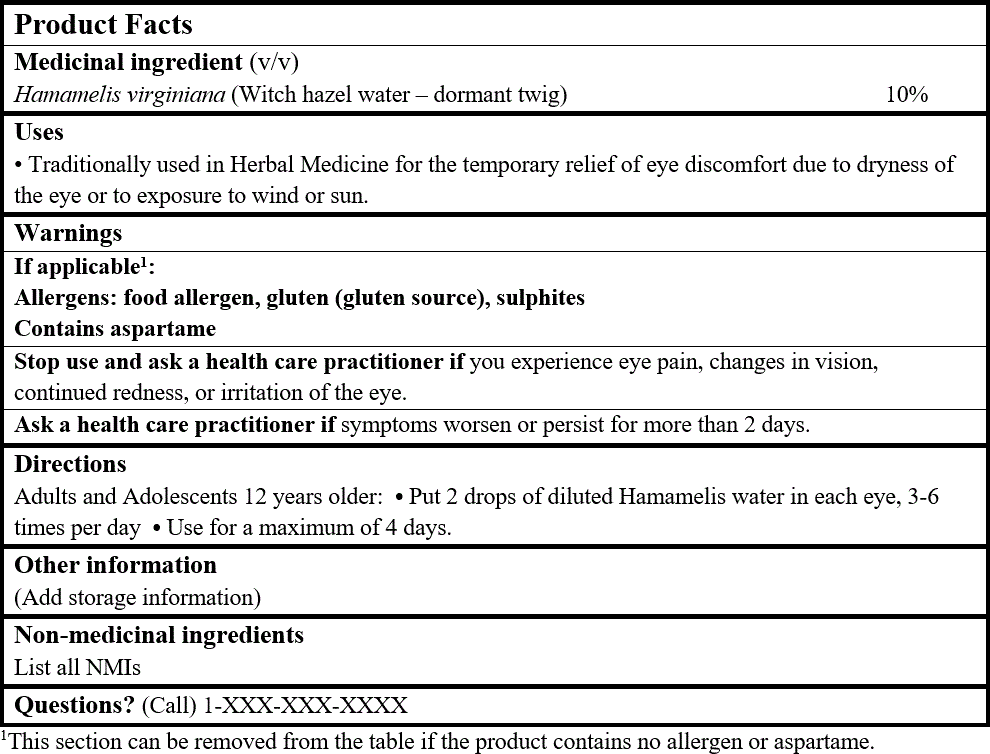
EXAMPLE OF PRODUCT FACTS:
Consult the Guidance Document, Labelling of Natural Health Products for more details.
References cited
- Bradley PR, editor. British Herbal Compendium: A Handbook of Scientific Information on Widely Used Plant Drugs, Volume 2. Bournemouth (GB): British Herbal Medicine Association; 2006.
- EMA 2009: European Medicines Agency. Committee on Herbal Medicinal Products. Community Herbal Monograph on Hamamelis virginiana L., folium et cortex aut ramunculus destillatium. [Accessed 2026 February 3]. Available from: https://www.ema.europa.eu/en/documents/herbal-monograph/final-community-herbal-monograph-hamamelis-virginiana-l-folium-cortex-aut-ramunculus-destillatum_en.pdf
- ESCOP 2003: European Scientific Cooperative on Phytotherapy Scientific Committee. ESCOP Monographs: The Scientific Foundation for Herbal Medicinal Products, 2nd edition. Exeter (GB): European Scientific Cooperative on Phytotherapy and Thieme; 2003.
- Gardner Z, McGuffin M, editors. American Herbal Products Association's Botanical Safety Handbook. 2nd edition. Boca Ration (FL): Taylor and Francis Group; 2013.
- USDA 2025: United States Department of Agriculture, Agricultural Research Service (USDA ARS), Germplasm Resources Information Network (GRIN)- Global. U.S. National Plant Germplasm System. [Accessed 2025 January 21]. Available from: https://npgsweb.ars-grin.gov/gringlobal/taxon/taxonomysearch
- USP-NF 2024: United States Pharmacopeia and the National Formulary. Rockville (MD): United States Pharmacopeial Convention, Inc.; 2024.
References reviewed
- Barnes J, Anderson LA, Philipson JD. Herbal Medicines, 3rd edition. London (GB): The Pharmaceutical Press; 2007.
- Berardi RR, DeSimone EM, Newton GD, Oszko MA, Popovich NG, Rollins CJ, Shimp LA, Tietze KJ, editors. Handbook of Nonprescription Drugs: An Interactive Approach to Self- Care, 13th edition. Washington (DC): American Pharmaceutical Association; 2002.
- BHP 1996: British Herbal Pharmacopoeia. Bournemouth (GB): British Herbal Medicine Association; 1996.
- Blumenthal M, Goldberg A, Brinkmann J, editors. Herbal Medicine: Expanded Commission E Monographs. Boston (MA): Integrative Medicine Communications; 2000.
- Bove M. An Encyclopedia of Natural Healing for Children and Infants. New Canaan (CT): Keats Publishing, Incorporated; 2001.
- BP 2008: British Pharmacopoeia Commission. British Pharmacopoeia 2008, Volume 1. London (UK): The Stationary Office; 2008.
- BPC 1934: The British Pharmaceutical Codex. London (GB): The Pharmaceutical Press; 1934.
- BPC 1973: The British Pharmaceutical Codex. London (GB): The Pharmaceutical Press; 1973.
- Brayfield A, Cadart C, editors. Martindale: The Complete Drug Reference. London (GB): Pharmaceutical Press; 2024. [Accessed 2024 November 21]. Available from: https://www.medicinescomplete.com/#/browse/martindale
- Brinker F. Herb Contraindications and Drug Interactions, 4th edition. Sandy (OR): Eclectic Medical Publications; 2010.
- Ellingwood F. American Materia Medica, Therapeutics and Pharmacognosy. Sandy (OR): Eclectic Medical Publications; 1983 [Reprint of 1919 original].
- Felter HW, Lloyd JU. King's American Dispensatory, Volume 1, 18th edition. Sandy (OR): Eclectic Medical Publications; 1983 [Reprint of 1898 original].
- Grieve M. A Modern Herbal, Volume 2. New York (NY): Dover Publications; 1971 [Reprint of 1931 Harcourt, Brace & Company publication].
- Hoffmann D. Medical Herbalism: The Science and Practice of Herbal Medicine. Rochester (VT): Healing Arts Press; 2003.
- McIntyre A. Herbal Treatment of Children - Western and Ayurvedic Perspectives. Toronto (ON): Elsevier Limited; 2005.
- Meyer JE. The Herbalist. Glenwood (IL): Meyerbooks; 1993.
- Mills S, Bone K. Principles and Practice of Phytotherapy. Toronto (ON): Churchill Livingstone; 2000.
- Mills S. The Essential Book of Herbal Medicine. Toronto (ON): Arkana; 1993.
- Mills S. The Dictionary of Modern Herbalism. Wellingborough (GB): Thorsons Publishers Ltd; 1985.
- Moerman DE. Native American Ethnobotany. Portland (OR): Timber Press; 1998.
- Ph. Eur. 2008: European Pharmacopoeia Commission. European Pharmacopoeia, 6th edition, Volume 2. Strasbourg (FR): Directorate for the Quality of Medicines and HealthCare of the Council of Europe (EDQM); 2008.
- Schilcher H. Phytotherapy in Paediatrics: Handbook for Physicians and Pharmacists. Stuttgart (DE): Medpharm Scientific Publishers; 1997.
- Williamson EM. Potter's Herbal Cyclopaedia: The Authoritative Reference work on Plants with a Known Medical Use. Saffron Walden (GB): The C.W. Daniel Company Limited; 2003.
- Williamson EM, Evans FJ, Wren RC. Potter's New Cyclopaedia of Botanical Drugs and Preparations. Saffron Walden (GB): C.W. Daniel Company Limited; 1988.
- Wren RC. Potter's Cyclopedia of Botanical Drugs and Preparations. London (GB): Potter and Clark; 1907.
- Zeylstra H. Hamamelis virginia. British Journal of Phytotherapy 1998;5(1):23-28.
Version history
| Publication date | Update type | Summary of main updates (from Feb 2026) |
|---|---|---|
| 2026-02-27 | Minor updates |
|
| 2022-02-17 | Validation | – |
| 2010-05-17 | Initial release | – |