
VITAMIN D (>1,000 - 2,500 IU)
 (PDF Version - 60 ko)
This monograph is intended to serve as a guide to industry for the preparation of Product Licence Applications (PLAs) and labels for natural health product market authorization. It is not intended to be a comprehensive review of the medicinal ingredients.
Notes
- Text in parentheses is additional optional information which can be included on the label at the applicant's discretion.
- The solidus (/) indicates that either term and/or statement may be selected on the label.
- Other Multi-vitamin/mineral supplement monograph claims are not permitted, as the risk-benefit profile for products providing more than 1,000 IU of vitamin D per day was deemed acceptable only for a specific subpopulation associated with the claims listed in this monograph, and not for general supplementation.
- In addition, although NNHPD included a few complementary ingredients in this monograph, high dose vitamin D can only be combined with the specific ingredients listed in this monograph.
This monograph cannot be combined with any other monograph.
Date
June 26, 2026
Proper name(s), Common name(s), Source information
| Proper Name(s) | Common Name(s) | Source information |
|---|---|---|
| Source ingredient(s) | ||
| Vitamin D |
|
Ergocalciferol |
|
Cholecalciferol |
References: Proper name: FCC 2025; RSC 2025; Brayfield and Cadart 2024; Common names: FCC 2025; RSC 2025; Brayfield and Cadart 2024; Source information: FCC 2025; RSC 2025; Brayfield and Cadart 2024.
| Proper name(s) | Common name(s) | Source information1,2 |
|---|---|---|
| Source ingredient(s) | ||
| Calcium | Calcium |
|
| Magnesium | Magnesium |
|
| Vitamin K2 | Vitamin K2 |
|
| Zinc | Zinc |
|
Reference: NNHPD 2026.
1For complementary ingredients both the synthetic and non-synthetic forms are supported by this monograph. However, if non-synthetic, the ingredient must be isolated and purified from a source material listed in its Natural Health Products Ingredients Database (NHPID) entry. For example, calcium sourced from bone meal, coral calcareous skeleton, or oyster shell is also acceptable. All medicinal ingredients isolated from source materials must be of an acceptable purity. This monograph does not support extracts.
2When applicable, any hydrated form of a source ingredient listed above would be acceptable on the marketed label as long as it is included in the NHPID.
Route of administration
Oral
Dosage form(s)
This monograph excludes foods or food-like dosage forms as indicated in the Compendium of Monographs Guidance Document.
Acceptable dosage forms for oral use are indicated in the dosage form drop-down list of the web-based Product Licence Application form for Compendial applications.
Use(s) or Purpose(s)
- Helps to prevent vitamin D deficiency (IOM 2006; Shils et al. 2006; Groff and Gropper 2000; IOM 1997).
- Vitamin D intake, when combined with sufficient calcium, a healthy diet and regular exercise may reduce the risk of developing osteoporosis in people with vitamin D deficiency (Kahwati et al. 2018; Shils et al. 2006; NIH 2001; Groff and Gropper 2000).
Dose(s)
Subpopulation(s)
Adults 18 years and older
Note: Adults 19 years and older is the only acceptable subpopulation for the source ingredients HAP or HVP and for zinc sourced from picolinate.
Quantity(ies)
| Subpopulation(s) | Medicinal ingredient | Minimum1 | Maximum2 |
|---|---|---|---|
| Adults 18 years and older | Vitamin D | 25 µg (> 1,000 IU*) | ≤ 62.5 µg (≤ 2,500 IU*) |
1This value is based on the previous Prescription Drug List limit (HC 2020).
2This value is based on the Prescription Drug List limit amended in 2021 (HC 2021).
Notes
- The quantity of vitamin D per dosage unit must always be provided in micrograms (µg).
- Optional: *International Units (IU) may be provided as additional quantity per dosage unit.
- Conversion factor: 1 IU of vitamin D = 0.025 µg cholecalciferol or ergocalciferol (IOM 2006).
| Subpopulation(s) | Complementary ingredient | Minimum | Maximum | |
|---|---|---|---|---|
| Adults | 18 years | Calcium | 65 mg | 1,500 mg |
| 19 years and older | ||||
| 18 years | Magnesium | 20 mg | 350 mg | |
| 19 years and older | 500 mg | |||
| 18 years | Vitamin K2 | 6 mcg | 75 mcg | |
| 19 years and older | 120 mcg | |||
| 18 years | Zinc (from non-picolinate sources) | 0.7 mg | 34 mg | |
| 19 years and older | 50 mg | |||
| 18 years | Zinc (from picolinate sources) | - | - | |
| 19 years and older | 0.7 mg | 25 mg | ||
Reference: NNHPD 2026.
1Any restrictions from the Multi-vitamin/mineral supplements monograph also apply.
Direction(s) for use
Products that do not contain calcium at therapeutic dose
Take with an adequate intake of calcium.
Products containing calcium or zinc
- Take with food (NNHPD 2026).
- Take a few hours before or after taking other medications or health products (NNHPD 2026).
Duration(s) of use
Products containing zinc sourced from picolinate
Ask a health care practitioner/health care provider/health care professional/doctor/physician for use beyond 12 weeks (NNHPD 2026).
Other products
Ask a health care practitioner/health care provider/health care professional/doctor/physician for use beyond 6 months (BfR 2020).
Risk information
Caution(s) and warning(s)
All products except products containing zinc sourced from picolinate requiring a contraindication
- Ask a health care practitioner/health care provider/health care professional/doctor/physician before use if you are pregnant or breastfeeding.
All products
- Ask a health care practitioner/health care provider/health care professional/doctor/physician before use if you have kidney disorders (NIH 2024; BfR 2020).
- Ask a health care practitioner/health care provider/health care professional/doctor/physician before use if you are taking other supplements or products containing vitamin D or vitamin D analogues.
- Ask a health care practitioner/health care provider/health care professional/doctor/physician before use if you are taking any medications including antacids, anticonvulsants, digoxin, cholestyramine, colestipol, mineral oil, steroids, statins or thiazide diuretics (NNHPD 2021; BfR 2020).
- Ask a health care practitioner/health care provider/health care professional/doctor/physician before use to determine if you would benefit from additional vitamin D as 15-20 mcg (600-800 IU) of vitamin D per day is an adequate quantity for most individuals.
Products containing vitamin K2
Ask a health care practitioner/health care provider/health care professional/doctor/physician before use if you are taking blood thinners (NNHPD 2026).
Products providing 25-34 mg of zinc per day for adults 18 years or 31-50 mg of zinc per day for adults 19 years and older
Ask a health care practitioner/health care provider/health care professional/doctor/physician before use if you are unsure whether you are taking enough copper as zinc supplementation can cause a copper deficiency (NNHPD 2026).
Contraindication(s)
All products
Do not use if you have hypercalcemia and/or hypercalciuria (NIH 2024; BfR 2020).
Products containing zinc sourced from picolinate
Do not use if you are pregnant or breastfeeding (NNHPD 2026).
Known adverse reaction(s)
All products
Stop use and ask a health care practitioner/health care provider/health care professional/doctor/physician if the following early symptoms of hypercalcemia occur: weakness, fatigue, drowsiness, headache, lack of appetite, dry mouth, metallic taste, nausea, vomiting, vertigo, ringing in the ears, lack of coordination and muscle weakness or if you develop any other symptom (NIH 2024; BfR 2020).
Products providing more than 350 mg of magnesium per day
When using this product you may experience diarrhea (NNHPD 2026).
Non-medicinal ingredients
Must be chosen from the current Natural Health Products Ingredients Database (NHPID) and must meet the limitations outlined in the database.
Storage conditions
Must be established in accordance with the requirements described in the Natural Health Products Regulations.
Specifications
- The finished product specifications must be established in accordance with the requirements described in the Natural and Non-prescription Health Products Directorate (NNHPD) Quality of Natural Health Products Guide.
- The medicinal ingredient must comply with the requirements outlined in the NHPID.
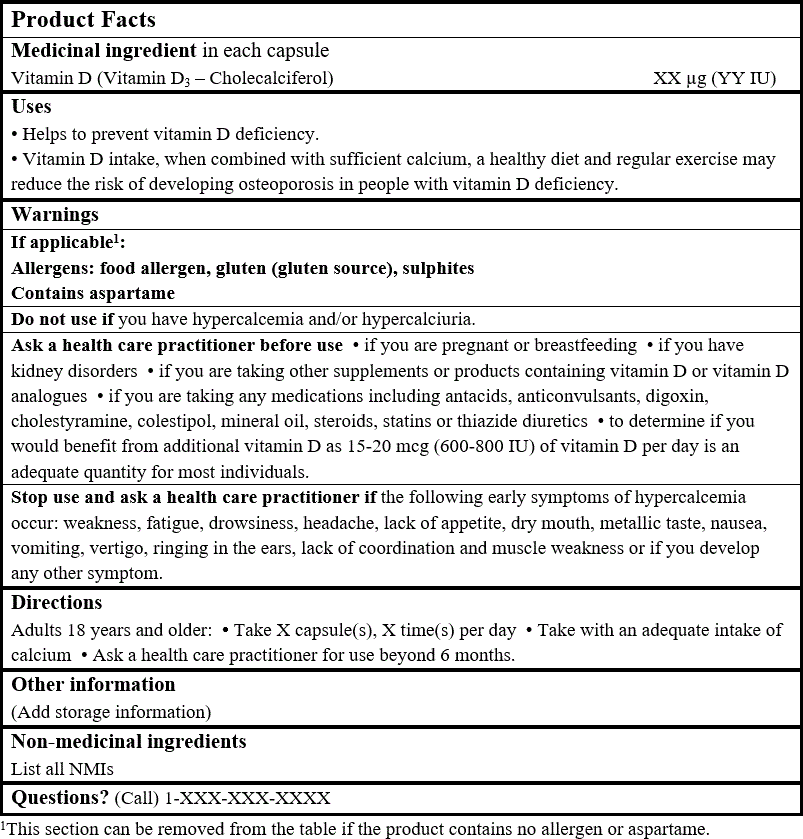
EXAMPLE OF PRODUCT FACTS:
Consult the Guidance Document, Labelling of Natural Health Products for more details.
References cited
- BfR 2020: Vitamin D: consumption of high-dose food supplements is unnecessary; BfR Opinion No 035; 2020. [Accessed 2026March 18]. Available from: https://www.bfr.bund.de/cm/349/vitamin-d-consumption-of-high-dose-food-supplements-is-unnecessary.pdf
- Brayfield A, Cadart C, editors. Martindale: The Complete Drug Reference. London (GB): Pharmaceutical Press; 2024. [Accessed 2026 March 18]. Available from: https://www.medicinescomplete.com/#/browse/martindale
- FCC 2025: Food Chemicals Codex, 14th edition. Rockville (MD): The United States Pharmacopeial Convention; 2025.
- Groff J, Gropper S. Advanced Nutrition and Human Metabolism, 3rd edition. Belmont (CA): Wadsworth/Thomson Learning; 2000.
- HC 2021: Health Canada's Prescription Drug List; Vitamin D, effective date: 2021-02-24. [Accessed 2026 March 18]. Available from: https://hpr-rps.hres.ca/pdl-phu.php
- HC 2020: Health Canada: Notice of Intend to Amend the Prescription Drug List: Vitamin D; 2020. [Accessed 2026 March 18]. Available from: https://www.canada.ca/en/health-canada/services/drugs-health-products/drug-products/prescription-drug-list/notices-changes/notice-intent-vitamin-d.html
- IOM 2006: Institute of Medicine. Otten JJ, Pitzi Hellwig J, Meyers LD, editors. Institute of Medicine. Dietary Reference Intakes: The Essential Guide to Nutrient Requirements. Washington (DC): National Academies Press; 2006.
- IOM 1997: Institute of Medicine. Standing Committee on the Scientific Evaluation of Dietary Reference Intakes, Food and Nutrition Board, Institute of Medicine. Dietary Reference Intakes for Calcium, Phosphorous, Magnesium, Vitamin D, and Fluoride. Washington (DC): National Academy Press; 1997.
- Kahwati LC, Weber RP, Pan H, Gourlay M, LeBlanc E, Coker-Schimmer M, Viswanathan M. Vitamin D, Calcium, or Combined Supplementation for the Primary Prevention of Fractures in Community-Dwelling Adults: Evidence Report and Systematic Review for the US Preventive Services Task Force. JAMA 2018;319(15):1600-1612.
- NIH 2024: National Institute of Health: Vitamin D Fact Sheet for Health Professionals; 2024. [Accessed 2026 March 18]. Available from: https://ods.od.nih.gov/factsheets/VitaminD-HealthProfessional/
- NIH 2001: National Institute of Health. Osteoporosis Prevention, Diagnosis, and Therapy. NIH Consensus Development Panel on Osteoporosis Prevention, diagnosis and therapy. JAMA 2001;17(1):1-36.
- NNHPD 2026: Natural and Non-Prescription Health Products Directorate. Multi-Vitamin/Mineral Supplements monograph. [Accessed 2026 May 29]. Available from: https://webprod.hc-sc.gc.ca/nhpid-bdipsn/atReq?atid=multi_vitmin_suppl3&lang=eng
- NNHPD 2021. Natural and Non-Prescription Health Products Directorate. Internal evidence and HC's product monographs.
- RSC 2025: Royal Society of Chemistry: The Merck Index Online; 2025. [Accessed 2026 March 18]. Available from: https://merckindex.rsc.org/
- Shils ME, Olson JA, Shike M, Ross AC, Caballero B, Cousins RJ, editors. Modern Nutrition in Health and Disease. 10th edition. Philadelphia (PA): Lippincott Williams & Wilkins; 2006.
References reviewed
Version History
| Publication date | Update type | Summary of main updates (from March 2026) |
|---|---|---|
| 2026-06-26 | Minor updates |
|
| 2026-03-27 | Minor updates |
|
| 2021-07-23 | Initial version | – |