
Turmeric -CURCUMA LONGA - Topical
 (PDF Version - 36 K)
This monograph is intended to serve as a guide to industry for the preparation of Product Licence Applications (PLAs) and labels for natural health product market authorization. It is not intended to be a comprehensive review of the medicinal ingredient.
Notes
- Text in parentheses is additional optional information which can be included on the label at the applicant's discretion.
- The solidus (/) indicates that the terms and/or statements are synonymous. Either term or statement may be selected by the applicant on the label.
Date
February 28, 2025
Proper name(s), Common name(s), Source information
| Proper name(s) | Common name(s) | Source information | ||
|---|---|---|---|---|
| Source material(s) | Part(s) | Preparation(s) | ||
| Curcuma longa |
|
Curcuma longa | Rhizome | Dry |
References: Proper name: USDA 2024; Common names: USDA 2024; Gardner and McGuffin 2013; Source information: PPRC 2020; ESCOP 2003; Blumenthal et al. 2000.
Route of administration
Topical
Dosage form(s)
Acceptable dosage forms when used according to the requirements indicated in this monograph: Cream; Gel; Liquid; Lotion; Ointment; Paste; Powder; Salve; Solution; Topical liquid (Paranjape 2005; Kapoor 2001).
Use(s) or Purpose(s)
- Traditionally used in Ayurveda to help relieve pain and inflammation (Paranjape 2005; Murthy 2004; API 2001; Kapoor 2001).
- Traditionally used in Ayurveda to help heal minor wounds (such as cuts/ (and) burns) (Paranjape 2005; Murthy 2004; API 2001; Kapoor 2001).
- Traditionally used in Ayurveda to help heal minor skin irritations (Paranjape 2005; Murthy 2004; API 2001; Kapoor 2001).
Notes
- The above uses can be combined on the product label if from the same traditional or non-traditional system of medicine (e.g., Traditionally used in Ayurveda to help relieve pain and inflammation and to help heal minor wounds).
- For multi-ingredient products:
- To prevent the product from being represented as a "traditional medicine", any indicated traditional use claim must refer to the specific medicinal ingredient(s) and recognized traditional system of medicine from which the claim originates when 1) both traditional and modern claims are present or 2) when claims originate from multiple systems of traditional medicine (e.g., Turmeric is traditionally used in Ayurveda to help relieve pain and inflammation).
- When ALL of the medicinal ingredients (MIs) in the product are used within the SAME identified system of traditional medicine AND the product makes ONLY traditional claims, listing of MIs in the traditional claim(s) is not required.
Dose(s)
Subpopulation(s)
Adults 18 years and older
Quantity(ies)
Note: On the PLA form, quantities can be expressed as percentage weight by weight (% w/w), percentage weight by volume (% w/v) or percentage volume by volume (% v/v), depending on the product formulation. On the product label, quantities can also be expressed in other equivalent concentration units (e.g., mg/mL).
Methods of preparation: Powdered, Non-Standardized Ethanolic Extracts (Tincture, Fluid extract)
5 - 100% of dried rhizome or dried rhizome extract preparation in the finished product (Jamali et al. 2020; API 2001; Nadkarni and Nadkarni 1976).
Notes:
- The extract ratio must be between 1:1 (fluid extract) and 1:20. The formulation must be prepared in a way which is equivalent to 50 to 1000 milligrams crude dried rhizome per 1 gram of finished product. For example, for a tincture prepared with a 1:5 w/w ratio, the finished product must contain between 25 to 100% extract preparation (50 - 1000 mg crude dried rhizome * 5 w/w (dilution) = 250 - 1000 mg extract in 1 gram finished product = 25 - 100 % extract preparation in the finished product).
- Products in a powder dosage form must be prepared by the consumer prior to application on the skin prior to use (see directions for use).
Methods of preparation: Non-Standardized Ethanolic Dry Extracts (Extract dry)
0.5 - 50% dried rhizome extract preparation in the finished product (Jamali et al. 2020; API 2001; Nadkarni and Nadkarni 1976).
Notes:
- For dry extracts, the extract ratio must be between 2:1 and 50:1. The formulation must be prepared in a way which is equivalent to a quantity of 50 to 1000 milligrams crude dried rhizome per 1 gram of finished product. For example, for a dry extract prepared with a 10:1 w/w ratio, the finished product must contain between 25 to 100% extract preparation (50 - 1000 mg crude dried rhizome / 10 w/w (concentration) = 5 mg dry extract in 1 g finished product = 25 - 50% extract preparation in the finished product).
- The minimum quantity of 0.5% still applies for more concentrated extracts (e.g., a product containing 0.5% of a dry extract contains 5 mg dry extract in 1 g finished product; 5 mg of a 30:1 w/w dry extract is equivalent to 150 mg crude dried rhizome).
Direction(s) for use
Powder dosage form
Prepare as a paste by mixing [insert volume to be measured by consumer, e.g., ½ teaspoon] of product with a small amount of water until you achieve the desired consistency. Apply to affected area(s), up to 4 times per day (API 2001; Kapoor 2001).
Liquid dosage forms (Liquid, Solution, Topical liquid)
Soak a small towel/pad/gauze/cotton in the product. Apply to affected area(s), up to 4 times per day (API 2001; Kapoor 2001).
Cream/Gel/Lotion/Ointment/Paste/Salve dosage forms
Apply to affected area(s), up to 4 times per day (API 2001; Kapoor 2001).
Duration(s) of use
No statement required.
Risk information
Caution(s) and warning(s)
- For external use only.
- When using this product avoid contact with eyes. If contact occurs, rinse thoroughly with water.
- Stop use and ask a health care practitioner/health care provider/health care professional/doctor/physician if symptoms worsen or last (for) more than 7 days.
- Keep out of reach of children. If swallowed, call a poison control centre or get medical help right away.
Contraindication(s)
Do not use on deep or puncture wounds, animal bites or serious burns.
Known adverse reaction(s)
No statement required.
Non-medicinal ingredients
Must be chosen from the current Natural Health Products Ingredients Database (NHPID) and must meet the limitations outlined in the database.
Storage conditions
Must be established in accordance with the requirements described in the Natural Health Products Regulations.
Specifications
- The finished product specifications must be established in accordance with the requirements described in the Natural and Non-prescription Health Products Directorate (NNHPD) Quality of Natural Health Products Guide.
- The medicinal ingredient must comply with the requirements outlined in the NHPID.
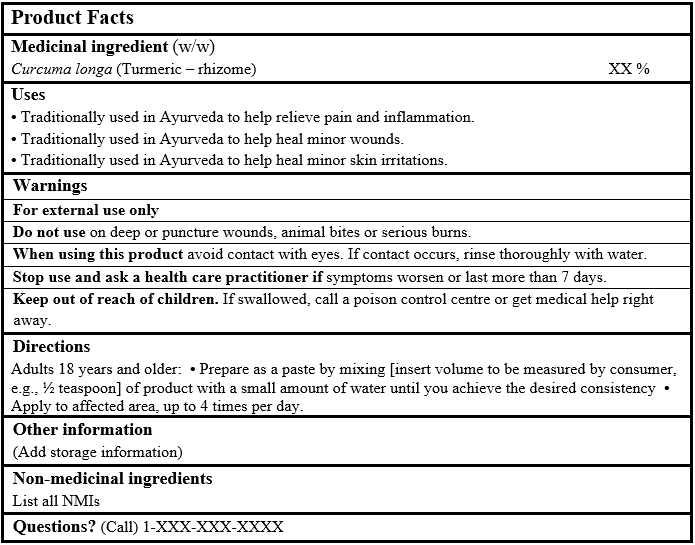
EXAMPLE OF PRODUCT FACTS:
Consult the Guidance Document, Labelling of Natural Health Products for more details.
References cited
- API 2001. The Ayurvedic Pharmacopoeia of India, 1st edition, Part I, Volume I. Delhi (IN): The Controller of Publications; 2001 [Reprint of 1990 publication].
- Blumenthal M, Goldberg A, Brinkmann J, editors. Herbal Medicine: Expanded Commission E Monographs. Boston (MA): Integrative Medicine Communications; 2000.
- ESCOP 2003: ESCOP Monographs: The Scientific Foundation for Herbal Medicinal Products, 2nd edition. Exeter (GB): European Scientific Cooperative on Phytotherapy and Thieme; 2003.
- Gardner Z, McGuffin M, editors. American Herbal Products Association's Botanical Safety Handbook. 2nd Edition. Boca Ration (FL): Taylor and Francis Group; 2013.
- Jamali N., Adib-Hajbaghery M., Soleimani A. The effect of curcumin ointment on knee pain in older adults with osteoarthritis: a randomized placebo trial. BMC Complementary Medicine and Therapies 2020;20(1):305.
- Kapoor LD. Handbook of Medicinal Ayurvedic Medicinal Plants. Boca Raton (FL): CRC press LLC; 2001.
- Murthy KRS. Bhavaprakasha of Bhavmisra, Volume 1. Varanasi (IND): Chowkhamba Krishnadas Academy; 2004.
- Nadkarni and Nadkarni. Dr. K.M. Nadkarni's Indian materia medica: with Ayurvedic, Unani-Tibbi, Siddha, allopathic, homeopathic, naturopathic & home remedies, appendices & indexes. Bombay: Popular Prakashan; 1979.
- Paranjpe P. Indian Medicinal Plants- Forgotten Healers (A Guide to Ayurvedic Herbal Medicine). Delhi (IND): Chaukhamba Sanskrit Pratishthan; 2005.
- PPRC 2020: Pharmacopoeia of the People's Republic of China, Volume 1, English edition, Beijing (CN): The State Pharmacopoeia Commission of the People's Republic of China; 2020.
- USDA 2024: United States Department of Agriculture Agricultural Research Service (USDA ARS), Germplasm Resources Information Network (GRIN) - Global. U.S. National Plant Germplasm System. [Accessed 2024 June 21]. Available from: https://npgsweb.ars-grin.gov/gringlobal/taxon/taxonomysearch
- Williamson EM, editor. Major Herbs of Ayurveda. Edinburgh (GB): Churchill Livingstone; 2002.
References reviewed
- Aggarwal BB, Goel A, Kunnumakkara AB. Curcumin as "Curecumin": From kitchen to clinic. Biochemical Pharmacology 2008;75:787-809.
- Araújo CA, Leon LL. Abstract: Biological activities of Curcuma longa L. Mem Inst Oswaldo Cruz 2001;96(5):723-728.
- Deodhar SD, Sethi R, Srimal RC. Preliminary studies on antirheumatic activity of curcumin (di-feruloyl methane). Indian Journal of Medical Research 1980;71:632-634.
- Felter HW. The Eclectic Materia Medica, Pharmacology and Therapeutics. Sandy (OR): Eclectic Medical Publications; 1983. [Reprint of 1922 original].
- Felter HW, Lloyd JU. King's American Dispensatory, Volume 2, 18th edition. Sandy (OR): Eclectic Medical Publications; 1983. [Reprint of 1898 original].
- Funk JL, Oyarzo JN, Frye JB, Chen G, Lantz RC, Jolad SD, Sólyom AM, Timmermann BN. Turmeric extracts containing curcuminoids prevent experimental rheumatoid arthritis. Journal of Natural Products 2006;69(3):351-355.
- Gerard J. The Herbal or General History of Plants. The Complete 1633 Edition as Revised and Enlarged by Thomas Johnson. NY (NY): Dover Publications; 1975.
- Grieve M. A Modern Herbal, Volume 2. New York (NY): Dover Publications; 1971. [Reprint of 1931 Harcourt, Brace & Company publication].
- Hatcher H, Planalp R, Cho J, Torti FM, Torti SV. Curcumin: From ancient medicine to current clinical trials. Cellular and Molecular Life Sciences 2008;65:1631-1652.
- Hoffmann D. Medical Herbalism: The Science and Practice of Herbal Medicine. Rochester (VT): Healing Arts Press; 2003.
- Jurenka JS. Anti-inflammatory properties of curcumin, a major constituent of Curcuma longa: a review of preclinical and clinical research. Alternative Medicine Review 2009;14(2):141-153.
- Khory RN, Katrak NN. Materia Medica of India and their Therapeutics. Delhi (IN): Komal Prakashan; 1999.
- Kiso Y, Suzuki Y, Watanabe N, Oshima Y, Hikino H. Antihepatotoxic principles of Curcuma longa rhizomes. Journal of Medicinal Plant Research 1983;49:185-187.
- Kohli K, Ali J, Ansari J, Raheman Z. Curcumin: a natural antiinflammatory agent. Indian Journal of Pharmacology 2005;37(3):141-147.
- Kulkarni RR, Patki PS, Jog VP, Gandage SG, Patwardhan B. Treatment of osteoarthritis with a herbomineral formulation: a double-blind, placebo-controlled, cross-over study. Journal of Ethnopharmacology 1991;33:91-95.
- Mills S. The Dictionary of Modern Herbalsim. Wellingborough (GB): Thorsons Publishers Ltd; 1985.
- Moerman DE. Native American Ethnobotany. Portland (OR): Timber Press; 1998.
- Rivera-Espinoza Y, Muriel P. Pharmacological actions of curcumin in liver diseases or damage. Liver International 2009;29(10):1457-1466.
- Satoskar RR, Shah SJ, Shenoy SG. Evaluation of anti-inflammatory property of curcumin (diferuloyl methane) in patients with postoperative inflammation. International Journal of Clinical Pharmacology, Therapy and Toxicology 1986;24(12):651-654.
- Srimal R, Dhawan B. Pharmacology of diferuloyl methane (curcumin), a non-sterodal anti-inflammatory agent. Journal of Pharmacy and Pharmacology 1973;25:447-452.