
ST. JOHN'S WORT - HYPERICUM PERFORATUM - Topical
 (PDF Version - 61 KB)
This monograph is intended to serve as a guide to industry for the preparation of Product Licence Applications (PLAs) and labels for natural health product market authorization. It is not intended to be a comprehensive review of the medicinal ingredient.
Notes
- Text in parentheses is additional optional information which can be included on the label at the applicant's discretion.
- The solidus (/) indicates that the terms and/or statements are synonymous. Either term or statement may be selected by the applicant on the label.
Date
February 28, 2025
Proper name(s), Common name(s), Source information
| Proper name(s) | Common name(s) | Source information | ||
|---|---|---|---|---|
| Source material(s) | Part(s) | Preparation(s) | ||
| Hypericum perforatum |
|
Hypericum perforatum | Flower | Fresh |
References: Proper name: USDA 2024; Common names: Gardner and McGuffin 2013; Anghelescu et al. 2006; Gastpar et al. 2006; Szegedi et al. 2005; Wichtl 2004; Source information: Bradley 2006; Mills and Bone 2005; Hoffmann 2003; Blumenthal et al. 2000; Felter and Lloyd 1983; Wren 1907.
Route of Administration
Topical
Dosage Form(s)
Acceptable dosage forms when used according to the requirements indicated in this monograph: Cream; Gel; Liquid; Lotion; Oil; Ointment; Solution; Topical liquid.
Use(s) or Purpose(s)
(Traditionally) used in Herbal Medicine to help heal minor wounds (such as cuts and burns) (Bradley 2006; Mills and Bone 2005; Hoffmann 2003; Blumenthal et al. 2000; Felter and Lloyd 1983; Wren 1907).
Notes
For multi-ingredient products:
- To prevent the product from being represented as a "traditional medicine", any indicated traditional use claim must refer to the specific medicinal ingredient(s) and recognized traditional system of medicine from which the claim originates when 1) both traditional and modern claims are present or 2) when claims originate from multiple systems of traditional medicine (e.g., St. John's wort is traditionally used in Herbal Medicine to help heal minor wounds such as cuts and burns).
- When ALL of the medicinal ingredients (MIs) in the product are used within the SAME identified system of traditional medicine AND the product makes ONLY traditional claims, listing of MIs in the traditional claim(s) is not required.
Dose(s)
Subpopulation(s)
Infants 0-12 months, Children 1-11 years, Adolescents 12-17 years, Adults 18 years and older (Bove 2001).
Quantity(ies)
Method of preparation: Oil, Medicated from fresh plant
25 - 100% fresh flower extract preparation (i.e., medicated oil) in the finished product (Bradley 2006; Wichtl 2004; Hoffmann 2003; Blumenthal et al. 2000; Maisenbacher and Kovar 1992; Felter and Lloyd 1983; Grieve 1971; DAB 1941; Wren 1907).
Notes:
- The extract ratio must be between 1:1 and 1:4 and the solvent used must be a vegetable fixed oil (e.g., olive oil, sunflower oil, etc.). The formulation must be prepared in a way which is equivalent to a quantity of 200 to 250 milligrams crude fresh flowers for 1 gram of finished product. If the oil further diluted into a semi-solid dosage form, the starting oil preparation must be more concentrated in order to achieve a similar ratio in the finished product. For example, for an oil prepared with a 1:2 w/w ratio, the concentration of oil in the finished product must be 50% (250 mg crude fresh flowers * 2 w/w (dilution) = 500 mg medicated oil in 1 g finished product = 50% w/w oil preparation in the finished product).
- On the PLA form, quantities can be expressed as percentage weight by weight (% w/w), percentage weight by volume (% w/v) or percentage volume by volume (% v/v), depending on the product formulation. On the product label, quantities can also be expressed in other equivalent concentration units (e.g., mg/mL).
Direction(s) for use
Apply to affected area(s), up to 3 times per day (Bove 2001; Blumenthal et al. 2000).
Duration(s) of Use
No statement is required
Risk Information
Caution(s) and warning(s)
- For external use only.
- When using this product avoid contact with eyes. If contact occurs, rinse thoroughly with water.
- Stop use and ask a health care practitioner/health care provider/health care professional/doctor/physician if symptoms worsen or last (for) more than 7 days.
- Keep out of reach of children. If swallowed, call a poison control centre or get medical help right away.
Contraindication(s)
Do not use on deep or puncture wounds, animal bites or serious burns.
Known adverse reaction(s)
No statement is required
Non-medicinal ingredients
Must be chosen from the current Natural Health Products Ingredients Database (NHPID) and must meet the limitations outlined in the database.
Storage conditions
Must be established in accordance with the requirements described in the Natural Health Products Regulations.
Specifications
- The finished product specifications must be established in accordance with the requirements described in the Natural and Non-prescription Health Products Directorate (NNHPD) Quality of Natural Health Products Guide.
- The medicinal ingredient must comply with the requirements outlined in the NHPID.
- The preparations must meet at least one of the following conditions in order to prevent the growth of the bacterial spores associated with botulism:
- Products are subjected to a validated treatment, such as heat treatment, with equivalent effect to the 12 D canning process (a thermal process designed to reduce the probability of survival of a single, heat-resistant spore of Clostridium botulinum by a factor of of 1012) to inactivate spores of C. botulinum (FAO 1985), or
- The water activity of the plant material is reduced to 0.94 or less before adding it to the oil, or
- Ensure that the pH of the plant material is adjusted to 4.6 or less before adding it to the oil.
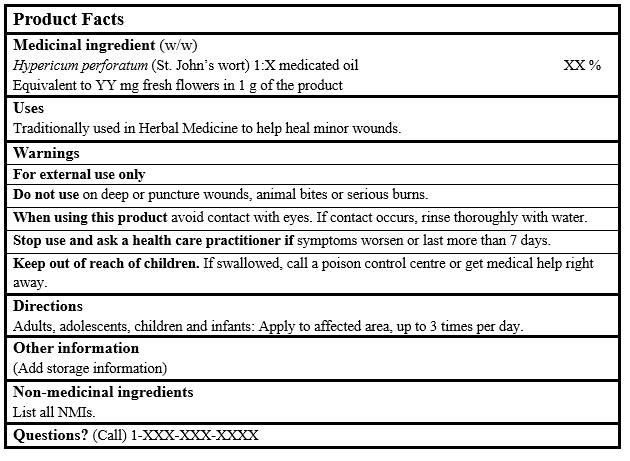
EXAMPLE OF PRODUCT FACTS:
Consult the Guidance Document, Labelling of Natural Health Products for more details.
References Cited
- Anghelescu IG, Kohnen R, Szegedi A, Klement S, Kieser M. Comparisons of Hypericum extract WS 5570 and paroxetine in ongoing treatment after recovery from an episode of moderate to severe depression: results from a randomized multicenter study. Pharmacopsychiatry 2006;39(6):213-219.
- Blumenthal M, Goldberg A, Brinkmann J, editors. Herbal Medicine: Expanded Commission E Monographs. Boston (MA): Integrative Medicine Communications; 2000.
- Bove M. An Encyclopedia of Natural Healing for Children & Infants, 2nd edition. Toronto (ON): McGraw-Hill; 2001.
- Bradley PR, editor. British Herbal Compendium, Volume 1. Bournemouth (GB): British Herbal Medicine Association; 2006.
- DAB 6: Deutsches Arzneibuch. Pharmacopoea Germanica. Berlin (DE): Decker; 1941.
- FAO 1985. Food and Agriculture Organization of the United Nations. Planning and engineering data 2: Fish canning. Myrseth A, editor. Fisheries Circular - C784; 1985. Rome (I): Food and Agriculture Organization of the United Nations Document Repository. [Accessed 2024 June 12]. Available from: http://www.fao.org/DOCREP/003/R6918E/R6918E02.HTM
- Felter HW, Lloyd JU. King's American Dispensatory, Volume 1, 18th edition. Sandy (OR): Eclectic Medical Publications; 1983 [Reprint of 1898 original].
- Gastpar M, Singer A, Zeller K. Comparative efficacy and safety of a once-daily dosage of hypericum extract STW3-VI and citalopram in patients with moderate depression: a double blind, randomised, multicentre, placebo-controlled study. Pharmacopsychiatry 2006;39(2):66-75.
- Gardner Z, McGuffin M, editors. American Herbal Products Association's Botanical Safety Handbook. 2nd edition. Boca Raton (FL): Taylor and Francis Group; 2013.
- Grieve M. A Modern Herbal, Volume 2. New York (NY): Dover Publications; 1971 [Reprint of 1931 Harcourt, Brace & Company publication].
- Hoffmann D. Medical Herbalism: The Science and Practice of Herbal Medicine. Rochester (VT): Healing Arts Press; 2003.
- Maisenbacher P, Kovar KA. Analysis and stability of Hyperici oleum. Planta Medica 1992;58(4):351-354.
- Mills S, Bone K. The Essential Guide to Herbal Safety. St. Louis (MO): Elsevier Churchill Livingstone; 2005.
- Szegedi A, Kohnen R, Dienel A, Kieser M. Acute treatment of moderate to severe depression with hypericum extract WS 5570 (St John's wort): randomised controlled double blind non-inferiority trial versus paroxetine. British Medical Journal 2005;330(7490):503.
- USDA 2024: United States Department of Agriculture Agricultural Research Service (USDA ARS), Germplasm Resources Information Network (GRIN) - Global. U.S. National Plant Germplasm System. [Accessed 2024 June 12]. Available from: https://npgsweb.ars-grin.gov/gringlobal/taxon/taxonomysearch
- Wichtl M, editor. Herbal Drugs and Phytopharmaceuticals: A Handbook for Practice on a Scientific Basis, 3rd edition. Stuttgart (D): Medpharm GmbH Scientific Publishers; 2004.
- Wren RC. Potter's Cyclopedia of Botanical Drugs and Preparations. London (GB): Potter and Clark; 1907.
References Reviewed
- Cosmetic Ingredient Review Expert Panel. Final report on the safety assessment of Hypericum Perforatum extract and Hypericum perforatum oil. International Journal of Toxicology 2001;20(Suppl 2):31-39.
- Isacchi B, Bergonzi MC, Carnevali F, van der Esch SA, Vincieri FF, Bilia AR. Analysis and stability of the constituents of St. John's wort oils prepared with different methods. Journal of Pharmaceutical and Biomedical Analysis 2007;45(5):756-761.
- Schempp CM, Hezel S, Simon JC. 2003. Topical treatment of atopic dermatitis with Hypericum cream. A randomised, placebo-controlled, double-blind half-side comparison study. Der Hautarzt; Zeitschrift für Dermatologie, Venerologie, und Verwandte Gebiete 54(3):248-253.
- Schempp CM, Ludtke R, Winghofer B, Simon JC. 2000. Effect of topical application of hypericum perforatum extract (St. John's wort) on skin sensitivity to solar simulated radiation. Photodermatology, Photoimmunology and Photomedicine 16(3):125-128.
- Sosa S, Pace R, Bornancin A, Morazzoni P, Riva A, Tubaro A, Della Loggia R. 2007. Topical anti-inflammatory activity of extracts and compounds from Hypericum perforatum L. The Journal of Pharmacy and Pharmacology 59(5):703-709.