
SERRAPEPTASE
 (PDF Version - 55 KB)
This monograph is intended to serve as a guide to industry for the preparation of Product Licence Applications (PLAs) and labels for natural health product market authorization. It is not intended to be a comprehensive review of the medicinal ingredient.
Notes
- Text in parentheses is additional optional information which can be included on the label at the applicant's discretion.
- The solidus (/) indicates that either term and/or statement may be selected on the label.
Date
July 25, 2025
Proper name(s), Common name(s), Source information
| Proper name(s) | Common name(s) | Source information | |
|---|---|---|---|
| Proper name(s) | Source material(s) | ||
|
|
Serratia marcescens E-15 | Whole cell |
References: Proper names: NHPID 2025;; Common names: NHPID 2025; Source information: Al-Khateeb and Nusair 2008.
Route(s) of Administration
Oral
Dosage form(s)
This monograph excludes foods or food-like dosage forms as indicated in the Compendium of Monographs Guidance Document.
Proteolytic Enzyme
Acceptable dosage forms for oral use are indicated in the dosage form drop-down list of the web-based Product Licence Application form for Compendial applications.
Note: Liquid and liquid-containing dosage forms (e.g., capsule, soft; spray) are not acceptable as Class II applications when serrapeptase/serratiopeptidase is combined with non-enzymatic ingredients as the enzyme activity may be impacted. These products may be submitted as a Class III application.
Reduction of symptoms associated with ear, nose and throat infections; Swelling and pain reduction; Mucolytic enzyme
The only acceptable pharmaceutical dosage forms include enteric-coated capsules, tablets, granules or similar preparations (Bhagat et al. 2013; Chopra et al. 2009; Balaji 2007). The dosage form must be qualified with an additional term to describe the delayed release (e.g. enteric-coated capsules, gastro-resistant tablets, microencapsulated enzymes).
Use(s) or Purpose(s)
- Proteolytic enzyme (Brayfield and Cadart 2024).
- Helps to reduce (symptoms such as) pain, quantity of secretion, inability to perceive smell and stuffy nose from ear, nose and/or throat infections (Mazzone et al. 1990; Tachibana et al. 1984).
- Mucolytic enzyme that helps break down mucous (Nakamura et al. 2003; Majima et al. 1990; Mazzone et al. 1990; Tachibana et al. 1984).
- Helps reduce and/or relieve postoperative cheek swelling and/or pain after dental surgery (Al- Khateeb and Nusair 2008; Tachibana et al. 1984).
Note: The above uses can be combined on the product label (e.g., Mucolytic enzyme that helps break down mucous and reduce symptoms such as pain, quantity of secretion, inability to perceive smell and stuffy nose from ear, nose or throat infections).
Dose(s)
Subpopulation(s)
Adults 18 years and older
Quantity(ies)
Proteolytic Enzyme
Not to exceed 120,000 serratiopeptidase units (SU), per day (Brayfield and Cadart 2024).
Reduction of symptoms associated with ear, nose and throat infections; Mucolytic enzyme
60,000 - 120,000 serratiopeptidase units (SU), per day (Chopra et al. 2009; Nakamura et al. 2003; Majima et al. 1990; Mazzone et al. 1990; Majima et al. 1988; Tachibana et al. 1984).
Swelling and pain reduction
30,000 - 120,000 serratiopeptidase units (SU), per day (Chopra et al. 2009; Al-Khateeb and Nusair 2008; Tachibana et al. 1984).
Direction(s) for use
Take 2 hours after a meal (Bhagat et al. 2013; Chopra et al. 2009; Mazzone et al. 1990).
Duration(s) of use
Products making a swelling and pain reduction claim (at any dose) and products providing more than 60,000 serratiopeptidase units (SU), per day
Ask a health care practitioner/health care provider/health care professional/doctor/physician for use beyond 7 days (Al-Khateeb and Nusair 2008; Tachibana et al. 1984).
Products providing 60,000 or less serratiopeptidase units (SU), per day
Ask a health care practitioner/health care provider/health care professional/doctor/physician for use beyond 4 weeks (Nakamura et al. 2003; Majima et al. 1990; Majima et al. 1988).
Risk information
Caution(s) and warning(s)
- Ask a health care practitioner/health care provider/health care professional/doctor/physician if symptoms persist or worsen.
- Ask a health care practitioner/health care provider/health care professional/doctor/physician before use if you are pregnant or breastfeeding
- Ask a health care practitioner/health care provider/health care professional/doctor/physician before use if you have gastrointestinal lesions/ulcers, a kidney or liver disorder, or are having surgery (Bhagat et al. 2013; Chopra et al. 2009; Al- Khateeb and Nusair 2008; Mazzone et al. 1990).
- Ask a health care practitioner/health care provider/health care professional/doctor/physician before use if you are taking blood thinners or anti-inflammatory medications (Bhagat et al. 2013; Chopra et al. 2009; Al-Khateeb and Nusair 2008; Mazzone et al. 1990).
Contraindication(s)
No statement required.
Known adverse reaction(s)
Stop use if rash, difficulty breathing, hypersensitivity and/or severe allergy occur (Bhagat et al. 2013; Balagi 2007).
Non-medicinal ingredients
Must be chosen from the current Natural Health Products Ingredients Database (NHPID) and must meet the limitations outlined in the database.
Storage conditions
Must be established in accordance with the requirements described in the Natural Health Products Regulations.
Specifications
- The finished product specifications must be established in accordance with the requirements described in the Natural and Non-prescription Health Products Directorate(NNHPD) Quality of Natural Health Products Guide.
- The medicinal ingredient must comply with the requirements outlined in the NHPID. Details of the manufacturing of the enzyme at the raw material stage should include fermentation medium and the isolation process of the medicinal ingredient.
- No traces of any antibiotics or their residues, should be detectable in the finished product. The medicinal ingredient may comply with the specifications outlined in the Japanese Pharmacopia (JP XVI) : Serrapeptase.
- The specifications must include testing for enzymatic activity of the medicinal ingredient at appropriate stages of formulation and manufacturing using the assay outlined in the current Japanese Pharmacopia (JP XVI) : Serrapeptase.
- Where published methods are not suitable for use, manufacturers will use due diligence to ensure that the enzymes remain active to the end of their shelf life indicated on the product label.
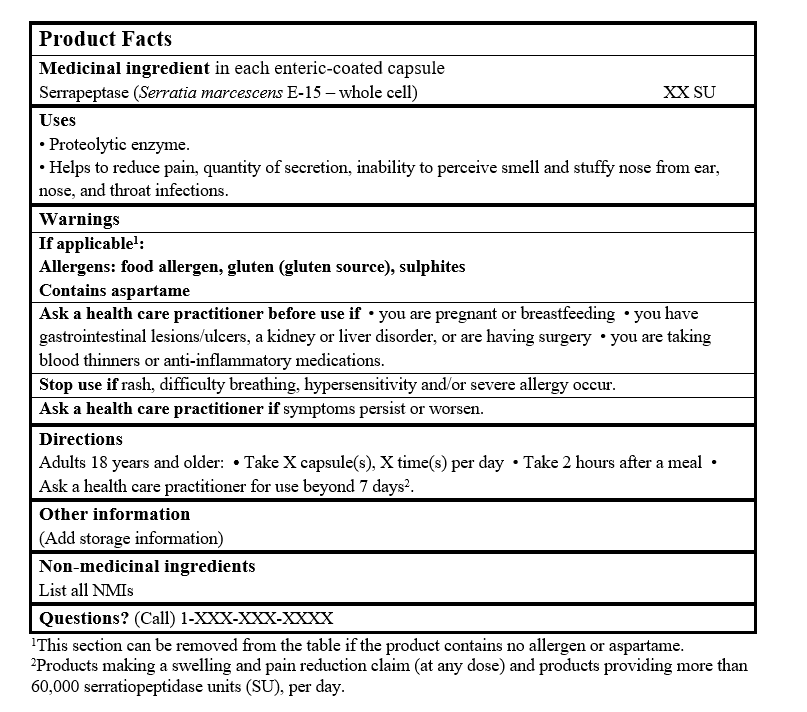
EXAMPLE OF PRODUCT FACTS:
Consult the Guidance Document, Labelling of Natural Health Products for more details.
References Cited
- Al-Khateeb TH and Nusair Y. Effect of the proteolytic enzyme serrapeptase on swelling, pain and trismus after surgical extraction of mandibular third molars. International Journal of Oral Maxillofacial Surgery 2008;37:264-268.
- Balaji SM. Textbook of Oral & Maxillofacial Surgery. Elsevier India; 2007.
- Bhagat S, Agarwal M and Roy V. Serratiopeptidase : A systemic review of the existing evidence. International Journal of Surgery 2013;11(3):209-217
- Brayfield A, Cadart C, editors. Martindale: The Complete Drug Reference. London (GB): Pharmaceutical Press; 2024. [Accessed 2024 November 21]. Available from: https://www.medicinescomplete.com/#/browse/martindale
- Chopra D, Rehan HS, Mehra P, et al. A randomized, double-blind, placebo-controlled study comparing the efficacy and safety of paracetamol, serratiopeptidase, ibuprofen and betamethasone using the dental impaction pain model. International Journal of Oral Maxillofacial Surgery 2009;38:350-355.
- Majima Y, Hirata K, Takeuchi K et al. Effects of orally administered drugs on dynamic viscoelasticity of human nasal mucus. The American Review of Respiratory Disease 1990;141(1):79-83.
- Majima Y, Inagaki M, Hirata K, et al. The effect of an orally administered proteolytic enzyme on the elasticity and viscosity of nasal mucus. Archives of Oto-rhino-laryngology 1988;244:355-359.
- Mazzone A, Catalani M, Costanzo M, et al. Evaluation of serratia peptidase in acute or chronic inflammation of otorhinolaryngology pathology : a multicentre, double-blind, randomized trial versus placebo. Journal of International Medical Research 1990;18:379-388.
- Nakamura S, Hashimoto Y, Mikami M, Yamanaka E, Soma T, Hino M, Azuma A, Kudoh S. Effect of the proteolytic enzyme serrapeptase in patients with chronic airway disease. Respirology 2003 Sep;8(3):316-320.
- NHPID 2025: Natural Health Products Ingredients Database. Natural and Non-Prescription Health Products Directorate. [Accessed 2025 June 30]. Available from: https://webprod.hc-sc.gc.ca/nhpid-bdipsn/?lang=eng
- Tachibana M, Mizukoshi O, Harada Y, et al. A multi-centre, double-blind study of serrapeptase versus placebo in post-antrotomy buccal swelling. Pharmatherapeutica 1984;3(8):526-530.