
SAGE - SALVIA OFFICINALIS - Buccal
 (PDF Version - 131 KB)
This monograph is intended to serve as a guide to industry for the preparation of Product Licence Applications (PLAs) and labels for natural health product market authorization. It is not intended to be a comprehensive review of the medicinal ingredient.
Notes
- Text in parentheses is additional optional information which can be included on the label at the applicant's discretion.
- The solidus (/) indicates that the terms and/or statements are synonymous. Either term or statement may be selected by the applicant on the label.
Date
March 28, 2025
Proper name(s), Common name(s), Source information
| Proper name(s) | Common name(s) | Source information | ||
|---|---|---|---|---|
| Source material(s) | Part(s) | Preparation(s) | ||
| Salvia officinalis |
|
Salvia officinalis | Leaf | Dry |
References: Proper name: USDA 2024; Gardner and McGuffin 2013; Common names: USDA 2024; Gardner and McGuffin 2013; Source information: Blumenthal et al. 2000; BHP 1983; Cook 1869.
Route of Administration
Buccal
Dosage Form(s)
Acceptable dosage forms when used according to the requirements indicated in this monograph: Gargle; Liquid; Loose; Mouthwash; Powder (Blumenthal 2000; ESCOP 1996; BHP 1983; Grieve 1971; Culbreth 1927; Felter 1922; Felter and Lloyd 1898).
Use(s) or Purpose(s)
(Traditionally) used in Herbal Medicine to help relieve minor mucous membrane inflammations of the mouth and throat (including aphthous ulcers/canker sores) (BHC 2006; Mills and Bone 2005; Wichtl 2004; Blumenthal et al. 2000; ESCOP 1996; BHP 1983; Culbreth 1927; Felter 1922).
Notes
For multi-ingredient products:
- To prevent the product from being represented as a "traditional medicine", any indicated traditional use claim must refer to the specific medicinal ingredient(s) and recognized traditional system of medicine from which the claim originates when 1) both traditional and modern claims are present or 2) when claims originate from multiple systems of traditional medicine (e.g., Sage is traditionally used in Herbal Medicine to help relieve minor mucous membrane inflammations of the mouth and throat).
- When ALL of the medicinal ingredients (MIs) in the product are used within the SAME identified system of traditional medicine AND the product makes ONLY traditional claims, listing of MIs in the traditional claim(s) is not required.
Dose(s)
Sub-population(s)
Adults 18 years and older
Quantity(ies)
Note: On the PLA form, quantities can be expressed as percentage weight by weight (% w/w), percentage weight by volume (% w/v) or percentage volume by volume (% v/v), depending on the product formulation. On the product label, quantities can also be expressed in other equivalent concentration units (e.g., mg/mL).
Loose/Powder dosage forms
Methods of preparation: Dry, Powdered
100% dried leaf (Blumenthal 2000; ESCOP 1996)
Note: Powdered and dried leaves must be prepared as an infusion by the consumer prior to use (see direction for use) and must provide an equivalent of 20 to 50 milligrams dried leaves per 1 milliliter of finished product.
Gargle/Mouthwash dosage forms
Methods of preparation: Non-Standardized Liquid Extracts (Decoction, Decoction concentrate, Infusion, Infusion concentrate, Liquid extract)
4 - 100% dried leaf extract preparation in the finished product (Blumenthal 2000; ESCOP 1995; Williamson 1988; Grieve 1931; Cook 1869).
Notes:
- The extract ratio must be between 1:2 and 1:50. The formulation must be prepared in a way which is equivalent to a quantity of 20 to 50 milligrams crude dried leaves per 1 milliliter of finished product. For example, for an infusion prepared with a 1:20 w/w ratio, the concentration of infusion in the final formulation must be 40 to 100% (20 - 50 mg crude dried leaves * 20 w/v (dilution) = 400 - 1000 mg liquid extract in 1 mL finished product = 40 - 100% w/v extract preparation in the finished product).
- Solvents permitted for liquid extract preparations other than decoctions and infusions are vinegar and water only, in a 1:1 mixture.
Method of preparation: Non-Standardized Ethanolic Liquid Extracts (Fluid extract, Tincture)
2 - 50% dried leaf extract preparation in the finished product (Mills and Bone 2005; Blumenthal 2000).
Note: The extract ratio must be between 1:1 (fluid extract) and 1:10. The formulation must be prepared in a way which is equivalent to a quantity of 20 to 50 milligrams crude dried leaves per 1 milliliter of finished product. For example, for a tincture prepared with a 1:5 w/w ratio, the concentration of tincture in the finished product must be 2 to 5% (20 - 50 mg crude dried leaves * 5 w/w (dilution) = 100 - 250 mg liquid extract in 1 mL finished product = 10 - 25% w/v extract preparation in the finished product).
Methods of preparation: Non-Standardized Dry Extracts (Extract dry)
0.5 - 2.5% dried leaf extract preparation in the finished product (Mills and Bone 2005; Blumenthal 2000; ESCOP 1996).
Notes:
- The extract ratio must be between 2:1 and 10:1. The formulation must be prepared in a way which is equivalent to a quantity of 20 to 50 milligrams crude dried leaves for 1 milliliter of finished product. For example, for a dry extract prepared with a 4:1 w/w ratio, the concentration of dry extract in the final formulation must be between 40 to 100% (20 - 50 mg crude dried leaves / 4 w/w (concentration) = 5 - 12.5 mg dry extract in 1 mL finished product = 0.5 - 1.25% w/w extract preparation in the finished product).
- The minimum quantity of 0.5% still applies for more concentrated extracts (e.g., a product containing 0.5% of a dry extract contains 5 mg dry extract in 1 g finished product; 5 mg of a 10:1 w/w dry extract is equivalent to 50 mg crude dried leaves).
- Solvents allowed for this method of preparation are water and/or ethanol, or a 1:1 mixture of vinegar and water.
Liquid dosage form
Method of preparation: Fluid extract
100% dried leaf extract preparation in the finished product (Blumenthal 2000).
Note: The extract ratio must be 1:1 and the solvent must be ethanol or a mix of ethanol and water. Undiluted fluid extract preparations must be applied to the mouth with a brush or swab (see direction for use).
Direction(s) for use
Loose/Powder dosage forms
- Place [insert volume to be measured by consumer in order to obtain 2 to 5 grams dried leaves, e.g., ½ teaspoon] of product in ½ cup (125 mL) of boiling water, infuse for 10 minutes and strain. Let cool. Use 1 tablespoon (15 mL) as a mouthwash/gargle, 3 times a day (Keukenmeester et al. 2012; BHP 1983).
- Do not swallow (Berardi et al. 2002).
Gargle/Mouthwash dosage forms
- Use 1 tablespoon (15 mL) as a mouthwash/gargle, 3 times a day (Keukenmeester et al. 2012; BHP 1983).
- Do not swallow (Berardi et al. 2002).
Liquid dosage form
- Apply directly to affected area(s) with a brush or swab, 3 times per day (Blumenthal et al. 2000).
- Do not eat or drink for 30 to 60 minutes after applying.
Duration(s) of Use
No statement required.
Risk Information
Caution(s) and warning(s)
Stop use and ask a health care practitioner/health care provider/health care professional/doctor/physician if symptoms worsen or last (for) more than 7 days.
Contraindication(s)
No statement required.
Known adverse reaction(s)
No statement required.
Non-medicinal ingredients
Must be chosen from the current Natural Health Products Ingredients Database (NHPID) and must meet the limitations outlined in the database.
Storage conditions
Must be established in accordance with the requirements described in the Natural Health Products Regulations.
Specifications
- The finished product specifications must be established in accordance with the requirements described in the Natural and Non-prescription Health Products Directorate (NNHPD) Quality of Natural Health Products Guide.
- The medicinal ingredient must comply with the requirements outlined in the NHPID.
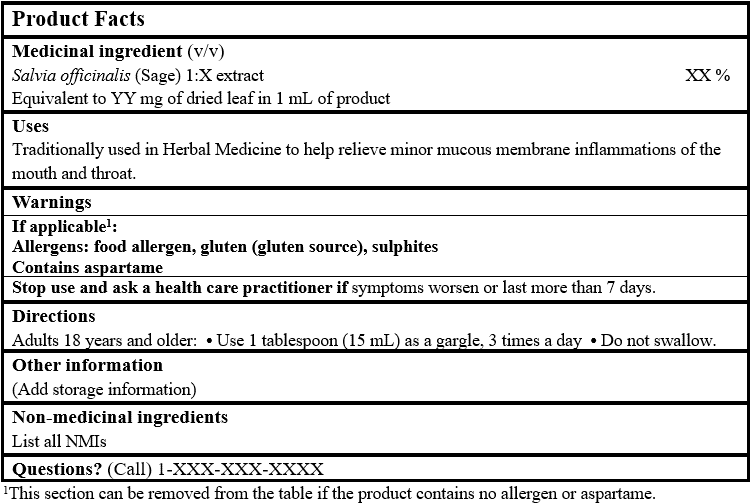
Example of Product Facts:
Consult the Guidance Document, Labelling of Natural Health Products for more details.
References Cited
- Barnes J, Anderson LA, Philipson JD. Herbal Medicines. 3rd edition. London (GB): The Pharmaceutical Press; 2007.
- Berardi RR, DeSimone EM, Newton GD, Oszko MA, Popovich NG, Rollins CJ, Shimp LA, Tietze KJ, editors. Handbook of Nonprescription Drugs: An Interactive Approach to Self- Care, 13th edition. Washington (DC): American Pharmaceutical Association; 2002.
- BHC 2006: Bradley PR, editor. British Herbal Compendium Volume 2: A Handbook of Scientific Information on Widely Used Plant Drugs - Companion to the British Herbal Pharmacopoeia. Bournemouth (GB): British Herbal Medicine Association; 2006.
- BHP 1983: British Herbal Pharmacopoeia. Bournemouth (GB): The British Herbal Medicine Association; 1983.
- Blumenthal M, Goldberg A, Brinckmann J, editors. Herbal Medicine: Expanded Commission E Monographs. Newton (MA): Integrative Medicine Communications; 2000.
- Bone K. A Clinical Guide to Blending Liquid Herbs: Herbal Formulations for the Individual Patient. St. Louis (MI): Churchill Livingstone; 2003.
- Cook WMH. The Physio-Medical Dispensatory: A Treatise on Therapeutics, Materia Medica, and Pharmacy, in Accordance with the Principles of Physiological Medication. Cincinnati (OH): WM.H. Cook; 1869. Reprint version by Medical Herbalism and medherb.com, Boulder (CO). [Accessed 2024 June 11]. Available from: http://www.henriettesherbal.com/eclectic/cook/index.html
- Culbreth DMR. A Manual of Materia Medica and Pharmacology 7th ed. Philadelphia (PA): Lea & Febiger; 1927. Abridged and alphabetized by Michael Moore, director. The Southwest School of Botanical Medicine, Bisbee (AZ). [Accessed 2024 June 11]. Available from: http://www.swsbm.com/ManualsOther/Culbreth.html
- ESCOP 1996: European Scientific Cooperative of Phytotherapy. Monographs on the Medicinal Uses of Plant Drugs. Exeter (GB): European Scientific Cooperative on Phytotheraphy; 1996.
- Felter HW. The Eclectic Materia Medica, Pharmacology and Therapeutics. Cincinnati (OH): John K. Scudder; 1922. Reprint version by Michael Moore, The Southwest School of Botanical Medicine, Bisbee (AZ). [Accessed 2024 June 11]. Available from: http://www.swsbm.com/FelterMM/Felters.html
- Felter HW, Lloyd JU. Kings American Dispensatory. 18th ed, 3rd revision. Cincinnati (OH): Ohio Valley Co.; 1898. Scanned version by Henriette Kress 1999-2011. [Accessed 2024 June 11]. Available from: http://www.henriettesherbal.com/eclectic/kings/index.html
- Gardner Z, McGuffin M, editors. American Herbal Products Association's Botanical Safety Handbook. 2nd edition. Boca Raton (FL): Taylor and Francis Group; 2013.
- Grieve, M. A Modern Herbal, Volume 1-2. New York (NY): Dover Publications, 1971 [Reprint of 1931 Harcourt, Brace & Company publication].
- Keukenmeester RS, Slot DE, Rosema NAM, Van der Weijden GA. Determination of a comfortable volume of mouthwash for rinsing. International Journal of Dental Hygiene 2012;10(3):169-174.
- Mills S, Bone K. The Essential Guide to Herbal Safety. St. Louis (MO): Elsevier Churchill Livingstone; 2005.
- USDA 2024: United States Department of Agriculture Agricultural Research Service (USDA ARS), Germplasm Resources Information Network (GRIN) - Global. U.S. National Plant Germplasm System. [Accessed 2024 June 11]. Available from: https://npgsweb.ars-grin.gov/gringlobal/taxon/taxonomysearch
- Wichtl M, editor. Herbal Drugs and Phytopharmaceuticals: A Handbook for Practice on a Scientific Basis. 3rd edition. Stuttgart (DE): Medpharm Scientific Publishers; 2004.
References Reviewed
- ASHP 2005: American Society of Health-System Pharmacists. American Hospital Formulary Service (AHFS) Drug Information. Philadelphia (PA): Lippincott Williams and Wilkins; 2005.
- Azevedo MF, Lima CF, Fernandes-Ferreira M, Almeida MJ, Wilson JM, Pereira-Wilson C. Rosmarinic acid, major phenolic constituent of Greek sage herbal tea, modulates rat intestinal SGLT1 levels with effects on blood glucose. Mol Nutr Food Res 2011; 55(Suppl 1): S15025.
- Bartram T. Bartram's Encyclopaedia of Herbal Medicine: The definitive guide to the herbal treatment of diseases. New York: Marlowe & Company; 1998.
- Blumenthal M, Brusse WR, Goldberg A, Gruenwald J, Hall T, Riggins CW, Rister RS. The Complete German Commission E Monographs: Therapeutic Guide to Herbal Medicines. Austin (TX): American Botanical Council in Cooperation with Integrative Medicine Communications; 1998
- Bommer S, Klein P, Suter A. First time proof of sage's tolerability and efficacy in menopausal women with hot flushes. Adv Ther 2011; 28(6): 490-500.
- CNF 2023: Canadian Nutrient File, Food and Nutrition, Health Canada. [Accessed 2024 June 11] Available from: https://food-nutrition.canada.ca/cnf-fce
- Christensen KB, Jorgensen M, Kotowska D, Petersen RK, Kristiansen K, Christensen LP. Activation of the nuclear receptor PPARγ by metabolities isolated from sage (Salvia officinalis L.). J Ethnopharmacol. 2010; 132(1): 127-33.
- Duke JA, Bogenschutz-Godwin MJ, duCellier J, Duke P-AK. Handbook of Medicinal Herbs. 2nd ed. Boca Raton (FL): CRC Press LLC; 2002.
- European Medicines Agency. Public statement on Salvia officinalis L., aetheroleum. London (GB): EMA Committee on Herbal Medicinal Products (HMPC); 19 October 2010. [Accessed 2024 July 04] Available from: https://www.ema.europa.eu/en/documents/public-statement/public-statement-salvia-officinalis-l-aetheroleum_en.pdf
- European Medicines Agency. Community Herbal Monograph on Salvia officinalis L., Folium. London (GB): EMA Committee on Herbal Medicinal Products (HMPC); 20 September 2016. [Accessed 2024 July 04] Available from: https://www.ema.europa.eu/en/documents/herbal-monograph/final-european-union-herbal-monograph-salvia-officinalis-l-folium-revision-1_en.pdf
- European Medicines Agency. Community Herbal Monograph on Salvia officinalis L., Folium. London (GB): EMA Committee on Herbal Medicinal Products (HMPC); 20 September 2016. [Accessed 2024 July 04] Available from: https://www.ema.europa.eu/en/documents/herbal-opinion/opinion-hmpc-european-union-herbal-monograph-salvia-officinalis-l-folium-revision-1_en.pdf
- Facciola S. Cornucopia II: A source book of edible plants. Vista (CA): Kampong Publications; 1998.
- Gruenwald J, Brendler T, Jaenicke C, editors. PDR for Herbal Medicines. 4th ed. Montvale (NJ): Thomson Healthcare Inc; 2007.
- Halicioglu O, Astarcioglu G, Yaprak I, Aydinlioglu H. Toxicity of Salvia officinalis in a newborn and a child: an alarming report. Pediatr Neurol 2011; 45(4): 259-60
- Kennedy DO, Scholey AB. The psychopharmacology of European herbs with cognitionenhancing properties. Curr Pharm Des 2006; 12(35): 4613-23
- Lima CF, Andrade PB, Seabra RM, Fernandes-Ferreira M, Pereira-Wilson C. The drinking of a Salvia officinalis infusion improves liver antioxidant status in mice and rats. J Ethnopharmacol 2005; 97(2): 383-9
- Lima CF, Azevedo MF, Araujo R, Fernandes-Ferreira M, Pereira-Wilson C. Metform-like effect of Salvia officinalis (common sage): is it useful in diabetes prevention? Br J Nutr 2006; 92(2): 326033
- Newall CA, Anderson LA, Phillipson JD. Herbal Medicines: A Guide for Health-care Professionals. London (GB): Pharmaceutical Press; 1996
- Perry NS, Bollen C, Perry EK, Ballard C. Salvia for dementia therapy: review of pharmacological activity and pilot tolerability clinical trial. Pharmacol Biochem Behav 2003; 75(3): 651-9
- Remington JP, Woods HC, editors. 1918. The Dispensatory of the United States of America 20th edition. Abridged; botanicals only. Scanned by Michael Moore, director, The Southwest School of Botanical Medicine, Bisbee (AZ). [Accessed 2024 June 11]. Available from: http://www.swsbm.com/Dispensatory/USD-1918-complete.pdf
- Sá CM, Ramos AA, Azevedo MF, Lima CF, Fernandes-Derreira M, Pereira-Wilson C. Sage tea drinking improves lipid profile and antioxidant defences in humans. Int J Mol Sci 2009; 10(9): 3937-50
- Swanston-Flatt SK, Day C, Flatt PR, Gould BJ, Bailey CJ. Diabetes Res. 1989; 10(2): 69-73 Umezu T. Evaluation of the effects of plant-derived essential oils on central nervous system function using discrete shuttle-type conditioned avoidance response in mice. Phytotherapy Research 2012;26(6):884-891.
- TGA 2020: Australian Therapeutic Goods TGA Approved Terminology for Medicines, Section 3 - Herbal Substances. March 2020. Symonston (AU): Australian Government Department of Health and Ageing, Therapeutic Good Administration. [Accessed 2024 June 11] Available from: https://www.tga.gov.au/sites/default/files/tga-approved-terminology-therapeutic-goods.pdf
- Weiss RF. Fintelmann VF. Herbal Medicine. 2nd edition, revised and expanded. Stuggart (NY): Thieme; 2000.
- World Health Organization. International Programme on Chemical Safety. Toxicological Evaluation of Certain Food Additives: WHO Food Additives Series 16. Geneva (CH): World Health Organization; 1981. [Accessed 2024 June 11]. Available from: http://www.inchem.org/documents/jecfa/jecmono/v16je01.htm
- World Health Organization. Summary of Evaluations Performed by the Joint FAO/WHO Expert Committee on Food Additives. Thujone. [Accessed 2024 June 11]. Available from: http://www.inchem.org/documents/jecfa/jeceval/jec_2273.htm
- World Health Organization. Summary of Evaluations Performed by the Joint FAO/WHO Expert Committee on Food Additives. Isothujone. [Accessed 2024 June 11]. Available from: http://www.inchem.org/documents/jecfa/jeceval/jec_2273.htm