
RUTIN
 (PDF Version - 36 K)
This monograph is intended to serve as a guide to industry for the preparation of Product Licence Applications (PLA) and labels for natural health product market authorization. It is not intended to be a comprehensive review of the medicinal ingredient.
Notes
- Text in parentheses is additional optional information which can be included on the label at the applicant’s discretion.
- The solidus (/) indicates that either term and/or statement may be selected on the label.
Date
January 30, 2026
Proper name(s), Common name(s), Source information
| Proper name(s) | Common name(s) | Source information |
|---|---|---|
| Source ingredient(s) | ||
|
|
|
References: Proper names: NIH 2025; RSC 2024; Common names: NIH 2025; RSC 2024; Source information: RSC 2024.
Route of Administration
Oral
Dosage Form(s)
This monograph excludes foods or food-like dosage forms as indicated in the Compendium of Monographs Guidance Document.
Acceptable dosage forms for oral use are indicated in the dosage form drop-down list of the web-based Product Licence Application form for Compendial applications.
Use(s) or Purpose(s)
- Source of (an) antioxidant(s)/Provides (an) antioxidant(s) (Brayfield and Cadart 2024; Murray and Bongiorno 2006; Harborne et al. 1999).
- Source of (an) antioxidant(s)/Provides (an) antioxidant(s) that help(s) fight/protect (cell) against/reduce (the oxidative effect of/the oxidative damage caused by/cell damage caused by) free radicals (Brayfield and Cadart 2024; Murray and Bongiorno 2006; Harborne et al. 1999).
- Used in Herbal Medicine as a capillary/blood vessel protectant (Brayfield and Cadart 2024; PDR 2008; Murray and Bongiorno 2006; Harborne et al. 1999; Leung and Foster 1996).
Note: If Rutin is combined with other medicinal ingredients with antioxidant properties, there is an option to use the antioxidant claims in plural. The singular should be used when the product only contains one chemical substance (e.g., Rutin) as the medicinal ingredient associated with the antioxidant claim.
Dose(s)
Subpopulation(s)
Adults 18 years and older
Quantity(ies)
Antioxidant
Not to exceed 1000 milligrams of Rutin per day and 500 milligrams per single dose (Boyle et al. 2000).
Capillary/ blood vessel protectant
400 – 1000 milligrams of Rutin, per day. Not to exceed 500 milligrams per single dose (PDR 2008).
Note: Must not exceed 600 milligrams of Citrus bioflavonoids, per day, when combined with other bioflavonoids such as but not limited to, citrus bioflavonoids, hesperidin, quercetin, etc.
Direction(s) for use
No statement required.
Duration(s) of Use
Products providing 250 mg or more Rutin, per day
Ask a health care practitioner/health care provider/health care professional/doctor/physician for use beyond 6 weeks (Boyle et al. 2000).
Risk Information
Caution(s) and warning(s)
Ask a health care practitioner/health care provider/health care professional/doctor/physician before use if you are pregnant or breastfeeding (PDR 2008).
Contraindication(s)
No statement required.
Known adverse reaction(s)
No statement required.
Non-medicinal ingredients
Must be chosen from the current Natural Health Products Ingredients Database (NHPID) and must meet the limitations outlined in the database.
Storage conditions
Must be established in accordance with the requirements described in the Natural Health Products Regulations.
Specifications
- The finished product specifications must be established in accordance with the requirements described in the Natural and Non-prescription Health Products Directorate (NNHPD) Quality of Natural Health Products Guide.
- The medicinal ingredient must comply with the requirements outlined in the NHPID.
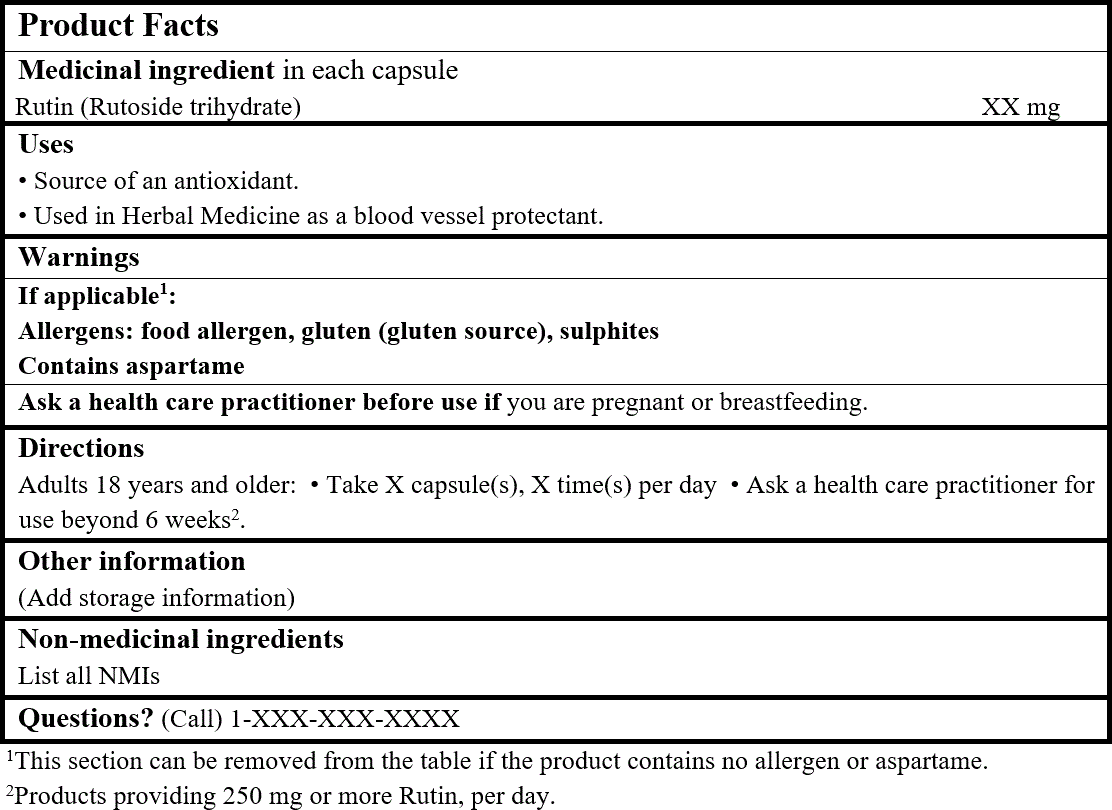
EXAMPLE OF PRODUCT FACTS:
Consult the Guidance Document, Labelling of Natural Health Products for more details.
References Cited
- Boyle SP, Dobson VL, Duthie SJ, Hinselwood DC, Kyle JAM, Collins AR. Bioavailability and efficiency of rutin as an antioxidant: a human supplementation study. European Journal of Clinical Nutrition 2000;54(10):774-784.
- Brayfield A, Cadart C, editors. Martindale: The Complete Drug Reference. London (GB): Pharmaceutical Press; 2024. [Accessed 2024 November 21]. Available from: https://www.medicinescomplete.com/#/browse/martindale
- Harborne JB, Baxter H, Moss GP, editors. Phytochemical Dictionary: A Handbook of Bioactive Compounds from Plants. 2nd edition. Philadelphia (PA): Taylor & Francis Ltd; 1999.
- Leung AY, Foster S. Encyclopedia of Common Natural Ingredients: Used in Food, Drugs and Cosmetics. 2nd edition. New York (NY): John Wiley & Sons; 1996.
- Murray MT, Bongiorno PB. Flavonoids—Quercetin, Citrus Flavonoids, and Hydroxyethylrutosides. In: Pizzorno JE, Murray MT, editors. Textbook of Natural Medicine, 3rd edition, volume 1. St. Louis (MI): Churchill Livingstone Elsevier; 2006. p. 967-973.
- NIH 2025: National Institutes of Health. PubChem. Bethesda (MD): National Library of Medicine, US Department of Health & Human Services; 2025. [Accessed 2025 February 10]. Available from: https://pubchem.ncbi.nlm.nih.gov/
- PDR 2008: Hendler SS, Rorvik D. PDR for Nutritional Supplements. 2nd edition. Montvale (NJ): Thomson Healthcare; 2008.
- RSC 2024: Royal Society of Chemistry: The Merck Index Online [Accessed 2024 November 26]. Available from: https://merckindex.rsc.org/
References Reviewed
- Dietrych-Szostak D, Oleszek W. Effect of processing on the flavonoid content in buckwheat (Fagopyrum esculentum Möench) grain. Journal of Agriculture and Food Chemistry 1999;47(10):4383-4387.
- Frankel EN, Waterhouse AL, Teissedre PI. Principal phenolic phytochemicals in selected California wines and their antioxidant activity in inhibiting oxidation of human low-density lipoproteins. Journal of Agriculture and Food Chemistry 1995;43(4):890-894.