
PROPOLIS - Orale
 (Version PDF - 36 ko)
La présente monographie vise à servir de guide à l'industrie pour la préparation de demandes de licence de mise en marché (DLMM) et d'étiquettes dans le but d'obtenir une autorisation de mise en marché d'un produit de santé naturel. Elle ne vise pas à être une étude approfondie de l'ingrédient médicinal.
Notes
- Les parenthèses contiennent des éléments d'information additionnels (facultatifs) qui peuvent être inclus sur l'étiquette à la discrétion du demandeur.
- La barre oblique (/) indique que les termes et/ou énoncés sont synonymes. Le demandeur peut utiliser n'importe lequel des termes ou énoncés indiqués sur l'étiquette.
Date
30 mai 2025
Nom(s) propre(s), Nom(s) commun(s), Information(s) d'origine
| Nom(s) propre(s) | Nom(s) commun(s) | Information(s) d'origine | ||
|---|---|---|---|---|
| Matière(s) d'origine | Partie(s) | Préparation(s) | ||
| Propolis |
|
Apis mellifera | Sécrétion | Sèche |
Références: Nom propre: PPRC 2020; Lotfy 2006; Noms communs: RSC 2024; PPRC 2020; Lotfy 2006; Salatino et al. 2005; Marcucci 1995; Information d'origine: Ramos et al. 2007; Burdock 1998.
Voie(s) d'administration
Orale
Forme(s) posologique(s)
Cette monographie exclut les aliments et les formes posologiques semblables aux aliments tel qu’indiqué dans le document de référence Compendium des monographies.
Les formes posologiques acceptables pour la voie d'administration orale sont indiquées dans la liste déroulante dans le formulaire web de demande de licence de mise en marché pour les demandes officinales.
Usage(s) ou fin(s)
- Source d'antioxydants/Fournit des antioxydants (Jasprica et al. 2007; Lotfy 2006; Kwon et al. 2004; Ichikawa et al. 2002; Tilgner 1999)
- Source d'antioxydants/Fournit des antioxydants qui aident à combattre/à protéger (les cellules) contre/à réduire (les effets oxydatifs des/les dommages oxydatifs causés par/les dommages cellulaires causés par) les radicaux libres (Jasprica et al. 2007; Lotfy 2006; Kwon et al. 2004; Ichikawa et al. 2002; Tilgner 1999).
- Utilisé (traditionnellement) en phytothérapie pour aider à soulager le mal de gorge et/ou autres infections de la bouche et de la gorge (Castalado et Capasso 2002; Mills et Bone 2000; Tilgner 1999).
Notes
Pour les produits à ingrédients multiples :
- Afin d'empêcher que le produit soit représenté comme une « médecine traditionnelle », toute allégation traditionnelle doit faire référence à/aux ingrédient(s) médicinal(aux) et au système de médecine traditionnelle reconnu d'où l'allégation provient lorsque 1) des allégations à la fois traditionnelles et modernes sont présentes ou 2) lorsque les allégations proviennent de multiples systèmes de médecine traditionnelle (par ex., La propolis est utilisée traditionnellement en phytothérapie pour aider à soulager le mal de gorge et autres infections de la bouche et de la gorge).
- Lorsque TOUS les ingrédients médicinaux (IM) du produit sont utilisés au sein du MÊME système de médecine traditionnelle identifié ET que le produit n'a QUE des allégations traditionnelles, l'inclusion de l'/des ingrédient(s) médicinal(aux) dans l'/les allégation(s) traditionnelle(s) n'est pas requise.
Dose(s)
Sous-population(s)
Adultes 18 ans et plusQuantité(s)
Antioxydant
Méthodes de préparation : Sec, poudre, extraits non normalisés (extrait sec*, teinture, extrait fluide, décoction, concentré de décoction, infusion, concentré d'infusion)
Ne pas dépasser 0,6 grammes de propolis séchée par jour (PPRC 2020; Jasprica et al. 2007).
Soulagement du mal de gorge/des infections de la bouche et de la gorge
Méthodes de préparation : Sec, poudre, extraits non normalisés (extrait sec*, teinture, extrait fluide, décoction, concentré de décoction, infusion, concentré d'infusion)
0,2 à 0,6 grammes de propolis séchée par jour (PPRC 2020; Tilgner 1999).
*Note: Les solvants permis pour la méthode de préparation ‹ Extraits non normalisés (extrait sec) › au sein de cette monographie sont l'éthanol et/ou l'eau uniquement.
Mode(s) d'emploi
Énoncé non requis
Durée(s) d'utilisation
Consulter un praticien de soins de santé/fournisseur de soins de santé/professionnel de la santé/docteur/médecin si l'utilisation se prolonge au-delà de 4 semaines (Jasprica et al. 2007).
Mention(s) de risque
Précaution(s) et mise(s) en garde
Tous les usages
- Consultez un praticien de soins de santé/fournisseur de soins de santé/professionnel de la santé/docteur/médecin avant l'utilisation si vous êtes enceinte ou si vous allaitez.
- Consultez un praticien de soins de santé/fournisseur de soins de santé/professionnel de la santé/docteur/médecin avant l'utilisation si vous avez des allergies aux produits de l'abeille, aux produits du peuplier ou au baume du Pérou (Brinker 2010; Marcucci 1995; Valsecchi et Cainelli 1984; Melli et al. 1983; Rudzki et Gryzwa 1983).
Soulagement du mal de gorge/des infections de la bouche et de la gorge
Consultez un praticien de soins de santé/fournisseur de soins de santé/professionnel de la santé/docteur/médecin si les symptômes persistent ou s'aggravent.
Contre-indications(s)
Énoncé non requis.
Réaction(s) indésirable(s) connue(s)
Cessez d'utiliser si une hypersensibilité/allergie se manifeste (PPRC 2020; Scully 2006; Hsu et al. 2004; Teraki et Shiohara 2001; Machácková 1988; Hausen et al. 1987; Valsecchi et Cainelli 1984; Melli et al. 1983; Rudzki et Grzywa 1983).
Ingrédients non médicinaux
Doivent être choisis parmi ceux de la version actuelle de la Base de données des ingrédients des produits de santé naturels (BDIPSN) et respecter les restrictions mentionnées dans cette base de données.
Conditions d'entreposage
Doivent être établies conformément aux exigences décrites dans le Règlement sur les produits de santé naturels.
Spécifications
- Les spécifications du produit fini doivent être établies conformément aux exigences décrites dans le Guide de référence sur la qualité des produits de santé naturels de la Direction des produits de santé naturels et sans ordonnance (DPSNSO).
- L'ingrédient médicinal doit être conforme aux exigences mentionnées dans la BDIPSN.
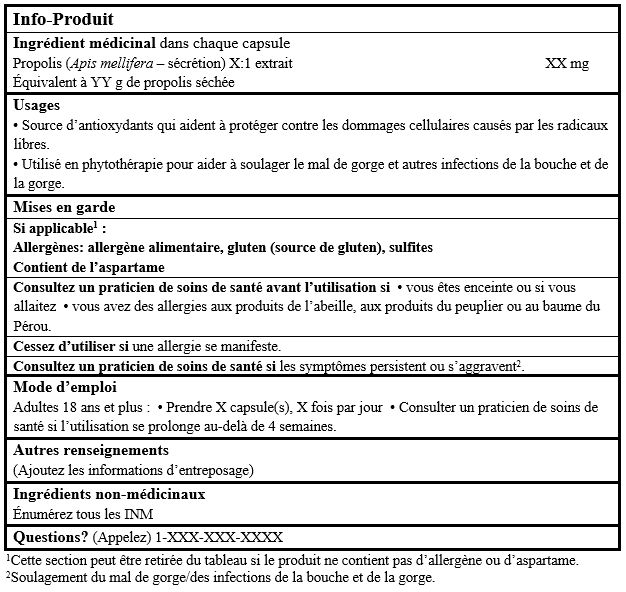
EXEMPLE D'INFO-PRODUIT:
Veuillez consulter la ligne directrice, Étiquetage des produits de santé naturels pour plus de détails.
Références citées
- Brinker F. Herb Contraindications and Drug Interactions, 4e édition. Sandy (OR): Eclectic Medical Publications; 2010.
- Burdock GA. Review of the biological properties and toxicity of bee propolis (propolis). Food and Chemical Toxicology 1998;36:347-363.
- Castalado S, Capasso F. Propolis, an old remedy used in modern medicine. Fitotherapia 2002;73(S1):S1-S6.
- Hausen BM, Wollenweber E, Senff H, Post B. Propolis allergy (II): the sensitizing properties of 1,1-dimethylallyl caffeic acid ester. Contact Dermatitis 1987;17:171-177.
- Hsu CY, Chiang WC, Weng TI, Chen WJ, Yuan A. Laryngeal edema and anaphalactic shock after topical propolis use for acute pharyngitis. American Journal of Emergency Medicine 2004;22(5):432-433.
- Ichikawa H, Satoh K, Tobe K, Yasuda I, Ushio F, Matsumoto K, Endo K, Ookubo C. Free radical scavenging activity of propolis. Redox Report 2002;7(5):347-350.
- Jasprica I, Mornar A, Debeljak Z, Molcic-Bubalo A, Medic-Saric M, Mayer L, Romic Z, Bucan K, Balog T, Sobocanec S, Sverko V. In vivo study of propolis supplementation effects on antioxidative status and red blood cells. Journal of Ethnopharmacology 2007;110:548-554.
- Kwon YS, Park DH, Shin EJ, Kwon MS, Ko KH, Kim WK, Jhoo JH, Hjoo WK, Wie MB, Jung BD, Kim HC. Antioxidant propolis attenuates kainite-induced neurotoxicity via adenosine A1 receptor modulation in the rat. Neuroscience Letters 2004;355:231-235.
- Lotfy M. Review: Biological activity of bee propolis in health and disease. Asian Pacific Journal of Cancer Prevention 2006;7:22-31.
- Machackova J. The incidence of allergy to propolis in 605 consecutive patients patch tested in Prague. Contact Dermatitis 1988;18:210-212.
- Marcucci MC. Propolis: chemical composition, biological properties and therapeutic activity. Apidologie 1995;26:83-89.
- Melli MC, Giorgini S, Sertoli A. Occupational dermatitis in a bee-keeper. Contact Dermatitis 1983;9(5):427-428.
- Mills S and Bone K. Principles and Practice of Phytotherapy; Modern Herbal Medicine. Londres (GB): Churchill Livingstone; 2000.
- PPRC 2020: Pharmacopoeia of the People's Republic of China, Volume I, English edition. Beijing (CN): The State Pharmacopoeia Commission of the People's Republic of China; 2020.
- Ramos AFN, Miranda JL. Propolis: a review of its anti-inflammatory and healing actions. J. Venom. Anim. Toxins incl. Trop. Dis. 2007;13(4):697-710.
- RSC 2024: Royal Society of Chemistry: The Merck Index Online [Consulté le 26 novembre 2024]. Disponible à : https://merckindex.rsc.org/
- Rudzki E, Grzywa Z. Dermatitis from propolis. Contact Dermatitis 1983;9(1):40-45.
- Salatino A, Teixeira EW, Negri G, Message D. Review: Origin and chemical variation of Brazilian propolis. Oxford University Press eCAM 2005;2(1):33-38.
- Scully C. Propolis: A background (Letter). British Dental Journal 2006;200(7):359-360.
- Teraki Y, Shiohara T. Propolis-induced granulomatous contact dermatitis accompanied by marked lymphadenopathy. British Journal of Dermatology 2001;144:1277-1278.
- Tilgner S. Herbal Medicine: From the Heart of the Earth. Creswell (OR): Wise Acres Press Inc; 1999.
- Valsecchi R, Cainelli T. Dermatitis from propolis. Contact Dermatitis 1984;11(5):317.
Références consultées
- Bankova V. Review: Recent trends and important developments in propolis research. Oxford University Press eCAM 2005;2(1):29-32.
- Botushanov PI, Grigorov GI, Aleksandrov GA. A clinical study of a silicate toothpaste with extract from propolis. Endodontology and Parodontology 2001;43(1-2):28-30.
- Cairo do Amaral R, Gomes RT, Rocha WMS, Abreu SLR, Santos VR. Periodontitis treatment with Brazilian green propolis gel. Pharmacologyonline 2006;3:336-341. [Consulté le 13 janvier 2025]. Disponible à: http://pharmacologyonline.silae.it/files/archives/2006/vol3/026.Santos.pdf
- Coelho LG, Bastos EMAF, Resende CC, Paula e Silva CM, Sanches BSF, Castro FJ, Moretzsohn LD, Vieira WLS, Trinidade OR. Brazilian green propolis on Helicobacter pylori infection. A pilot clinical study. Helicobacter 2007;12:572-574.
- Crisan I, Zaharia CN, Popovici F, Jucu V, Belu O, Dascalu C, Mutiu A, Petrescu A. Natural propolis extract NIVCRISOL in the treatment of acute and chronic rhinopharyngitis in children. Romanian Journal of Virology 1995;46(3-4):115-133.
- El-Khatib AS, Agha AM, Mahran LG, Khayyal MT. Prophylactic effect of aqueous propolis extract against acute experimental hepatotoxicity in vivo. Verlag der Zeitschrift fur Naturforsch 2002;57c:379-385.
- Fuliang HU, Hepburn HR, Xuan H, Chen M, Daya S, Radloff SE. 2005. Effects of propolis on blood glucose, blood lipid and free radicals in rats with diabetes mellitus. Pharmacological Research 51:147-152.
- Gabrys J, Konecki J, Krol W, Scheller S, Shani J. Free amino acids in bee hive product (propolis) as identified and quantified by gas-liquid chromatography. Pharmacological Research Communications 1986;18(6):513-518.
- Gambelunghe C, Rossi R, Sommavilla M, Ferranti C, Rossi R, Ciculi C, Gizzi S, Micheletti A, Rufini S. Effects of Chrysin on Urinary Testosterone Levels in Human Males. Journal of Medicinal Food; 2003;6(4):387-390.
- Gebara ECE, Pustiglioni AN, de Lima LAPA, Mayer MPA. Propolis extract as an adjuvant to periodontal treatment. Oral Health and Preventative Dentistry 2003;1(1):29-35.
- Ghisalberti EL. Propolis: a review. Bee World 1979;60:59-84.
- Giusti F, Miglietta R, Pepe P, Seidenari S. Sensitization to propolis in 1255 children undergoing patch testing. Contact Dermatitis 2004;51:255-258.
- Gregory SR, Piccolo N, Piccolo MT, Piccolo MS, Heggers JP. Comparison of Propolis Skin Cream to Silver Sulfadiazine: A Naturopathic Alternative to Antibiotics in Treatment of Minor Burns. The Journal of Alternative and Complementary Medicine 2002;8(1):77-83.
- Imhof M, Lipovac M, Kurz Ch, Barta J, Verhoeven HC, Huber JC. Propolis solution for the treatment of chronic vaginitis. International Journal of Gynecology and Obstetrics 2005;89:127-132.
- Khayyal MT, El-Ghazaly MA, El-Khatib AS, Hatem AM, de Vries PJF, El-Shafei S, Khattab MM. A clinical pharmacological study of the potential beneficial effects of a propolis food product as an adjuvant in asthmatic patients. Fundamental and Clinical Pharmacology 2003;17:93-102.
- Koo H, Cury JA, Rosalen PL, Ambrosano GMB, Ikegaki M, Park YK. Effect of a mouthrinse containing selected propolis on 3-day dental plaque accumulation and polysaccharide formation. Caries Research 2002;36(6):445-448.
- Krell R. Value-Added Products from Beekeeping. Agricultural Services Bulletin No. 124. Rome (IT): Food and Agriculture Organisation of the United Nations, Agriculture and Consumer Protection; 1996. [Consulté le 13 janvier 2025]. Disponible à : http://www.fao.org/docrep/w0076E/w0076E00.htm
- Machackova J. The incidence of allergy to propolis in 605 consecutive patients patch tested in Prague. Contact Dermatitis 1988;18:210-212.
- Magro-Filho O, de Carvalho AC. Topical effect of propolis in the repair of sulcoplasties by the modified Kazanjian technique. Cytological and clinical evaluation. Journal of the Nihon School of Dentistry 1994;36(2):102-111.
- Menniti-Ippolito F, Mazzanti G, Vitalone A, Firenzuoli F, Santuccio C. Surveillance of suspected adverse reactions to natural health products: the case of propolis. Drug Safety 2008;31(5):419-423.
- Mirzoeva OK and Calder PC. The effect of propolis and its components on eicosanoid production during the inflammatory response. Prostaglandins, Leukotrienes and Essential Fatty Acids 1996;55(6):441-449.
- Murray MC, Worthington HV, Blinkhorn AS. A study to investigate the effect of a propolis-containing mouthrinse on the inhibition of de novo plaque formation. Journal of Clinical Periodontology 1997;24:796-798.
- Nakajima Y, Tsuruma K, Shinazawa M, Mishima S, Hara H. Comparison of bee products based on assays of antioxidant capacities. BMC Complementary and Alternative Medicine 2009;9(1):4.
- Santos VR, Pimenta FJGS, Aguiar MCF, do Carmo MAV, Naves MD, Mesquita RA. Short Communication: Oral Candidiasis Treatment with Brazilian Ethanol Propolis Extract. Phytotherapy Research 2005;19:652-654.
- Sforcin JM. Propolis and the immune system: a review. Journal of Ethnopharmacology 2007;113:1-14.
- Viuda-Martos M, Ruiz-Navajas Y, Fernández-López J, Pérez-Alvarez JA.. Functional properties of honey, propolis, and royal jelly. Journal of Food Science 2008;73(9):R117-124.
- Vynograd N, Vynograd I, Sosnowski Z. A comparative multi-centre study on the efficacy of propolis, acyclovir and placebo in the treatment of genital herpes (HSV). Phytomedicine 2000;7(1):1-6.