
PASSIONFLOWER - PASSIFLORA INCARNATA
Help on accessing alternative formats, such as Portable Document Format (PDF), Microsoft Word and PowerPoint (PPT) files, can be obtained in the alternate format help section.
 (PDF Version - 57 KB)
This monograph is intended to serve as a guide to industry for the preparation of Product Licence Applications (PLAs) and labels for natural health product market authorization. It is not intended to be a comprehensive review of the medicinal ingredient.
Notes
- Text in parentheses is additional optional information which can be included on the label at the applicant's discretion.
- The solidus (/) indicates that the terms and/or statements are synonymous. Either term or statement may be selected by the applicant on the label.
Date
November 29, 2024
Proper name(s), Common name(s), Source information
| Proper name(s) | Common name(s) | Source information | ||
|---|---|---|---|---|
| Source material(s) | Part(s) | Preparation(s) | ||
| Passiflora incarnata |
|
Passiflora incarnata | Herb top | Dry |
References: Proper name: USDA 2023, EMA 2014; Common names: USDA 2023, EMA 2014; Source information: EMA 2014.
Route of Administration
Oral
Dosage Form(s)
This monograph excludes foods or food-like dosage forms as indicated in the Compendium of Monographs Guidance Document.
Acceptable dosage forms for oral use are indicated in the dosage form drop-down list of the web-based Product Licence Application form for Compendial applications.
Use(s) or Purpose(s)
- (Traditionally) used in Herbal Medicine to help relieve restlessness and/or nervousness (calmative) (Godfrey and Saunders 2010; Wichtl 2004; Blumenthal et al. 2000; Felter and Lloyd 1983).
- (Traditionally) used in Herbal Medicine as a sleep aid (during times of mental stress) (EMA 2014; Felter and Lloyd 1983).
Notes
- The above claims can be combined on the product label if from the same traditional or non-traditional system of medicine (e.g. Traditionally used in Herbal Medicine to help relieve restlessness and/or nervousness and as a sleep aid during times of mental stress).
- For multi-ingredient products:
- To prevent the product from being represented as a "traditional medicine," any indicated traditional use claim must refer to the specific medicinal ingredient(s) and recognized traditional system of medicine from which the claim originates when 1) both traditional and modern claims are present or 2) when claims originate from multiple systems of traditional medicine (e.g. Passionflower is traditionally used in Herbal Medicine as a sleep aid during times of mental stress).
- When ALL of the medicinal ingredients (MIs) in the product are used within the SAME identified system of traditional medicine AND the product makes ONLY traditional claims, listing of MIs in the traditional claim(s) is not required.
Dose(s)
Subpopulation(s)
Adolescents 12-17 years and Adults 18 years and older (EMA 2014)
Quantity(ies)
Methods of preparation: Dry, Powdered, Non-Standardized Ethanolic Extracts (Dry extract, Tincture, Fluid extract)
0.25 - 8 grams of dried herb top, per day (EMA 2014)
Methods of preparation: Non-Standardized Aqueous Extracts (Dry extract, Decoction, Infusion)
1 - 8 grams of dried herb top, per day (EMA 2014).
Direction(s) for use
Sleep aid
Take (1 hour) before bedtime, as needed (EMA 2014).
Restlessness/nervousness
No statement required.
Duration(s) of Use
No statement required.
Risk Information
Caution(s) and warning(s)
Sleep aid
Ask a health care practitioner/health care provider/health care professional/doctor/physician if sleeplessness persists for more than 4 weeks (chronic insomnia) (Berardi et al. 2002: DiPiro et al. 2002).
Restlessness/nervousness
Ask a health care practitioner/health care provider/health care professional/doctor/physician if symptoms persist or worsen.
All uses
- Ask a health care practitioner/health care provider/health care professional/doctor/ physician before use if you are pregnant or breastfeeding (EMA 2014).
- When using this product avoid taking with alcohol or products that cause drowsiness (EMA 2014; Brinker 2010).
- When using this product exercise caution if you drive or use machinery as you may experience drowsiness (EMA 2014).
Contraindication(s)
No statement required.
Known adverse reaction(s)
Stop use if hypersensitivity/allergy occurs (EMA 2014).
Non-medicinal ingredients
Must be chosen from the current Natural Health Products Ingredients Database (NHPID) and must meet the limitations outlined in the database.
Storage conditions
Must be established in accordance with the requirements described in the Natural Health Products Regulations .
Specifications
- The finished product specifications must be established in accordance with the requirements described in the Natural and Non-prescription Health Products Directorate (NNHPD) Quality of Natural Health Products Guide.
- The medicinal ingredient must comply with the requirements outlined in the NHPID.
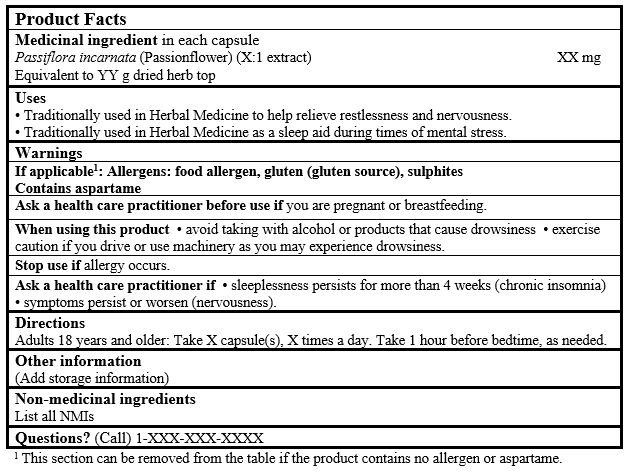
EXAMPLE OF PRODUCT FACTS:
Consult the Guidance Document, Labelling of Natural Health Products for more details.
References Cited
- Berardi RR, DeSimone EM, Newton GD, Oszko MA, Popovich NG, Rollins CJ, Shimp LA, Tietze KJ, editors. Handbook of Nonprescription Drugs: An Interactive Approach to Self-Care, 13th edition. Washington (DC): American Pharmaceutical Association; 2002.
- Blumenthal M, Goldberg A, Brinkmann J, editors. Herbal Medicine: Expanded Commission E Monographs. Boston (MA): Integrative Medicine Communications; 2000.
- Brinker F. Herb Contraindications and Drug Interactions, 4th edition. Sandy (OR): Eclectic Medical Publications; 2010.
- DiPiro JT, Talbert RL, Yee GC, Matzke GR, Wells BG, Posey LM. Pharmacotherapy: A Pathophysiological Approach, 5th edition. New York (NY): McGraw-Hill Co. Inc.; 2002
- EMA 2014. European Medicines Agency. Community Monograph on. London (UK): EMEA Committee on Herbal Medicinal Products (HMPC), 20 September 2016. [Accessed 2023 October 1]. Available from: https://www.ema.europa.eu/documents/herbal-summary/passion-flower-summary-public_en.pdf
- Felter HW, Lloyd JU. King's American Dispensatory, Volume 1, 18th edition. Sandy (OR): Eclectic Medical Publications; 1983 [Reprint of 1898 original].
- Godfrey A, Saunders PR, Barlow K, Gilbert C, Gowan M, Smith F. Principles and Practices of Naturopathic Botanical Medicine, Volume 1: Botanical Medicine Monographs. Toronto (ON): CCNM Press; 2010.
- USDA 2023: United States Department of Agriculture Agricultural Research Service (USDA ARS), Germplasm Resources Information Network (GRIN) - Global. U.S. National Plant Germplasm System. [Accessed 2023 September 11]. Available from: https://npgsweb.ars-grin.gov/gringlobal/taxon/taxonomysearch
- Wichtl M, editor. 2004. Herbal Drugs and Phytopharmaceuticals: A Handbook for Practice on a Scientific Basis, 3rd edition. Stuttgart (D): Medpharm GmbH Scientific Publishers.
References Reviewed
- ESCOP 2003: ESCOP Monographs: The Scientific Foundation for Herbal Medicinal Products, 2nd edition. Exeter (UK): European Scientific Cooperative on Phytotherapy and Thieme; 2003.