
Frankincense - Boswellia Sacra
Buccal
 (PDF Version - 69 KB)
This monograph is intended to serve as a guide to industry for the preparation of Product Licence Applications (PLAs) and labels for natural health product market authorization. It is not intended to be a comprehensive review of the medicinal ingredient.
Notes
- Text in parentheses is additional optional information which can be included on the label at the applicant's discretion.
- The solidus (/) indicates that the terms and/or statements are synonymous. Either term or statement may be selected by the applicant on the label.
Date
January 10, 2025
Proper name(s), Common name(s), Source information
| Proper name(s) | Common name(s) | Source information | |
|---|---|---|---|
| Source material(s) | Part(s) | ||
| Boswellia sacra |
|
Boswellia sacra | Stem bark resin |
References: Proper name: USDA 2024; Common names: Gardner and McGuffin 2013; Source information: PPRC 2020.
Route of Administration
Buccal
Dosage Form(s)
This monograph excludes foods or food-like dosage forms as indicated in the Compendium of Monographs Guidance Document.
Dosage forms must be suited for buccal administration which allow for direct contact between the affected tissue and the medicinal ingredient: Gargle; Liquid; Mouthwash.
Use(s) or Purpose(s)
Used in Traditional Chinese Medicine (TCM) to help relieve mild inflammations of the gums, mouth and throat (Bensky et al. 2004; Tierra and Tierra 1998).
Notes
For multi-ingredient products:
- To prevent the product from being represented as a "traditional medicine", any indicated traditional use claim must refer to the specific medicinal ingredient(s) and recognized traditional system of medicine from which the claim originates when 1) both traditional and modern claims are present or 2) when claims originate from multiple systems of traditional medicine (e.g., Frankincense is used in Traditional Chinese Medicine (TCM) to help relieve mild inflammations of the gums, mouth and throat).
- When ALL of the medicinal ingredients (MIs) in the product are used within the SAME identified system of traditional medicine AND the product makes ONLY traditional claims, listing of MIs in the traditional claim(s) is not required.
Dose(s)
Subpopulation(s)
Adults 18 years and older
Quantity(ies)
Methods of preparation: Dry, Powdered, Non-Standardized Ethanolic Extracts (Dry extract, Tincture, Fluid extract)
3 - 5 grams of stem bark resin, per day (PPRC 2020).
Methods of preparation: Decoction, Decoction concentrate
3 - 10 grams of stem bark resin, per day (Bensky et al. 2004; Chen and Chen 2004).
Direction(s) for use
Gargle and/or rinse as needed.
Duration(s) of Use
Ask a health care practitioner/health care provider/health care professional/doctor/physician for prolonged use.
Risk Information
Caution(s) and warning(s)
No statement required.
Contraindication(s)
Do not use if you are pregnant or breastfeeding.
Known adverse reaction(s)
No statement required.
Non-medicinal ingredients
Must be chosen from the current Natural Health Products Ingredients Database (NHPID) and must meet the limitations outlined in the database.
Storage conditions
Must be established in accordance with the requirements described in the Natural Health Products Regulations.
Specifications
- The finished product specifications must be established in accordance with the requirements described in the Natural and Non-prescription Health Products Directorate (NNHPD) Quality of Natural Health Products Guide.
- The medicinal ingredient must comply with the requirements outlined in the NHPID.
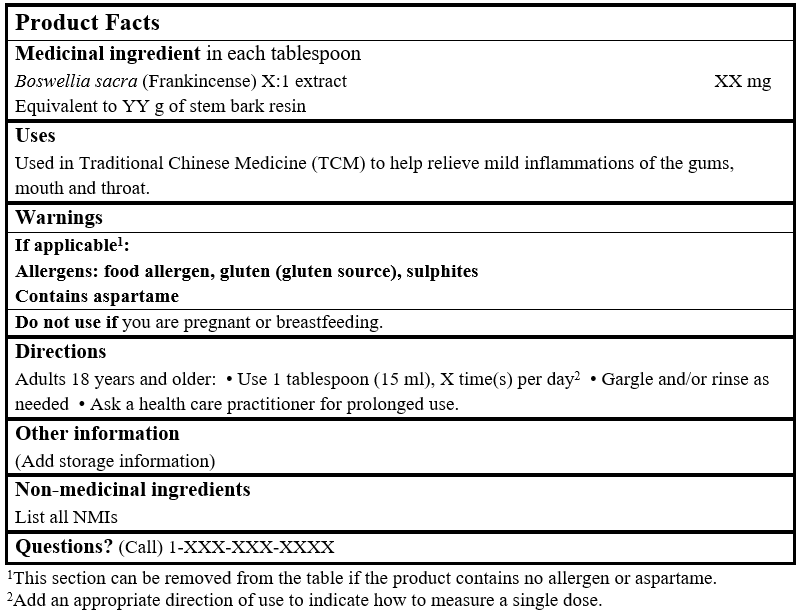
Example of Product Facts:
Consult the Guidance Document, Labelling of Natural Health Products for more details.
References Cited
- Bensky D, Clavey, Stöger E, Gamble A. Chinese Herbal Medicine: Materia Medica. 3rd edition. Seattle (WA): Eastland Press, Incorporated; 2004.
- Chen JK, Chen TT. Chinese Medical Herbology and Pharmacology. Crampton L, editor. City of Industry (CA): Art of Medicine Press Inc.; 2004.
- Gardner Z, McGuffin M, editors. American Herbal Products Association's Botanical Safety Handbook. 2nd edition. Boca Ration (FL): Taylor and Francis Group; 2013.
- PPRC 2020: Pharmacopoeia of the People's Republic of China. Volume 1, English edition. Beijing (CN): The State Pharmacopoeia Commission of the People's Republic of China; 2020.
- Tierra M, Tierra L. 1998. Chinese Traditional Herbal Medicine: Volume 2 Materia Medica and Herbal Resource. Twin Lakes (WI): Lotus Press.
- USDA 2024: United States Department of Agriculture, Agricultural Research Service (USDA ARS), Germplasm Resources Information Network (GRIN) - Global. U.S. National Plant Germplasm System. [Accessed 2024 November 14]. Available from: https://npgsweb.ars-grin.gov/gringlobal/taxon/taxonomysearch
References Reviewed
- Bensky D, Gamble A. Chinese Herbal Medicine Materia Medica- Revised Edition. Seattle (WA): Eastland Press Inc.; 1986.
- Bown D. Encyclopedia of Herbs and Their Uses. New York (NY): Dorling Kindersley Limited; 1995.
- Gruenwald J, Brendler T, Jaenicke C. PDR for Herbal Medicines. Montvale (NJ): Medical Economics Company Inc.; 1998.
- Kapoor LD. Handbook of Ayurvedic Medicinal Plants. New York (NY): CRC Press; 2001.
- Leung AY, Foster S. Encyclopedia of Common Natural Ingredients used in Food, Drugs and Cosmetics- 2nd edition. Toronto (ON): John Wiley and Sons Inc.; 1996.
- Li SC. Chinese Medicinal Herbs. San Francisco (CA): Georgetown Press; 1973.
- Long Z. The Chinese Materia Medica. Xue Yuan (China): Academy Press; 1998.
- Lu H. A Comprehensive Textbook of Chinese Herbology. Vancouver (BC): Academy of Oriental Heritage; 1999.
- Williamson EM, editor. Major Herbs of Ayurveda. London (UK): Elsevier Science Limited; 2002.