
OLIVE LEAF - OLEA EUROPAEA
 (PDF Version - 57 KB)
This monograph is intended to serve as a guide to industry for the preparation of Product Licence Applications (PLAs) and labels for natural health product market authorization. It is not intended to be a comprehensive review of the medicinal ingredient.
Notes
- Text in parentheses is additional optional information which can be included on the label at the applicant's discretion.
- The solidus (/) indicates that either term and/or statement may be selected on the label.
Date
December 19, 2025
Proper name(s), Common name(s), Source information
| Proper name(s) | Common name(s) | Source information | ||
|---|---|---|---|---|
| Source material(s) | Part(s) | Preparation(s) | ||
| Olea europaea | Olive leaf | Olea europaea | Leaf |
|
References: Proper name: USDA 2024; Common name: USDA 2024; EMA 2017; Source information: EMA 2017; Jemai et al. 2009.
Route of administration
Oral
Dosage form(s)
This monograph excludes foods or food-like dosage forms as indicated in the Compendium of Monographs Guidance Document.
Acceptable dosage forms for oral use are indicated in the dosage form drop-down list of the web-based Product Licence Application form for Compendial applications.
Use(s) or Purpose(s)
- Source of antioxidants/Provides antioxidants (Jemai et al. 2009; Andreadou et al. 2006).
- Source of antioxidants/Provides antioxidants that help fight/protect (cell) against/reduce (the oxidative effect of/the oxidative damage caused by/cell damage caused by) free radicals (Jemai et al. 2009; Andreadou et al. 2006).
- Used in Herbal Medicine as a diuretic (EMA 2017; Bone 2003).
Dose(s)
Subpopulation(s)
Adults 18 years and older
Quantity(ies)
Antioxidant
Methods of preparation: Dry, Powdered, Non-Standardized Ethanolic Extracts (Dry extract, Tincture, Fluid extract)
Not to exceed 3.5 grams of dried leaf, per day (Bone 2003).
Methods of preparation: Standardized Ethanolic Extracts (Dry extract, Tincture, Fluid extract)
Not to exceed 3.5 grams of dried leaf, per day and 20.8 % oleuropein (Perrinjaquet-Moccetti et al. 2008; Bone 2003).
Methods of preparation: Decoction, Decoction concentrate
- Not to exceed 10 grams of dried leaves, per day and 5 grams per single dose (EMA 2017).
- Not to exceed 20 grams of fresh leaves, per day and 10 grams per single dose (EMA 2017).
Methods of preparation: Decoction standardized, Decoction concentrate standardized
- Not to exceed 10 grams of dried leaves per day, 5 grams per single dose and 20.8 % oleuropein (EMA 2017; Perrinjaquet-Moccetti et al. 2008).
- Not to exceed 20 grams of fresh leaves per day, 10 grams per single dose and 20.8 % oleuropein (EMA 2017; Perrinjaquet-Moccetti et al. 2008).
Methods of preparation: Infusion, Infusion concentrate
Not to exceed 30 grams of dried leaves, per day and 8 grams per single dose (EMA 2017).
Methods of preparation: Infusion standardized, Infusion concentrate standardized
Not to exceed 30 grams of dried leaves, per day, 8 grams per single dose and 20.8 % oleuropein (EMA 2017; Perrinjaquet-Moccetti et al. 2008).
Diuretic
Methods of preparation: Dry, Powdered, Non-Standardized Ethanolic Extracts (Dry extract, Tincture, Fluid extract)
0.6 - 3.5 grams of dried leaves, per day (EMA 2017; Bone 2003).
Methods of preparation: Standardized Ethanolic Extracts (Dry extract, Tincture, Fluid extract)
0.6 - 3.5 grams of dried leaves, per day and not to exceed 20.8 % oleuropein (EMA 2017; Perrinjaquet-Moccetti et al. 2008; Bone 2003).
Methods of preparation: Decoction, Decoction concentrate
- 5 grams of dried leaves, 1 to 2 times per day (EMA 2017).
- 10 grams of fresh leaves, 1 to 2 times per day (EMA 2017).
Methods of preparation: Decoction standardized, Decoction concentrate standardized
- 5 grams of dried leaves, 1 to 2 times per day and not to exceed 20.8 % oleuropein (EMA 2017; Perrinjaquet-Moccetti et al. 2008).
- 10 grams of fresh leaves, 1 to 2 times per day and not to exceed 20.8 % oleuropein (EMA 2017; Perrinjaquet-Moccetti et al. 2008).
Methods of preparation: Infusion, Infusion concentrate
7 - 8 g dried leaves, 1 to 3 times per day (EMA 2017).
Methods of preparation: Infusion standardized, Infusion concentrate standardized
7 - 8 g dried leaves, 1 to 3 times per day and not to exceed 20.8 % oleuropein (EMA 2017; Perrinjaquet-Moccetti et al. 2008).
Note: For standardized extracts, as evidence mainly supports the quantity crude equivalent of olive leaves, both the quantity crude equivalent and the maximum concentration of the potency constituent must be met.
Direction(s) for use
Take with food (Bone 2003).
Duration(s) of use
Diuretic
For occasional use only (APhA 2002; CPhA 2002).
Risk information
Caution(s) and warning(s)
All products
- Ask a health care practitioner/health care provider/health care professional/doctor/physician before use if you pregnant or breastfeeding (EMA 2017).
- Ask a health care practitioner/health care provider/health care professional/doctor/physician before use if you have a kidney disorder (EMA 2017).
- Ask a health care practitioner/health care provider/health care professional/doctor/physician before use if you are taking other diuretics (EMA 2017).
Contraindication(s)
No statement required.
Known adverse reaction(s)
All products except those making a diuretic claim
When using this product diuretic effect may occur.
Non-medicinal ingredients
Must be chosen from the current Natural Health Products Ingredients Database (NHPID) and must meet the limitations outlined in the database.
Storage conditions
Must be established in accordance with the requirements described in the Natural Health Products Regulations.
Specifications
- The finished product specifications must be established in accordance with the requirements described in the Natural and Non-Prescription Health Products Directorate (NNHPD) Quality of Natural Health Products Guide.
- The medicinal ingredient must comply with the requirements outlined in the NHPID.
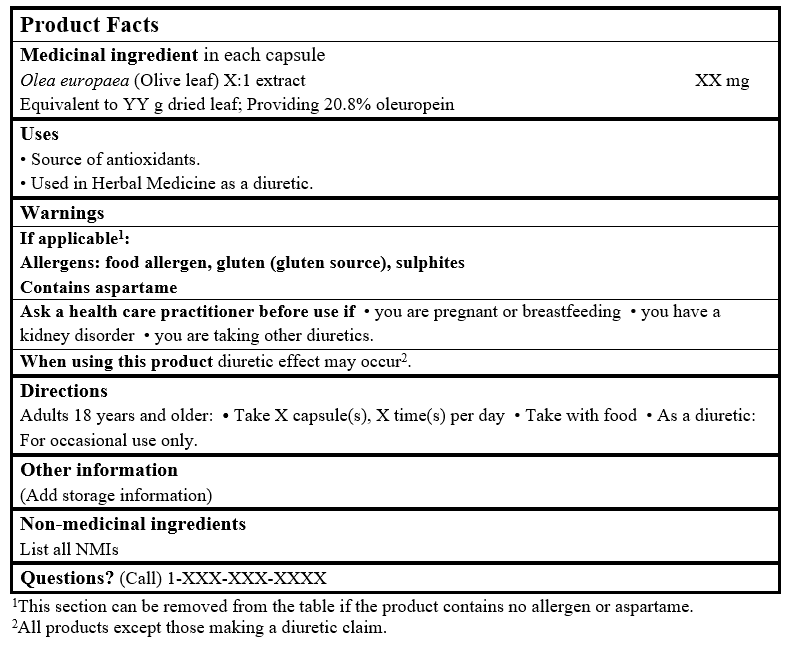
EXAMPLE OF PRODUCT FACTS (for NHPs):
Consult the Guidance Document, Labelling of Natural Health Products for more details.
References Cited
- Andreadou I, Iliodromitis EK, Mikros E, Constantinou M, Agalias A, Magiatis P, Skaltsounis AL, Kamber E, Kremastinos DH. The olive constituent oleuropein exhibits anti-ischemic, antioxidative, and hypolipidemic effects in anesthetized rabbits. Journal of Nutrition and Disease 2006;136(8):2213-2219.
- APhA 2002: Berardi RR, DeSimone EM, Newton GD, Oszko MA, Popovich NG, Rollins CJ, Shimp LA, Tietze KJ, editors. Handbook of Nonprescription Drugs: An Interactive Approach to Self-Care. 13th edition. Washington (DC): American Pharmaceutical Association; 2002.
- Bone K. A Clinical Guide to Blending Liquid Herbs: Herbal Formulations for the Individual Patient. St. Louis (MO): Elsevier Churchill Livingstone; 2003.
- CPhA 2002: Canadian Pharmacists Association. Patient Self-Care. Helping Patients Make Therapeutic Choices. Ottawa (ON): Canadian Pharmacists Association; 2002.
- de Bock M, Derraik JGB, Brennan CM, Biggs JB, Morgan PE, Hodgkinson SC, Hofman PL, Cutfield WS. Olive (Olea europaea L.) leaf polyphenols improve insulin sensitivity in middleaged overweight men: a randomized, placebo-controlled, crossover trial. PLoS ONE 8(3):e57622. doi: 10.1371/journal.pone.0057622
- EMA 2017: European Medicines Agency. European Union herbal monograph on Olea europaea L., folium. [Accessed 2024 November 27]. Available from: https://www.ema.europa.eu/en/documents/herbal-monograph/final-european-union-herbal-monograph-olea-europaea-l-folium-first-version_en.pdf
- Jemai H, El Feki A, Sayadi S. Antidiabetic and antioxidant effects of hydroxytyrosol and oleuropein from olive leaves in alloxan-diabetic rats. Journal of Agriculture and Food Chemistry 2009;57(19):8798-8804.
- Perrinjaquet-Moccetti T, Busjahn A, Schmidlin C, Schmidt A, Bradl B, Aydogan, C. Food Supplementation with an olive (Olea europaea L.) leaf extract reduces blood pressure in borderline hypertensive monozygotic twins. Phytotherapy Research 2008;22(9):1239-1242.
- Susalit E, Agus N, Effendi I, Tjandrawinata RR, Nofiarny D, Perrinjaquet-Moccetti T, Verbruggen M. Olive (Olea europaea) leaf extract effective in patients with stage-1 hypertension: Comparison with Captopril. Phytomedicine 2011;18:251-258.
- USDA 2024: United States Department of Agriculture, Agricultural Research Service (USDA ARS), Germplasm Resources Information Network (GRIN) - Global. U.S. National Plant Germplasm System. [Accessed 2024 November 14]. Available from: https://npgsweb.ars-grin.gov/gringlobal/taxon/taxonomysearch
- Wainstein J, Ganz T, Boaz M, Bar Dayan Y, Dolev E, Kerem Z, Madar Z. Olive leaf extract as a hypoglycemic agent in both human diabetic subjects and in rats. Journal of Medicinal Food 2012;15(7):605-610.
References Reviewed
- Abaza L, Ben Youssef N, Manai H, Mahjoub Haddad F, Methenni K, Zarrouk M. Chétoui olive leaf extracts: influence of the solvent type on phenolics and antioxidant activities. Grasas y Aceites 2011;62(1):96-104.
- Blumenthal M. The Complete German Commission E Monographs: Therapeutic Guide to Herbal Medicines. Austin (TX): American Botanical Council in cooperation with Integrative Medicine Communications; 1998.
- Brinker F. Herb Contraindications and Drug Interactions, 4th edition. Sandy (OR): Eclectic Medical Publications; 2010.
- Cherif S, Rahal N, Haouala M, Hizaoui B, Dargouth F, Gueddiche M, Kallel Z, Balansard G, Boukef K. Essai clinique d'un extrait titré de feuilles d'olivier dans le traitement de l'hypertension artérielle essentielle. Journal de pharmacie de Belgique 1996;51(2):101-124.
- de Bock M, Thorstensen EB, Derraik JGB, Henderson HV, Hofman PL, Cutfield WS. Human absorption and metabolism of oleuropein and hydroxytyrosol ingested as olive (Olea europaea L.) leaf extract. Molecular Nutrition and Food Research 2013;57(11):2079-2085.
- EFSA 2011: European Food Safety Authority. Scientific Opinion on the substantiation of health claims related to polyphenols in olive and protection of LDL particles from oxidative damage (ID 1333, 1638, 1639, 1696, 2865), maintenance of normal blood HDL-cholesterol concentrations (ID 1639), maintenance of normal blood pressure (ID 3781), "anti-inflammatory properties" (ID 1882), "contributes to the upper respiratory tract health" (ID 3468), "can help to maintain a normal function of gastrointestinal tract" (3779), and "contributes to body defences against external agents" (ID 3467) pursuant to Article 13(1) of Regulation (EC) No 1924/2006. EFSA Panel on Dietetic Products, Nutrition and Allergies (NDA), European Food Safety Authority (EFSA), Parma, Italy. [Accessed 2024 November 27]. Available from: http://www.efsa.europa.eu/en/efsajournal/pub/2033.htm
- El SN, Karakaya S. Olive tree (Olea europaea) leaves: potential beneficial effects on human health. Nutrition Reviews 2009;67(11):632-638.
- Hoffmann D. Medical Herbalism: The Science and Practice of Herbal Medicine. Rochester (VT): Healing Arts Press; 2003.
- Skenderi G. Herbal Vade Mecum. Rutherford (NJ): Herbacy Press; 2004.
- Singh I, Mok M, Christensen AM, Turner AH, Hawley JA. The effects of polyphenols in olive leaves on platelet function. Nutrition, Metabolism & Cardiovascular Diseases 2008;18:127-132.
- Thorne Research Inc. Monograph: Olive Leaf. Alternative Medicine Review 2009;14(1):62-66. Weiss RF and Fintelmann V. Herbal Medicine. 2nd edition. New York (NY): Thieme; 2000.
- Williamson EM, Evans FJ, Wren RC. Potter's Herbal Cyclopaedia: The Authoritative Reference Work on Plants with a Known Medicinal Use. Saffron Walden (GB): The C.W. Daniel Company Limited; 2003.