
FENUGREEK - TRIGONELLA FOENUM-GRAECUM - Topical
 (PDF Version - 48 KB)
This monograph is intended to serve as a guide to industry for the preparation of Product Licence Applications (PLAs) and labels for natural health product market authorization. It is not intended to be a comprehensive review of the medicinal ingredient.
Notes
- Text in parentheses is additional optional information which can be included on the label at the applicant's discretion.
- The solidus (/) indicates that either term and/or statement may be selected on the label.
Date
May 29, 2026
Proper name(s), Common name(s), Source information
| Proper name(s) | Common name(s) | Source information | ||
|---|---|---|---|---|
| Source material(s) | Part(s) | Preparation(s) | ||
| Trigonella foenum-graecum |
|
Trigonella foenum-graecum | Seed | Dry |
References: Proper name: USDA 2025; Common name: Gardner and McGuffin 2013; Source information: Bradley 2006; Blumenthal et al. 2000
Route of administration
Topical
Dosage form(s)
Acceptable dosage forms when used according to the requirements indicated in this monograph: Cream; Gel; Liquid; Loose; Lotion; Ointment; Paste; Powder; Salve; Solution; Topical liquid.
Use(s) or Purpose(s)
(Traditionally) used in Herbal Medicine to help heal minor skin wounds, burns and irritations (Bradley 2006; Blumenthal et al. 2000; Meyer 1993; Mills 1985; Felter and Lloyd 1983; Wren 1907).
Notes
- For multi-ingredient products:
- To prevent the product from being represented as a "traditional medicine", any indicated traditional use claim must refer to the specific medicinal ingredient(s) and recognized traditional system of medicine from which the claim originates when 1) both traditional and modern claims are present or 2) when claims originate from multiple systems of traditional medicine (e.g., Fenugreek is traditionally used in Herbal Medicine to help heal minor skin wounds, burns and irritations).
- When ALL of the medicinal ingredients (MIs) in the product are used within the SAME identified system of traditional medicine AND the product makes ONLY traditional claims, listing of MIs in the traditional claim(s) is not required.
Dose(s)
Subpopulation(s)
Adults 18 years and older
Quantity(ies)
Loose/Powder dosage forms
Methods of preparation: Dry, Powdered
100% dried seeds (EMA 2021; Bradley 2006; Blumenthal et al. 2000).
Note: Products in loose or powder dosage forms must be prepared as a decoction by the consumer prior to use (see direction for use).
Cream/Gel/Lotion/Liquid/Ointment/Paste/Salve/Solution/Topical liquid dosage forms
Methods of preparation: Non-Standardized Aqueous Extracts (Decoction, Decoction concentrate, Infusion, Infusion concentrate)
5 - 100% dried seed extract preparation in the finished product (EMA 2021, Bradley 2006; Blumenthal et al. 2000).
Notes: The extract ratio must be between 1:1 to 1:20. The formulation must be prepared in a way which is equivalent to a quantity of 50 - 200 milligrams crude dried seeds for 1 milliliter of finished product. For example, for a decoction prepared with a 1:10 w/w ratio, the concentration of extract preparation in the final product must be 50 - 100% (50 - 200 mg crude dried seeds * 10 fold dilution w/w = 500 - 2000 mg liquid extract in 1 mL finished product = 50 - 100% w/v extract preparation in the finished product).
Methods of preparation: Non-Standardized Ethanolic Extracts (Fluid extract, Tincture)
5 - 25% dried seed extract preparation in the finished product (Blumenthal et al. 2000; Grieve 1971).
Notes: The extract ratio must be between 1:1 to 1:5. The formulation must be prepared in a way which is equivalent to a quantity of 50 milligrams crude dried seeds for 1 milliliter of finished product. For example, for a tincture prepared with a 1:5 w/w ratio, the concentration of extract preparation in the final product must be 25% (50 mg crude dried seeds * 5 fold dilution w/w = 250 mg liquid extract in 1 mL finished product = 25% w/v extract preparation in the finished product).
Direction(s) for use
Solid dosage forms (Loose, Powder)
Place [insert volume to be measured by consumer in order to obtain a quantity between 12.5 and 50 grams of dried seeds, e.g., 1 - 2 tablespoons] of dried seeds in 1 cup (250 ml) of water, bring to a boil and simmer 5 minutes. Add to a hot bath or soak a small towel/pad/gauze/cotton in the warm liquid. Apply to affected area(s), up to 3 times per day (EMA 2021; Bradley 2006; Blumenthal et al. 2000).
Liquid dosage forms (Liquid, Solution, Topical liquid)
Add to a hot bath or soak a small towel/pad/gauze/cotton in liquid. Apply to affected area(s), up to 3 times per day (EMA 2021; Bradley 2006; Blumenthal et al. 2000).
Semi-solid dosage forms (Cream, Gel, Lotion, Ointment, Paste, Salve)
Apply to affected area(s), up to 3 times per day (EMA 2021; Blumenthal et al. 2000).
Duration(s) of use
No statement required.
Risk information
Caution(s) and warning(s)
Ask a health care practitioner/health care provider/health care professional/doctor/physician if symptoms persist or worsen.
Contraindication(s)
No statement is required.
Known adverse reaction(s)
No statement is required.
Non-medicinal ingredients
Must be chosen from the current Natural Health Products Ingredients Database (NHPID) and must meet the limitations outlined in the database.
Storage conditions
Must be established in accordance with the requirements described in the Natural Health Products Regulations.
Specifications
- The finished product specifications must be established in accordance with the requirements described in the Natural and Non-Prescription Health Products Directorate (NNHPD) Quality of Natural Health Products Guide.
- The medicinal ingredient must comply with the requirements outlined in the NHPID.
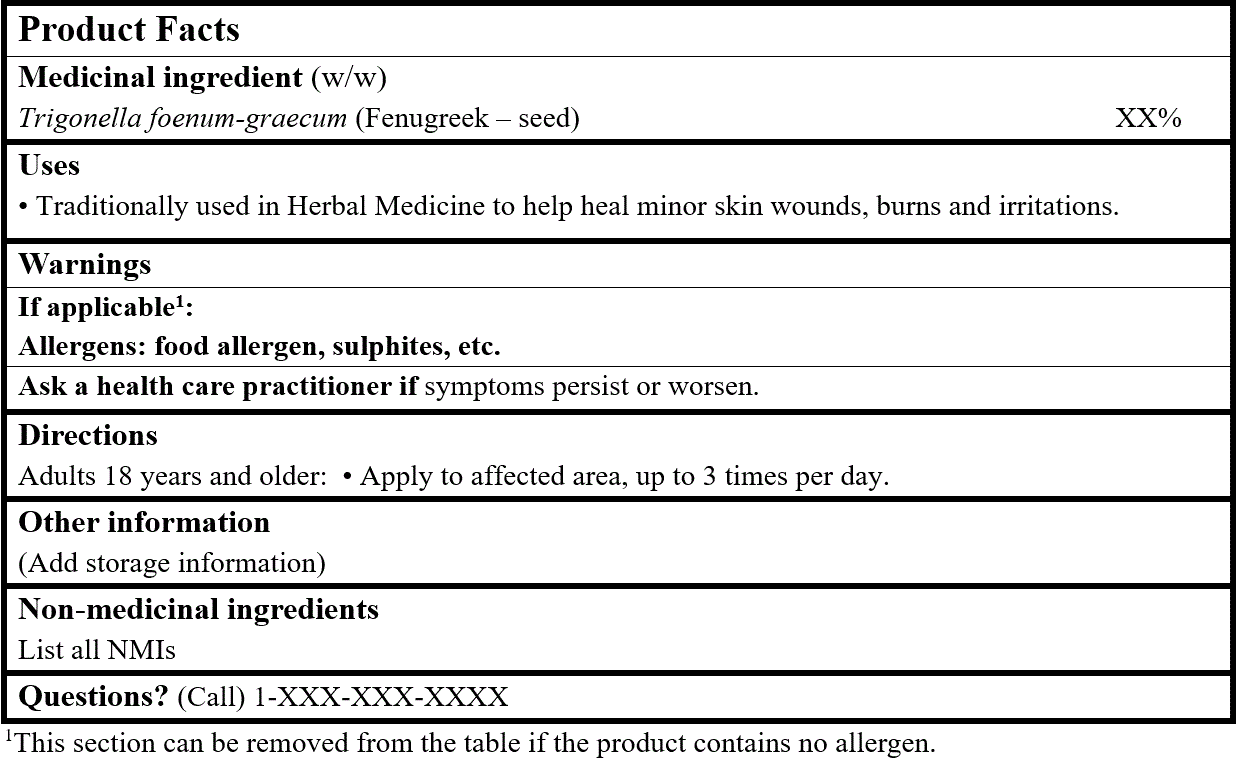
EXAMPLE OF PRODUCT FACTS:
Consult the Guidance Document, Labelling of Natural Health Products for more details.
References cited
- Blumenthal M, Goldberg A, Brinkmann J, editors. Herbal Medicine: Expanded Commission E Monographs. Boston (MA): Integrative Medicine Communications; 2000.
- Bradley PR, editor. British Herbal Compendium: A Handbook of Scientific Information on Widely Used Plant Drugs, Volume 2. Bournemouth (UK): British Herbal Medicine Association; 2006.
- EMA 2021: European Medicines Agency. European Union herbal monograph on Trigonella foenum-graecum L., semen. Committee on Herbal Medicinal Products (HMPC); 2021. [Accessed 2026 April 29]. Available at: https://www.ema.europa.eu/en/medicines/herbal/trigonellae-foenugraeci-semen
- Felter HW, Lloyd JU. King's American Dispensatory, Volume 1, 18th edition. Sandy (OR): Eclectic Medical Publications; 1983 [Reprint of 1898 original].
- Gardner Z, McGuffin M, editors. American Herbal Products Association's Botanical Safety Handbook. 2nd Edition. Boca Raton (FL): Taylor and Francis Group; 2013.
- Grieve M. A Modern Herbal. London (UK): Penguin Books; 1971.
- Meyer JE. The Herbalist. Glenwood (IL): Meyerbooks; 1993.
- Mills S. The Dictionary of Modern Herbalism. Wellingborough (UK): Thorsons Publishers Ltd; 1985.
- USDA 2025: United States Department of Agriculture, Agricultural Research Service (USDA ARS), Germplasm Resources Information Network (GRIN) - Global. U.S. National Plant Germplasm System. [Accessed 2026 April 24]. Available from: https://npgsweb.ars-grin.gov/gringlobal/taxon/taxonomysearch
- Wren RC. Potter's Cyclopedia of Botanical Drugs and Preparations. London (UK): Potter and Clark; 1907.
References reviewed
- API 1999: The Ayurvedic Pharmacopoeia of India, 1st edition, Part I, Volume II. Delhi (IN): The Controller of Publications; 1999 [Reprint of 1990 publication].
- Barnes J, Anderson LA, Philipson JD. Herbal Medicines: A Guide for Healthcare Professionals, 2nd edition. London (UK): The Pharmaceutical Press; 2002.
- Barnes J, Anderson LA, Philipson JD. Herbal Medicines: A Guide for Healthcare Professionals, 3rd edition. London (UK): The Pharmaceutical Press; 2007.
- Bartram T. Bartram's Encyclopedia of Herbal Medicine. London (UK): Robinson Publishing Ltd; 1998.
- BHP 1996: British Herbal Medicine Association (BHMA) Scientific Committee. British Herbal Pharmacopoeia. Bournemouth (UK): British Herbal Medicine Association; 1996.
- Bisset NG, Wichtl M. Herbal Drugs and Phytopharmaceuticals, 2nd edition. Stuttgart (DE): Medpharm GmbH Scientific Publishers; 2001.
- Bordia A, Verma SK, Srivastava KC. Effect of ginger (Zingiber officinale Rosc.) and fenugreek (Trigonella foenumgraecum L.) on blood lipids, blood sugar and platelet aggregation in patients with coronary artery disease. Prostaglandins, Leukotrienes, and Essential Fatty Acids 1997;56(5):379-384.
- Bradley PR, editor. British Herbal Compendium: A Handbook of Scientific Information on Widely Used Plant Drugs, Volume 1. Bournemouth (UK): British Herbal Medicine Association; 1992.
- Choudhary D, Chandra D, Choudhary S, Kale RK. Modulation of glyoxalase, glutathione S-transferase and antioxidant enzymes in the liver, spleen and erythrocytes of mice by dietary administration of fenugreek seeds. Food and Chemical Toxicology 2001;39(10):989-997.
- Ellingwood F. American Materia Medica, Therapeutics and Pharmacognosy. Sandy (OR): Eclectic Medical Publications; 1983 [Reprint of 1919 original].
- Felter HW. The Eclectic Materia Medica, Pharmacology and Therapeutics. Sandy (OR): Eclectic Medical Publications; 1983 [Reprint of 1922 original].
- Genet S, Kale RK, Baquer NZ. Alterations in antioxidant enzymes and oxidative damage in experimental diabetic rat tissues: Effect of vanadate and fenugreek (Trigonella foenum graecum). Molecular and Cellular Biochemistry 2002;236(1-2):7-12.
- Gruenwald J, Brendler T, Jaenicke C, editors. PDR for Herbal Medicines, 2nd edition. Montvale (NJ): Medical Economics Company; 1998.
- Gruenwald J, Brendler T, Jaenicke C, editors. PDR for Herbal Medicines, 3rd edition. Montvale (NJ): Thompson PDR; 2004.
- Gupta A, Gupta R, Lal B. Effect of Trigonella foenum-graecum (fenugreek) seeds on glycaemic control and insulin resistance in type 2 diabetes mellitus: a double blind placebo controlled study. The Journal of the Associated Physicians of India 2001;49:1057-1061.
- Kaviarasan S, Vijayalakshmi K, Anuradha CV. Polyphenol-rich extract of fenugreek seeds protect erythrocytes from oxidative damage. Plant Foods for Human Nutrition 2004;59(4):143-147.
- Korman SH, Cohen E., Preminger A. Pseudo-maple syrup urine disease due to maternal prenatal ingestion of fenugreek. Journal of Paediatrics and Child Health 2001;37(4):403-404.
- Mills S, Bone K. Principles and Practice of Phytotherapy. Toronto (ON): Churchill Livingstone; 2000.
- Ravikumar P, Anuradha CV. Effect of fenugreek seeds on blood lipid peroxidation and antioxidants in diabetic rats. Phytotherapy Research 1999;13(3):197-201.
- Sharma RD. Effect of fenugreek seeds and leaves on blood glucose and serum insulin responses in human subjects. Nutrition Research 1986;6(12):1353-1364.
- Sharma RD and Raghuram TC. Short Communication: Hypolipidaemic effect of fenugreek seeds: A clinical study. Phytotherapy Research 1991;5(3):145-147.
- Sharma RD, Raghuram TC, Rao NS. Effect of Fenugreek seeds on blood glucose and serum lipids in Type I diabetes. European Journal of Clinical Nutrition 1990;44(4):301-306.
- Sharma RD, Sarkar A, Hazra DK, Misra B, Singh JB, Maheshwara BB, Sharma SK. Short Communication: Hypolipidaemic Effect of Fenugreek Seeds: a Chronic Study in Non-insulin Dependant Diabetic Patients. Phytotherapy Research 1996;10(4):332-334.
- Srinivasan K. Fenugreek (Trigonella foenum-graecum): a review of health beneficial physiological effects. Food Reviews International 2006;22(2):203-224.
- Thirunavukkarasu V, Anuradha CV, Viswanathan P. Protective effect of fenugreek (Trigonella foenum graecum) seeds in experimental ethanol toxicity. Phytotherapy Research 2003;17(7):737-743.
- Yalçin SS., Tekinalp G, Ozalp I. Peculiar odor of traditional food and maple syrup urine disease. Pediatrics International 1999;41(1):108-109.
Version History
| Publication date | Update type | Summary of main updates (from May 2026) |
|---|---|---|
| 2026-05-29 | Minor updates |
|
| 2018-08-28 | Validation (topical only) | – |
| 2009-06-24 | Minor updates (oral and topical) | – |
| 2008-01-28 | Initial release (oral and topical) | – |