
ELEUTHERO - ELEUTHEROCOCCUS SENTICOSUS
 (PDF Version - 95 KB)
This monograph is intended to serve as a guide to industry for the preparation of Product Licence Applications (PLAs) and labels for natural health product market authorization. It is not intended to be a comprehensive review of the medicinal ingredient.
Notes
- Text in parentheses is additional optional information which can be included on the label at the applicant's discretion.
- The solidus (/) indicates that either term and/or statement may be selected on the label.
Date
October 31, 2025
Proper name(s), Common name(s), Source information
| Proper names(s) | Common names(s) | Source information | ||
|---|---|---|---|---|
| Source material(s) | Part(s) | Preparation(s) | ||
| Eleutherococcus senticosus |
|
Eleutherococcus senticosus |
|
Dry |
References: Proper name: USDA 2024; Common names: USDA 2024; Gardner and McGuffin 2013; Source information: Barnes et al. 2007; Hoffmann 2003.
Route(s) of Administration
Oral (ESCOP 2003; Bradley 1992)
Dosage form(s)
This monograph excludes foods or food-like dosage forms as indicated in the Compendium of Monographs Guidance Document.
Acceptable dosage forms for oral use are indicated in the dosage form drop-down list of the web-based Product Licence Application form for Compendial applications.
Use(s) or Purpose(s)
- Used in Herbal Medicine as a tonic to help relieve general weakness/fatigue and/or to aid during recovery (ESCOP 2003; Blumenthal et al. 2000; Mills and Bone 2000; Bradley 1992).
- Used in Herbal Medicine to help improve mental and/or physical performance after periods of mental and/or physical exertion (ESCOP 2003; Hoffmann 2003; Mills and Bone 2000; Bradley 1992).
- Used in Herbal Medicine as an adaptogen to help increase energy and resistance to stress over time (e.g. in case of mental and physical fatigue related to stress) (Winston et Maimes 2007; WHO 2004; Bone 2003; Blumenthal et al. 2000).
Dose(s)
Subpopulation(s)
Adults 18 years and older
Quantity(ies)
Methods of preparation: Dry, Powdered, Non-Standardized Extracts (Dry extract*, Tincture, Fluid extract, Decoction, Decoction concentrate, Infusion, Infusion concentrate)
0.91 - 6 grams of dried root/root and rhizome, per day (Winston et Maimes 2007; WHO 2004; ESCOP 2003; Hoffmann 2003; Blumenthal et al. 2000; Mills and Bone 2000; Bradley 1992).
*Note: Solvents allowed for the method of preparation “Non-Standardized Extracts (Dry extract)” as part of this monograph are ethanol and/or water only.
Direction(s) for use
No statement required.
Duration(s) of use
Ask a health care practitioner/health care provider/health care professional/doctor/physician for use beyond 4 weeks (ESCOP 2003).
Risk information
Caution(s) and warning(s)
- Ask a health care practitioner/health care provider/health care professional/doctor/physician if symptoms persist or worsen.
- Ask a health care practitioner/health care provider/health care professional/doctor/physician before use if you are pregnant or breastfeeding (Barnes et al. 2007; ESCOP 2003).
- Ask a health care practitioner/health care provider/health care professional/doctor/physician before use if you have an acute infection (Brinker 2010; Mills and Bone 2000).
Contraindication(s)
Do not use if you have high blood pressure (Gardner and McGuffin 2013; Brinker 2010; Barnes et al. 2007; Blumenthal et al. 2000; Mills and Bone 2000).
Known adverse reaction(s)
No statement required.
Non-medicinal ingredients
Must be chosen from the current Natural Health Product Ingredient Database (NHPID) and must meet the limitations outlined in the database.
Storage conditions
Must be established in accordance with the requirements described in the Natural Health Products Regulations.
Specifications
- The finished product specifications must be established in accordance with the requirements described in the Natural and Non-prescription Health Products Directorate (NNHPD) Quality of Natural Health Products Guide.
- The medicinal ingredient must comply with the requirements outlined in the NHPID.
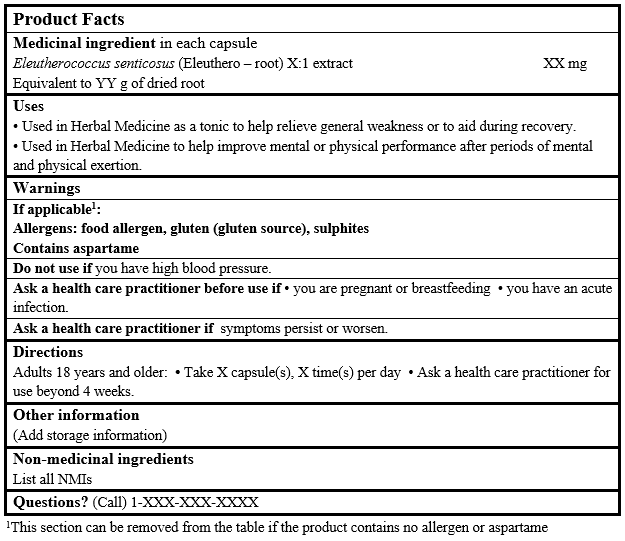
EXAMPLE OF PRODUCT FACTS:
Consult the Guidance Document, Labelling of Natural Health Products for more details.
References Cited
- Barnes J, Anderson LA, Philipson JD. Herbal Medicines, 3rd edition. London (UK): The Pharmaceutical Press; 2007.
- Blumenthal M, Goldberg A, Brinkmann J, editors. Herbal Medicine: Expanded Commission E Monographs. Boston (MA): Integrative Medicine Communications; 2000.
- Bradley PR, editor. British Herbal Compendium: A Handbook of Scientific Information on Widely Used Plant Drugs, Volume 1. Bournemouth (UK): British Herbal Medicine Association; 1992.
- Brinker F. Herb Contraindications and Drug Interactions, 4th edition. Sandy (OR): Eclectic Medical Publications; 2010.
- Bone K. A clinical guide to blending liquid herbs: Herbal formulations for the individual patient. St. Louis (MI): Churchill Livingstone; 2003.
- ESCOP 2003: ESCOP Monographs: The Scientific Foundation for Herbal Medicinal Products, 2nd edition. Exeter (UK): European Scientific Cooperative on Phytotherapy and Thieme; 2003.
- Gardner Z, McGuffin M, editors. American Herbal Products Association's Botanical Safety Handbook. 2nd edition. Boca Ration (FL): Taylor and Francis Group; 2013.
- Hoffmann D. Medical Herbalism. Rochester (VT): Healing Arts Press; 2003.
- Mills S, Bone K. Principles and Practice of Phytotherapy. Toronto (ON): Churchill Livingstone; 2000.
- USDA 2024: United States Department of Agriculture, Agricultural Research Service (USDA ARS), Germplasm Resources Information Network (GRIN) - Global. U.S. National Plant Germplasm System.[Accessed 2024 August 1]. Available from: https://npgsweb.ars-grin.gov/gringlobal/taxon/taxonomysearch
- WHO: World Health Organization. WHO monographs on selected medicinal plants; Volume 2; Geneva (CH): World Health Organization; 2004.
- Winston D, Maimes S. Adaptogens: Herbs for strength, stamina and stress relief. Rochester (VT): Healing Arts Press; 2007.
References reviewed
- Asano K, Takahashi T, Miyashita M, Matsuzaka A, Muramatsu S, Kuboyama M, Kugo H, Imai J. Effect of Eleuthero senticosus Extract on Human Physical Working Capacity. Planta Medica 1986;52(3):175-177.
- BHP 1996: British Herbal Pharmacopoeia. Bournemouth (UK): British Herbal Medicine Association; 1996.
- Bohn B, Nebe CT, Birr C. Flow-cytometric studies with Eleutherococcus senticosus extract as an immunomodulatory agent. Arzneimittelforschung 1987;37(10):1193-1196.
- Cicero A, Derosa G, Brillante R, Bernardu R, Nascetti S, Gaddi A. Effects of Siberian Ginseng (Eleutherococcus senticosus maxim.) on elderly quality of life: A randomized clinical trial. Archives of Gerontology and Geriatrics. Supplement 2004;(9):69-73.
- Donovan JL, DeVane CL, Chavin KD, Taylor RM, Markowitz JS. Siberian Ginseng (Eleutherococcus senticosus) effects on CYP2D6 and CYP3A4 activity in normal volunteers. Drug Metabolism and Disposition: the biological fate of chemicals 2003;31(5):519-522.
- Eschbach P, Webster M, Boyd J, McArthur P, Evetovich T. The effect of Siberian Ginseng (Eleutherococcus Senticosus) on substrate utilization and performance during prolonged cycling. International Journal of Sport Nutrition and Exercise Metabolism 2000;10(4):444-451.
- Gaffney B, Hügel H, Rich P. The effects of Eleutherococcus senticosus and Panax ginseng on steroidal hormone indices of stress and lymphocyte subset numbers in endurance athletes. Life Sciences. 2001;70(4):431-442.
- Hartz A, Bentler S, Noyes R, Hoehns J, Logemann C, Sinift Y, Butani W, Wang W, Brake K, Ernst M, Kautzman H. Randomized controlled trial of Siberian Ginseng for chronic fatigue. Psychological Medicine 2004;34(1):51-61.
- Kaloeva ZD. Effect of the glycosides of Eleutherococcus senticosus on the hemodynamic indices of children with hypotensive states. Farmakologiia Toksikologiia 1986;49(5):73.
- Mills E, Dugoua J, Perri D, Koren G. Herbal Medicines in Pregnancy and Lactation: An Evidence-Based Approach. London (UK): Taylor and Francis Medical; 2006.
- Mills S. The Dictionary of Modern Herbalism. Wellingborough (UK): Thorsons Publishers Ltd; 1985.
- Szołomicki S, Samochowiec L, Wójcicki J, Droździk M. The influence of active components of Eleutherococcus senticosus on Cellular Defence and Physical Fitness in Man. Phytotherapy Research 2000;14(1):30-35.
- Wu Y, Wang X, Li M, Compbell TC. [Effect of Ciwujia (Radix Acanthopanax senticosus) preparation on exercise performance under constant endurance load for the elderly]. Journal of Hygiene research 1999;27(6):421-444. [in Chinese].