
ÉCHINACÉE - ECHINACEA ANGUSTIFOLIA
Si vous avez besoin d'aide pour accéder aux formats de rechange, tels que Portable Document Format (PDF), Microsoft Word et PowerPoint (PPT), visitez la section d'aide sur les formats de rechange.
 (Version PDF - 96.0 ko)
La présente monographie vise à servir de guide à l'industrie pour la préparation de demandes de licence de mise en marché (DLMM) et d'étiquettes dans le but d'obtenir une autorisation de mise en marché d'un produit de santé naturel. Elle ne vise pas à être une étude approfondie de l'ingrédient médicinal.
Notes
- Les parenthèses contiennent des éléments d'information additionnels (facultatifs) qui peuvent être inclus sur l'étiquette à la discrétion du demandeur.
- La barre oblique (/) indique que les termes et/ou énoncés sont synonymes. Le demandeur peut utiliser n'importe lequel des termes ou énoncés indiqués sur l'étiquette.
Date
28 mars 2025
Nom(s) propre(s), Nom(s) commun(s), Information(s) d'origine
| Nom(s) propre(s) | Nom(s) commun(s) | Information(s) d'origine | ||
|---|---|---|---|---|
| Matière(s) d'origine | Partie(s) | Préparation(s) | ||
Echinacea angustifolia |
|
Echinacea angustifolia |
|
Sèche |
Références: Nom propre: USDA 2024; Noms communs: USDA 2024; Bruneton 1999; Informations d'origine: Barnes et al. 2007; Grieve 1971.
Voie d'administration
Orale
Forme(s) posologique(s)
Cette monographie exclut les aliments et les formes posologiques semblables aux aliments tel qu'indiqué dans le document de référence Compendium des monographies.
Enfants 2 ans: Les formes posologiques acceptables se limitent à l'émulsion/suspension et aux solutions/préparation liquides (Giacoia et al. 2008; EMA/CHMP 2006).
Enfants 3-5 ans: Les formes posologiques acceptables se limitent aux formes à croquer, à l'émulsion/suspension, aux poudres et aux solutions/préparation liquides (Giacoia et al. 2008; EMA/CHMP 2006).
Enfants 6-11 ans, adolescents 12-17 ans, et adultes 18 ans et plus: Les formes posologiques acceptables pour la voie d'administration orale sont indiquées dans la liste déroulante dans le formulaire web de demande de licence de mise en marché pour les demandes officinales.
Usage(s) ou fin(s)
- Utilisé (traditionnellement) en phytothérapie pour aider à soulager les symptômes d'infections des voies respiratoires supérieures (Barnes et al. 2007; Blumenthal et al. 2000; Ellingwood 1983; Felter et Lloyd 1983; Grieve 1971).
- Utilisé (traditionnellement) en phytothérapie pour aider à soulager les maux de gorge (Blumenthal et al. 2000; Moerman 1998).
Notes
- Les usages ci-dessus peuvent être combinés sur l'étiquette du produit s'ils proviennent du même système de médecine traditionnelle ou non-traditionnelle (par ex., Utilisé traditionnellement en phytothérapie pour aider à soulager les symptômes d'infections des voies respiratoires supérieures et les maux de gorge).
- Pour les produits à ingrédients multiples :
- Afin d'empêcher que le produit soit représenté comme une « médecine traditionnelle », toute allégation traditionnelle doit faire référence à/aux ingrédient(s) médicinal(aux) et au système de médecine traditionnelle reconnu d'où l'allégation provient lorsque 1) des allégations à la fois traditionnelles et modernes sont présentes ou 2) lorsque les allégations proviennent de multiples systèmes de médecine traditionnelle (par ex., L'échinacée est utilisée traditionnellement en phytothérapie pour aider à soulager les maux de gorge).
- Lorsque TOUS les ingrédients médicinaux (IM) du produit sont utilisés au sein du MÊME système de médecine traditionnelle identifié ET que le produit n'a QUE des allégations traditionnelles, l'inclusion de l'/des ingrédient(s) médicinal(aux) dans l'/les allégation(s) traditionnelle(s) n'est pas requise.
Dose(s)
Sous-population(s)
Tel que spécifié ci-dessous.
Quantité(s)
Méthodes de préparation: Sec, poudre, extraits non normalisés (extrait sec*, teinture, extrait fluide, décoction, concentré de décoction, infusion, concentré d'infusion)
| Sous-population(s)1,2 | Racine/rhizome séché (g/jour) | ||
|---|---|---|---|
| Minimum | Maximum | ||
Enfants |
2 à 4 ans |
0,17 g |
0,5 g |
5 à 9 ans |
0,25 g |
0,8 g |
|
10 à 11 ans |
0,5 g |
1,5 g |
|
Adolescents |
12 à 14 ans |
0,5 g |
1,5 g |
15 à 17 ans |
1,0 g |
3,0 g |
|
Adultes |
18 ans et plus |
1,0 g |
3,0 g |
1Les doses pour les enfants et les adolescents ont été calculées à partir d'une fraction de la dose adulte (JC 2023). Les références suivantes appuient l'emploi de l'échinacée angustifolia chez les enfants : McIntyre 2005; Bove 2001; Schilcher 1997.
2Les références suivantes ont servi à établir la dose pour les adultes : Barnes et al. 2007; Blumenthal et al. 2000; Bradley 1992
*Note : Les solvants permis pour la méthode de préparation « Extraits non normalisés (extrait sec) » au sein de cette monographie sont l'éthanol et/ou l'eau uniquement.
Mode(s) d'emploi
Énoncé non requis.
Durée(s) d'utilisation
Consulter un praticien de soins de santé/fournisseur de soins de santé/professionnel de la santé/docteur/médecin si l'utilisation se prolonge au-delà de 8 semaines (Brinker 2010).
Mention(s) de risque
Précaution(s) et mise(s) en garde
- Consultez un praticien de soins de santé/fournisseur de soins de santé/professionnel de la santé/docteur/médecin si les symptômes persistent ou s'aggravent.
- Consultez un praticien de soins de santé/fournisseur de soins de santé/professionnel de la santé/docteur/médecin avant l'utilisation si vous avez une maladie systémique progressive telle que la tuberculose, la collagénose, la sclérose en plaques ou une maladie du système immunitaire (Gardner et McGuffin 2013; Brinker 2010).
- Consultez un praticien de soins de santé/fournisseur de soins de santé/professionnel de la santé/docteur/médecin avant l'utilisation si vous prenez des médicaments qui inhibent le système immunitaire (Brinker 2010; Mills et Bone 2005).
Contre-indications(s)
Énoncé non requis.
Réaction(s) indésirable(s) connue(s)
Énoncé non requis.
Ingrédients non médicinaux
Doivent être choisis parmi ceux de la version actuelle de la Base de données des ingrédients des produits de santé naturels (BDIPSN) et respecter les restrictions mentionnées dans cette base de données.
Conditions d'entreposage
Doivent être établies conformément aux exigences décrites dans le Règlement sur les produits de santé naturels.
Spécifications
- Les spécifications du produit fini doivent être établies conformément aux exigences décrites dans le Guide de référence sur la qualité des produits de santé naturels de la Direction des produits de santé naturels et sans ordonnance (DPSNSO).
- L'ingrédient médicinal doit être conforme aux exigences mentionnées dans la BDIPSN.
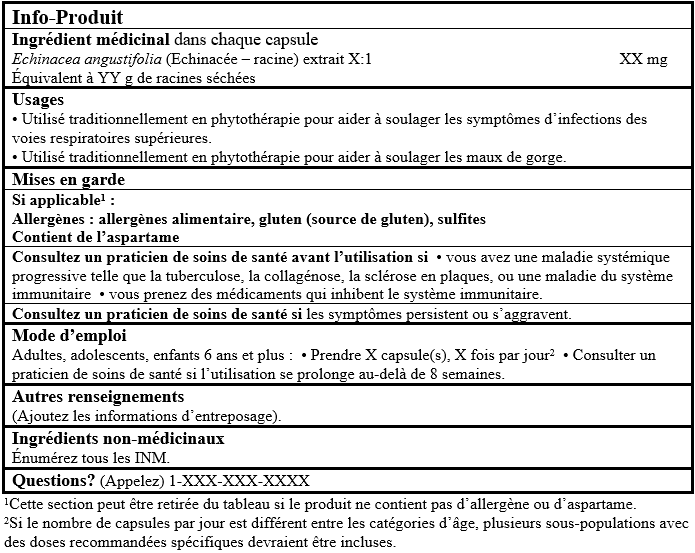
Exemple d'info-produit :
Veuillez consulter la ligne directrice, Étiquetage des produits de santé naturels pour plus de détails.
Références citées
Barnes J, Anderson LA, Philipson JD. Herbal Medicines, 3e édition. Londres (GB): The Pharmaceutical Press; 2007.
Blumenthal M, Goldberg A, Brinkmann J, éditeurs. Herbal Medicine: Expanded Commission E Monographs. Boston (MA): Integrative Medicine Communications; 2000.
Bove M. An Encyclopedia of Natural Healing for Children and Infants. New Canaan (CT): Keats Publishing, Incorporated; 2001.
Bradley PR, éditeur. British Herbal Compendium: A Handbook of Scientific Information on Widely Used Plant Drugs, Volume 1. Bournemouth (GB): British Herbal Medicine Association; 1992.
Brinker F. Herb Contraindication and Drug Interactions, 4e édition. Sandy (OR): Eclectic Medical Publications; 2010.
Bruneton J. Pharmacognosie, Phytochimie, Plantes Médicinales, 3e édition. Paris (F) : Technique & Documentation; 1999.
Ellingwood F. American Materia Medica, Therapeutics and Pharmacognosy. Sandy (OR): Eclectic Medical Publications; 1983 [Réimpression de la publication de 1919].
EMA/CHMP 2006: European Medicines Agency: Pre-authorization Evaluation of Medicines for Human Use. Committee for Medicinal Products for Human Use. Reflection Paper: Formulations of choice for the paediatric population. EMA/CHMP/PEG/194810/2005. [Consulté le 2 avril 2024]. Disponible à : https://www.ema.europa.eu/en/documents/scientific-guideline/reflection-paper-formulations-choice-paediatric-population_en.pdf
Felter HW, Lloyd JU. King's American Dispensatory, Volume 1, 18e édition. Sandy (OR): Eclectic Medical Publications; 1983 [Réimpression de la publication de 1898].
Gardner Z, McGuffin M, éditeurs. American Herbal Products Association's Botanical Safety Handbook. 2e édition. Boca Ration (FL): Taylor and Francis Group; 2013.
Giacoia GP, Taylor-Zapata P, Mattison D. Eunice Kennedy Shriver National Institute of Child Health and Human Development Pediatric Formulation Initiative: selected reports from working groups. Clinical Therapeutics 2008;30(11):2097-2101.
Grieve M. A Modern Herbal, Volume 1. New York (NY): Dover Publications; 1971 [Réimpression de la publication de 1931 Harcourt, Brace & Company].
JC 2023: Justice Canada. Règlement sur les produits de santé naturels. Ottawa (ON): Justice Canada. [Consulté le 22 février 2024]. Disponible à : https://laws-lois.justice.gc.ca/fra/reglements/DORS-2003-196/index.html
McIntyre A. Herbal Treatment of Children - Western and Ayurvedic Perspectives. Toronto (ON): Elsevier Limited; 2005.
Mills S, Bone K. The Essential Guide to Herbal Safety. St. Louis (MO): Elsevier Churchill Livingstone; 2005.
Moerman DE. Native American Ethnobotany. Portland (OR): Timber Press; 1998.
Schilcher H. Phytotherapy in Paediatrics: Handbook for Physicians and Pharmacists. Stuttgart (D): Medpharm Scientific Publishers; 1997.
USDA 2024: United States Department of Agriculture Agricultural Research Service (USDA ARS), Germplasm Resources Information Network (GRIN) - Global. U.S. National Plant Germplasm System. [Consulté le 22 février 2024]. Disponible à : https://npgsweb.ars-grin.gov/gringlobal/taxon/taxonomysearch
Références consultées
Altamirano-Dimas M, Hudson JB, Cochrane D, Nelson C, Arnason JT. Modulation of immune response gene expression by echinacea extracts: results of a gene array analysis.Canadian Journal of Physiology and Pharmacology 2007;85(11):1091-1098.
Barnes J, Anderson LA, Gibbons S, Phillipson JD. Echinacea species (Echinacea angustifolia (DC.) Hell., Echinacea pallida (Nutt.) Nutt., Echinacea purpurea (L.) Moench): a review of their chemistry, pharmacology and clinical properties. The Journal of Pharmacy and Pharmacology 2005;57(8):929-954.
Barnes J, Anderson LA, Philipson JD. Herbal Medicines: A Guide for Healthcare Professionals, 2e édition. Londres (GB): The Pharmaceutical Press; 2002.
Barrett B. Medicinal properties of echinacea: a critical review. Phytomedicine 2003;10(1):66-86.
Barrett BP, Brown RL, Locken K, Maberry R, Bobula JA, D'Alessio D. Treatment of the common cold with unrefined echinacea: a randomized, double-blind, placebo-controlled trial. Annals of Internal Medicine 2002;137(12):939-946.
Barrett B, Brown R, Voland R, Maberry R, Turner R. Relations among questionnaire and laboratory measures of rhinovirus infection. The European Respiratory Journal 2006;28(2):358-363.
Barrett B, Harahan B, Brown D, Zhang Z, Brown R. Sufficiently important difference for common cold: severity reduction. Annals of Family Medicine 2007;5(3):216-223.
Barrett B, Vohmann M, Calabrese C. Echinacea for upper respiratory infection. The Journal of Family Practice 1999;48(8):628-635.
Bauer R, Khan IA, Wagner H. TLC and HPLC analysis of Echinacea pallida and E. angustifolia roots. Planta Medica 1988;54(5):426-430.
Bauer R, Wagner H. Echinacea species as potential immunostimulatory drugs. Dans : Wagner H, Farnsworth NR, éditeurs. Economics and Medicinal Plants Research, volume 5. Londres (UK), Academic Press; 1991.
BHP 1996: British Herbal Pharmacopoeia. Bournemouth (GB): British Herbal Medicine Association; 1996.
BHP 1983: British Herbal Pharmacopoeia. Cowling (GB): British Herbal Medical Association; 1983.
Binns SE, Arnason JT, Baum BR. Phytochemical variation within populations of Echinacea angustifolia (Asteraceae). Biochemical Systematics and Ecology 2002;30:837-854.
Block KI, Mead MN. Immune system effects of echinacea, ginseng, and astragalus: a review. Integrative Cancer Therapies 2003;2(3):247-267.
Blumenthal M, Farnsworth NR, Leach M. Echinacea angustifolia in rhinovirus infections. New England Journal of Medicine 2005;353(18):1971-1972.
Bone K. Echinacea: what makes it work? Alternative Medicine Review 1997;2(2):87-93.
Bone K. Echinacea: When should it be used? Alternative Medicine Review 1997;2(6):451-458.
Boon H, Smith MJ. The Complete Natural Medicine Guide to the 50 Most Common Medicinal Herbs, 2e édition. Toronto (ON): Robert Rose Inc; 1999.
Bisset NG, Wichtl M, éditeurs. Herbal Drugs and Phytopharmaceuticals. 2e édition. Stuttgart (Germany): medpharm GmbH Scientific Publishers; 2001.
Bradley PR, éditeur. British Herbal Compendium: A Handbook of Scientific Information on Widely Used Plant Drugs, Volume 1. Bournemouth (GB): British Herbal Medicine Association; 1992.
Carr RR, Nahata MC. Complementary and alternative medicine for upper-respiratory-tract infection in children. American Journal of Health-System Pharmacists 2006;63:33-39.
Caruso TJ, Gwaltney JM Jr. Reply to Barton and Hemilä. Clinical Infectious Diseases 2005;41:763-764.
Caruso TJ, Gwaltney JM Jr. Treatment of the common cold with Echinacea: a structured review. Clinical Infectious Diseases 2005;40(6):807-810.
Chevallier A. The Encyclopedia of Medicinal Plants. New York (NY): DK Publishing Inc; 1996.
Classen B, Csavas M, Borbas A, Dingermann T, Zundorf I. Monoclonal antibodies against an arabinogalactan-protein from pressed juice of Echinacea purpurea. Planta Medica 2004;70(9):861- 865.
Cohen HA, Varsano I, Kahan E, Sarrell EM, Uziel Y. Effectiveness of an herbal preparation containing echinacea, propolis, and vitamin C in preventing respiratory tract infections in children: a randomized, double-blind, placebo-controlled, multicenter study. Archives of Pediatrics & Adolescent Medicine 2004;158(3):217-221.
Ernst E. The risk-benefit profile of commonly used herbal therapies: Gingko, St John's Wort, Ginseng, Echinacea, Saw Palmetto and Kava. Annals of Internal Medicine 2002;136(1):42-53.
Felter HW. The Eclectic Materia Medica, Pharmacology and Therapeutics. Sandy (OR): Eclectic Medical Publications; 1983 [Réimpression de la publication de 1922].
Felter HW, Lloyd JU. King's American Dispensatory, Volume 1, 18e édition. Sandy (OR): Eclectic Medical Publications; 1983 [Réimpression de la publication de 1898].
Foster S. Echinacea. The Purple Coneflowers. Austin (TX): Steven Foster; 1996.
Gallo M, Sarkar M, Au W, Pietrzak K, Comas B, Smith M, Jaeger TV, Einarson A, Koren G. Pregnancy outcome following gestational exposure to echinacea: a prospective controlled study. Archives of Internal Medicine 2000;160(20):3141-3143.
Gertsch J, Schoop R, Kuenzle U, Suter A. Echinacea alkylamides modulate TNF-α gene expression via cannabinoid receptor CB2 and multiple signal transduction pathways. FEBS Letters 2004;577(3):563-569.
Giles JT, Palat CT, Chien SH, Chien SH, Chang ZG, Kennedy DT. Evaluation of Echinacea for treatment of the common cold. Pharmacotherapy 2000;20(6):690-697.
Grieve M. A Modern Herbal, Volume 1. New York (NY): Dover Publications; 1971 [Réimpression de la publication de 1931 Harcourt, Brace & Company].
Gunning K. Echinacea in the treatment and prevention of upper respiratory tract infections. The Western Journal of Medicine 1999;171(3):198-200.
Haddad PS, Azar GA, Groom S, Boivin M. Natural health products, modulation of immune function and prevention of chronic diseases. Evidence-Based Complementary and Alternative Medicine 2005;2(4):513-520.
Hemilä H. Echinacea, vitamin C, the common cold and blinding. Clinical Infectious Diseases 2005;41(5):762-763.
Islam J, Carter R. Use of Echinacea in upper respiratory tract infection. Southern Medical Journal 2005;98(3):311-318.
Kemp DE, Franco KN. Possible leucopenia associated with long-term use of echinacea. The Journal of the American Board of Family Practice 2002;15(5):417-419.
Knight V. Echinacea treatment for the common cold. Clinical Infectious Diseases 2005;40(6):811-812.
Lee AN, Werth VP. Activation of autoimmunity following use of immunostimulatory herbal supplements. Archives of Dermatology 2004;140:723-727.
Li T. Echinacea: cultivation and medicinal value. HortTechnology 1998;8(2):122-129.
Linde K, Barrett B, Wölkart K, Bauer B, Melchart D. Echinacea for preventing and treating the common cold. Cochrane Database of Systematic Reviews. 2006;1 CD000530. DOI: 10.1002/14651858.CD000530.pub2
Lindenmuth GF, Lindenmuth EB. The efficacy of echinacea compound herbal tea preparation on the severity and duration of upper respiratory and flu symptoms: a randomized, double-blind, placebo-controlled study. Journal of Alternative and Complementary Medicine 2000;6(4):327-334.
Matthias A, Addison RS, Penman KG, Dickinson RG, Bone KM, Lehmann RP. Echinacea alkamide disposition and pharmacokinetics in humans after tablet ingestion. Life Sciences 2005;77(16):2019-2029.
Matthias A, Banbury L, Bone KM, Leach DN, Lehmann RP. Echinacea alkylamides modulate induced immune responses in T-cells. Fitoterapia 2008;79(1):53-58.
Matthias A, Blanchfield JT, Penman KG, Toth I, Lang CS, De Voss JJ, Lehmann RP. Permeability studies of alkylamides and caffeic acid conjugates from echinacea using a Caco-2 cell monolayer model. Journal of Clinical Pharmacy and Therapeutics 2004;29(1):7-13.
McGregor RL. The taxonomy of the genus echinacea (compositae). University of Kansas Science Bulletin 1968;48(4):113-142.
Melchart D, Linde K, Fischer P, Kaesmayr J. Echinacea for preventing and treating the common cold. Cochrane Database of Systematic Reviews 1999;1 CD000530. DOI: 10.1002/14651858.CD000530.
Melchart D, Linde K, Worku F, Bauer R, Wagner H. Immunomodulation with Echinacea- a systematic review of controlled clinical trials. Phytomedicine 1994;1:245-254.
Melchart D, Linde K, Worku F, Sarkady L, Holzmann M, Jurcic K, Wagner H. Results of five randomized studies on the immunomodulatory activity of preparations of Echinacea. Journal of Alternative and Complementary Medicine 1995;1(2):145-160.
Melchart D, Walther E, Linde K, Brandmaier R, Lersch C. Echinacea root extracts for the prevention of upper respiratory tract infections. Archives of Family Medicine 1998;7(6):541-545.
Merali S, Binns S, Paulin-Levasseur M, Ficker C, Smith M, Baum B, Brovelli E, Arnason JT. Antifungal and anti-inflammatory activity of the Genus Echinacea. Pharmaceutical Biology 2003;41(6):412-420.
Meyer JE. The Herbalist. Glenwood (IL): Meyerbooks; 1993.
Miller LG. Herbal medicinals: selected clinical considerations focusing on known or potential drug-herb interactions. Archives of Internal Medicine 1998;158(20):2200-2211.
Mills S, Bone K. Principles and Practice of Phytotherapy. Toronto (ON): Churchill Livingstone; 2000.
Mossad SB. Treatment of the common cold. British Medical Journal 1998;317(7150):33-36.
Mullins RJ, Heddle R. Adverse reactions associated with echinacea: the Australian experience. Annals of Allergy, Asthma & Immunology 2002;88(1):42-51.
Myers SP, Wohlmuth H. Echinacea-associated anaphylaxis. Medicinal Journal of Australia 1998;168(11):583-584.
OMS 1999: Organisation mondiale de la santé (OMS). Monographs on Selected Medicinal Plants : Volume 1. Geneva (CHE) : Organisation mondiale de la santé; 1999.
Pepping J. Echinacea. American Journal of Health System Pharmacy 56(2):121-122. Percival SS. 2000. Use of Echinacea in Medicine. Biochemical Pharmacology 1999;60(2):155-158.
Percival SS. Use of Echinacea in Medicine. Biochemical Pharmacology 2000;60(2):155-158.
Perri D, Dugoua JJ, Mills E, Koren G. Safety and efficacy of Echinacea (Echinacea angustifolia, E. purpurea and E. Pallida) during pregnancy and lactation. Canadian Journal of Clinical Pharmacology 2006;13(3):e262-e267.
Randolph RK, Gellenbeck K, Stonebrook K, Brovelli E, Qian Y, Bankaitis-Davis D, Cheronis J. Regulation of human immune gene expression as influenced by a commercial blended echinacea product: preliminary studies. Experimental Biology and Medicine 2003;228(9):1051-1056.
Sampson W. Studying herbal remedies. New England Journal of Medicine 2005;353(4):337-339.
Schoop R, Klein P, Suter A, Johnston SL. Echinacea in the prevention of induced rhinovirus colds: a meta-analysis. Clinical Therapeutics 2006;28(2):174-183.
Senchina DS, Flagel LE, Wendel JF, Kohut ML. Phenetic comparison of seven Echinacea species based on immunomodulatory characteristics. Economic Botany 2006;60(3):205-211.
Shah SA, Sander S, White CM, Rinaldi M, Coleman CI. Evaluation of Echinacea for the prevention and treatment of the common cold: a meta-analysis. The Lancet Infectious Diseases 2007;7(7):473-480.
Taylor JA, Weber W, Standish L, Quinn H, Goesling J, McGann M, Calabrese C. Efficacy and safety of Echinacea in treating upper respiratory tract infections in children: a randomized controlled trial. JAMA 2003;290(21):2824-2830.
Thomas PR. Echinacea: a natural remedy for the common cold and flu? Nutrition Today 2001;36(5):249-253.
Tragni E, Galli CL, Tubaro A, Del Negro P, Della Loggia R. Anti-inflammatory activity of Echinacea angustifolia fractions separated on the basis of molecular weight. Pharmaceutical Research Communications 1988;20(5):87-90.
Tubaro A, Tragni E, Del Negro P, Galli CL, Della Loggia R. Anti-inflammatory activity of a polysaccharidic fraction of Echinacea angustifolia. Journal of Pharmacy and Pharmacology 1987;39(7):567-569.
Turner RB. The treatment of rhinovirus infections: progress and potential. Antiviral Research 2001;49(1):1-14.
Turner RB, Bauer R, Woelkart K, Hulsey TC, Gangemi JD. An evaluation of Echinacea angustifolia in experimental rhinovirus infections. The New England Journal of Medicine 2005;353(4):341-348.
Turner RB, Riker DK, Gangemi JD. Ineffectiveness of Echinacea for prevention of experimental rhinovirus colds. Antimicrobial Agent and Chemotherapy 2000;44(6):1708-1709.
Wichtl M, éditeur. Herbal Drugs and Phytopharmaceuticals: A Handbook for Practice on a Scientific Basis, 3e édition. Stuttgart (D): Medpharm GmbH Scientific Publishers; 2004.
Woelkart K, Bauer R. The role of alkamides as an active principle of Echinacea. Planta Medica 2007;73(7):615-623.
Wölkart K, Gangemi JD, Turner RB, Bauer R. Enzymatic degradation of echinacoside and cynarine in Echinacea angustifolia root preparations. Pharmaceutical Biology 2004;42(6):443-448.
Woelkart K, Koidl C, Grisold A, Gangemi JD, Turner RB, Marth E, Bauer R. Bioavailability and pharmacokinetics of alkamides from the roots of Echinacea angustifolia in humans. Journal of Clinical Pharmacology 2005;45(6):683-689.
Wren RC. Potter's Cyclopedia of Botanical Drugs and Preparations. Londres (UK): Potter and Clark; 1907.