
RÉGLISSE DÉGLYCYRRHIZINÉE
Buccale
 (Version PDF - 62 ko)
La présente monographie vise à servir de guide à l'industrie pour la préparation de demandes de licence de mise en marché (DLMM) et d'étiquettes dans le but d'obtenir une autorisation de mise en marché d'un produit de santé naturel. Elle ne vise pas à être une étude approfondie de l'ingrédient médicinal.
Notes
- Les parenthèses contiennent des éléments d'information additionnels (facultatifs) qui peuvent être inclus sur l'étiquette à la discrétion du demandeur.
- La barre oblique (/) indique que n'importe lequel des termes et/ou énoncés peut être sélectionné sur l'étiquette.
Date
31 octobre 2025
Nom(s) propre(s), Nom(s) commun(s), Information(s) d'origine
| Nom(s) propre(s) | Nom(s) commun(s) | Information(s) d'origine | |
|---|---|---|---|
| Matière(s) d'origine | Partie(s) | ||
| Réglisse déglycyrrhizinée |
|
|
|
Références: Nom propre: BDIPSN 2025; BP 2008; Noms communs: Pizzorno et Murray 2006; Blumenthal et al. 2000; Informations d'origine: USDA 2025; USP-NF 2024; PPRC 2020; BP 2008; Ph. Eur. 2008.
Voie d'administration
Buccale
Forme(s) posologique(s)
Cette monographie exclut les aliments et les formes posologiques semblables aux aliments tel qu'indiqué dans le document de référence Compendium des monographies.
Les formes posologiques doivent être appropriées pour une administration buccale et permettre un contact direct entre le tissu affecté et l'ingrédient médicinal : Gargarisme; Liquide; Rince-bouche.
Usage(s) ou fin(s)
(Utilisé en phytothérapie (comme démulcent) pour) aide(r) à soulager les inflammations mineures des membranes muqueuses de la bouche (tel que les aphtes buccaux) (Pizzorno et Murray 2006; Bruneton 1999; Das et al. 1989).
Dose(s)
Sous-population(s)
Tel que spécifié ci-dessous.
Quantité(s)
Méthode de préparation : Préparé et sec
| Sous-population(s)1,2 | Extrait de réglisse déglycyrrhizinée (mg) | |||
|---|---|---|---|---|
| Minimum/dose unique | Maximum/dose unique | Fréquence/jour | ||
| Enfants | 2 à 4 ans | 33 mg | 190 mg | 4 fois |
| 5 à 9 ans | 50 mg | 285 mg | 4 fois | |
| 10 à 11 ans | 100 mg | 570 mg | 4 fois | |
| Adolescents | 12 à 14 ans | 100 mg | 570 mg | 4 fois |
| 15 à 17 ans | 200 mg | 1140 mg | 4 fois | |
| Adultes | 18 ans et plus | 200 mg | 1140 mg | 4 fois |
1Les doses pour les enfants et les adolescents ont été calculées par une fraction de la dose pour adultes (JC 2024). L'utilisation de la réglisse chez les enfants et les adolescents est appuyée par les références suivantes : McIntyre 2005; Schilcher 1997; Bove 1996.
2Les doses adultes proviennent de Pizzorno et Murray 2006 et de Das et al. 1989.
Mode(s) d'emploi
Se rincer la bouche et/ou se gargariser, 4 fois par jour (Das et al. 1989).
Durée(s) d'utilisation
Énoncé non requis.
Mention(s) de risque
Précaution(s) et mise(s) en garde
Consultez un praticien de soins de santé/fournisseur de soins de santé/professionnel de la santé/docteur/médecin si les symptômes persistent ou s'aggravent
Contre-indications(s)
Énoncé non requis.
Réaction(s) indésirable(s) connue(s)
Énoncé non requis.
Ingrédients non médicinaux
Doivent être choisis parmi ceux de la version actuelle de la Base de données sur les ingrédients des produits de santé naturels (BDIPSN) et respecter les restrictions mentionnées dans cette base de données.
Conditions d'entreposage
Doivent être établies conformément aux exigences décrites dans le Règlement sur les produits de santé naturels.
Spécifications
- Les spécifications du produit fini doivent être établies conformément aux exigences décrites dans le Guide de référence sur la qualité des produits de santé naturels de la Direction des produits de santé naturels et sans ordonnance (DPSNSO).
- L'ingrédient médicinal doit être conforme aux exigences mentionnées dans la BDIPSN.
- Le produit fini ne doit pas contenir plus de 3% de la quantité originale d'acide glycyrrhizique présente dans la matière d'origine (Bradley 1992).
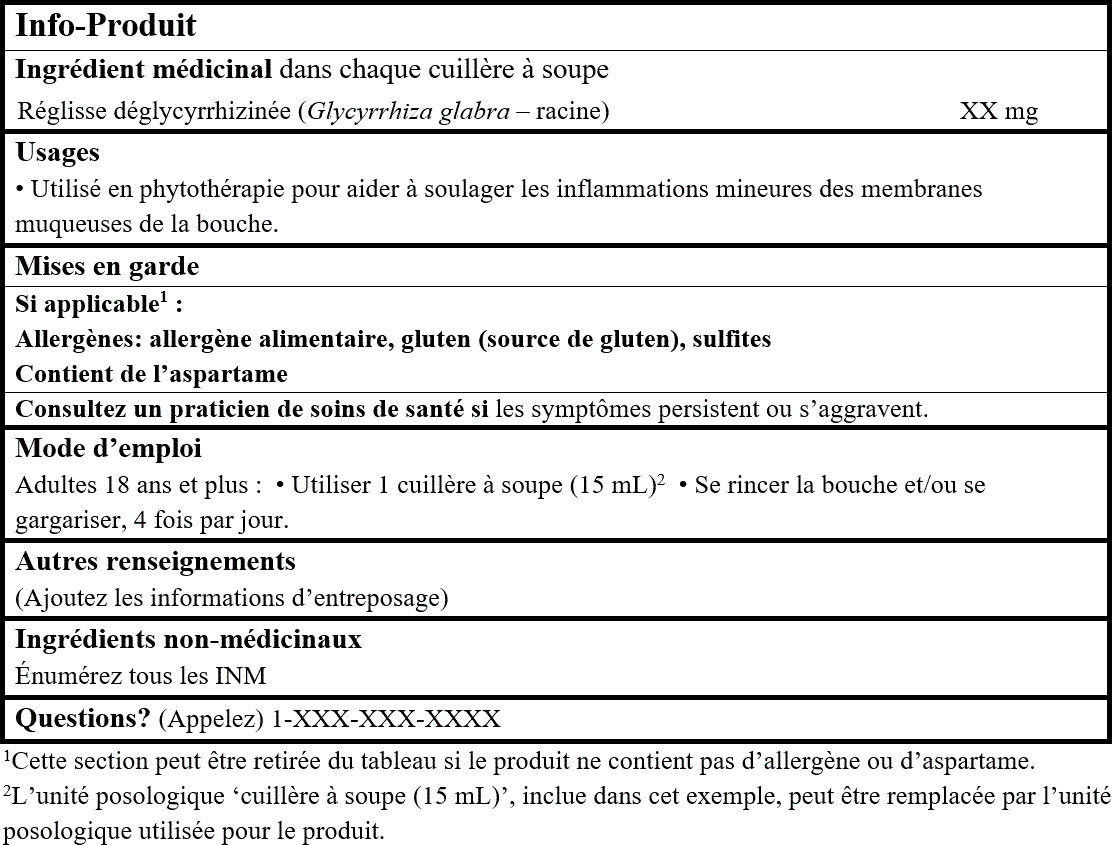
EXEMPLE D'INFO-PRODUIT :
Veuillez consulter la ligne directrice, Étiquetage des produits de santé naturels pour plus de détails.
Références Citées
- BDIPSN 2025 : Base de données d'ingrédients de produits de santé naturels. Direction des produits de santé et sans ordonnance. [Consulté le 10 octobre 2025]. Disponible à : https://webprod.hc-sc.gc.ca/nhpid-bdipsn/?lang=fr
- Blumenthal M, Goldberg A, Brinkmann J, éditeurs. Herbal Medicine: Expanded Commission E Monographs. Boston (MA): Integrative Medicine Communications; 2000.
- Bove M. An Encyclopedia of Natural Healing for Children and Infants. New Canaan (CT): Keats Publishing, Incorporated; 1996.
- BP 2008: British Pharmacopoeia Commission. British Pharmacopoeia. Volume 2. London (GB): The Stationary Office; 2008.
- Bruneton J. Pharmacognosy, Phytochemistry, Medicinal Plants. 2e édition. Paris (FR) Lavoisier Publishing; 1999.
- Das SK, Das V, Gulati AK, Singh VP. Deglycyrrhizinated liquorice in aphthous ulcers. Journal of Association of Physicians of India 1989;37(10):647.
- JC 2024: Justice Canada. Règlement sur les aliments et drogues. (C.01.021). Ottawa (ON): Justice Canada; 2024. [Consulté le 26 septembre 2024] Disponible à : http://laws- lois.justice.gc.ca/fra/reglements/C.R.C.%2C_ch._870/page-95.html
- McIntyre A. Herbal Treatment of Children ‐ Western and Ayurvedic Perspectives. Toronto (ON): Elsevier Limited; 2005.
- Ph. Eur. 2008: European Pharmacopoeia Commission. 2008. European Pharmacopoeia, 6e édition, Volume 2. Strasbourg (FR): Directorate for the Quality of Medicines and HealthCare of the Council of Europe (EDQM).
- Pizzorno Jr JEP, Murray MT. Textbook of Natural Medicine. 3rd edition. Volume 1. St Louis (MI), Churchill Livingstone Elsevier; 2006.
- PPRC 2020: Pharmacopoeia of the People's Republic of China, Volume 1, English edition. Beijing (CN): The State Pharmacopoeia Commission of the People's Republic of China; 2020.
- Schilcher H. Phytotherapy in Paediatrics: Handbook for Physicians and Pharmacists. Stuttgart (DE): Medpharm Scientific Publishers; 1997.
- USDA 2025: United States Department of Agriculture, Agricultural Research Service (USDA ARS), Germplasm Resources Information Network (GRIN) – Global. U.S. National Plant Germplasm System. [Consulté le 10 octobre 2025]. Disponible à : https://npgsweb.ars-grin.gov/gringlobal/taxon/taxonomysearch
- USP-NF 2024: United States Pharmacopeia and the National Formulary. Rockville (MD): United States Pharmacopeial Convention, Inc.; 2024.
Références Consultées
- Agarwal A, Gupta D, Yadav G, Goyal P, Singh PK, Singh U. An evaluation of the efficacy of licorice gargle for attenuating postoperative sore throat: a prospective, randomized, singleblind study. Ambulatory Anesthesiology 2009;109(1):77-81.
- Anonymous. Treatment of duodenal ulcer with glycyrrhizinic-acid-reduced liquorice. British Medical Journal 1971;3:501-503.
- Bardhan KD, Cumberland DC, Dixon RA, Holdsworth CD. Clinical trial of deglycyrrhizinised liquorice in gastric ulcer. Gut 1978;19:779-782.
- Blumenthal M. The ABC Clinical Guide to Herbs. New York (NY): Thieme; 2003.
- Brayfield A, Cadart C, éditeurs. Martindale: The Complete Drug Reference. London (GB): Pharmaceutical Press; 2024. [Consulté le 21 novembre 2024]. Disponible à : https://www.medicinescomplete.com/#/browse/martindale
- Brinker F. Herb Contraindications and Drug Interactions, 4e édition. Sandy (OR): Eclectic Medical Publications; 2010.
- Brogden RN, Speight TM, Avery GS. Deglycyrrhizinised liquorice: a report of its pharmacological properties and therapeutic efficacy in peptic ulcer. Drugs 1974;8(5):330-339.
- D'Imperio N, Piccari GG, Sarti F, Soffritti M, Spongano P, Benvenuti C, Dal Monte PR. Double-blind trial in duodenal and gastric ulcers: Cimetidine and deglycyrrhizinized liquorice. Acta Gastro-Enterologica Belgica 1978;41:427-434.
- Doll R, Langman MJS, Shawdon HH. Treatment of gastric ulcer with carbenoxolone: antagonistic effect of spironolactone. Gut 1968;9(1):42-45.
- Engqvist A, von Feilitzen F, Pyk E, Reichard H. Double-blind trial of deglycyrrhizinated liquorice in gastric ulcer. Gut 1973;14(9):711-715.
- Feldman H, Gilat T. A trial of deglycyrrhizinated liquorice in the treatment of duodenal ulcer. Gut 1971;12(6):449-451.
- Goldman L, Ausiello D, editors. CECIL Textbook of Medicine, 22e édition, Volume 1. Philadelphia (PA), Elsevier Inc; 2004.
- Kassir ZA. Endoscopic controlled trial of four drug regimens in the treatment of chronic duodenal ulceration. Irish Medical Journal 1985;78:153-156.
- Larkworthy W, Holgate PF. Deglycyrrhizinized liquorice in the treatment of chronic duodenal ulcer. A retrospective endoscopic survey of 32 patients. Practitioner 1975;215(1290):787-92.
- Martin MD, Sherman J, van der Ven P, Burgess J. A controlled trial of a dissolving oral patch concerning glycyrrhiza (licorice) herbal extract for the treatment of aphthous ulcers. General Denistry 2008;56(2):206-210: quiz 211-2, 224.
- Mills S, Bone K. The Essential Guide to Herbal Safety. St. Louis (MO): Churchill Livingstone; 2005.
- Morgan AG, Pacsoo C, McAdam WAF. Maintenance therapy: a two year comparison between Caved-S and cimetidine treatment in the prevention of symptomatic gastric ulcer recurrence. Gut 1985;26:599-602.
- Räikkönen K, Pesonen A-K, Heinonen K, Lahti J, Komsi N, Eriksson JG, Seckl JR, Järvenpää A-L, Strandberg TE. Maternal licorice consumption and detrimental cognitive and psychiatric outcomes in children. American Journal of Epidemiology 2009;170(9):1137-1146.
- Strandberg TE, Andersson S, Järvenpää AL, McKeigue PM. Preterm birth and licorice consumption during pregnancy. American Journal of Epidemiology 2002;156(9):803-805.
- Tewari SN, Trembalowicz FC. Some experience with deglycyrrhizinated liquorice in the treatment of gastric and duodenal ulcers with special reference to its spasmolytic effect. Gut 1968;9:48-51.