
Hawthorn
 (PDF Version - 51.3 KB)
This monograph is intended to serve as a guide to industry for the preparation of Product Licence Applications (PLA) and labels for natural health product market authorization. It is not intended to be a comprehensive review of the medicinal ingredient.
Note
- Text in parentheses is additional optional information which can be included on the label at the applicant's discretion.
- The solidus (/) indicates that either term and/or statement may be selected on the label.
Date
July 31, 2026
Proper name(s), Common name(s), Source information
| Proper name(s) | Common name(s) | Source information | ||
|---|---|---|---|---|
| Source material(s) | Part(s) | Preparation(s) | ||
| Crataegus laevigata |
|
Crataegus laevigata | Fruit |
|
| Flower and leaf | Dry | |||
| Crataegus monogyna |
|
Crataegus monogyna | Fruit |
|
| Flower and leaf | Dry | |||
References: Proper names: USDA 2025; Common names: Gardner and McGuffin 2013; Wichtl 2004; Source information: ESCOP 2009; Barnes 2007; Bradley 2006; Belz and Loew 2003; Degenring et al. 2003; ESCOP 2003; WHO 2002; Mills and Bone 2000; Grieve 1971.
Route Of Administration
Oral (ESCOP 2009; Bradley 2006; Mills and Bone 2000)
Dosage Form(s)
This monograph excludes foods or food-like dosage forms as indicated in the Compendium of Monographs Guidance Document.
Acceptable dosage forms for oral use are indicated in the dosage form drop-down list of the web-based Product Licence Application form for Compendial applications.
Use(s) or Purpose(s)
Fruit
Traditionally used in Herbal Medicine to help maintain and/or support cardiovascular health in adults (ESCOP 2009; Bradley 2006; Wichtl 2004; ESCOP 2003; WHO 2002; Mills and Bone 2000; Grieve 1971).
Fruit; Flower and leaf
Used in Herbal Medicine to help maintain and/or support cardiovascular health in adults (Bradley 2006; Wichtl 2004; Degenring et al. 2003; ESCOP 2003; WHO 2002; Mills and Bone 2000).
Notes
- For multi-ingredient products:
- To prevent the product from being represented as a "traditional medicine", any indicated traditional use claim must refer to the specific medicinal ingredient(s) and recognized traditional system of medicine from which the claim originates when 1) both traditional and modern claims are present or 2) when claims originate from multiple systems of traditional medicine (e.g. Hawthorn is traditionally used in Herbal Medicine to help maintain and support cardiovascular health in adults).
- When ALL of the medicinal ingredients (MIs) in the product are used within the SAME identified system of traditional medicine AND the product makes ONLY traditional claims, listing of MIs in the traditional claim(s) is not required.
Dose(s)
Subpopulation(s)
Adults 18 years and older
Quantity(ies)
Fruit
Traditional and Non-traditional Herbal Medicine claims
Methods of preparation: Powdered, Non-Standardized Ethanolic Extracts (Dry extract, Tincture, Fluid extract)
0.6 - 3.5 grams of dried fruit, per day (ESCOP 2009; Bradley 2006; Grieve 1971).
Methods of preparation: Dry*, Non-Standardized Aqueous Extracts (Dry extract, Decoction, Decoction concentrate, Infusion, Infusion concentrate)
1.5 - 6 grams of dried fruit, per day (EMA 2016; Bradley 2006; Mills and Bone 2000).
*Note: Dried fruit should be prepared as an infusion or decoction by consumers prior to use (see direction for use).
Non-traditional Herbal Medicine claim
Methods of preparation: Standardized Ethanolic Extracts (Liquid extract)
Liquid extract equivalent to 700 milligrams of fresh fruit per day, providing a minimum of 6.4 mg Oligomeric proanthocyanidins (OPC), per day (Degenring 2003).
Flower and leaf
Non-traditional Herbal Medicine claim
Methods of preparation: Dry*, Powdered, Non-Standardized Extracts (Dry extract, Tincture, Fluid extract, Decoction, Decoction concentrate, Infusion, Infusion concentrate)
1.5 - 5 grams of dried flower and leaf, per day (Bradley 2006; ESCOP 2003).
*Note: Dried flower and leaf should be prepared as an infusion or decoction by consumers prior to use (see direction for use).
Methods of preparation: Standardized Ethanolic Extracts (Dry extract)
160 - 900 milligrams of extract, per day, standardized to 18.75% of Oligomeric procyanidins, as epi-catechin, and/or to 2.2% of flavonoids, as hyperoside (WHO 2002; Blumenthal et al. 2000).
Direction(s) for use
Loose dosage form (for infusion/decoction)*
Place [insert volume to be measured by consumer, e.g., X teaspoons] of dried fruits/flowers and leaves in [insert the volume of water, e.g., ½ cup (125 mL)] of boiling/cold water. Infuse for [e.g., 5-15 minutes]/Bring to a boil and let simmer for [e.g., 10-20 minutes]. Strain and drink.
*Note: This direction of use statement can be modified on the label provided that it gives clear instructions to consumers.
Combination rule
The medicinal ingredients in Table 1 may be combined, provided that the total quantity of ingredients from the same source material part (fruits or flowers and leaves) remains within the range specified in the monograph. Combinations of ingredients from different source material parts are not permitted.
Duration of use
Use for at least 8 weeks to see beneficial effects (Mills and Bone 2000).
Risk Information
Caution(s) and warning(s)
- Ask a health care practitioner/health care provider/health care professional/doctor/physician if symptoms persist or worsen.
- Ask a health care practitioner/health care provider/health care professional/doctor/physician before use if you are taking cardiac glycosides (e.g., digoxin) or blood pressure or heart medications (Brinker 2010; Bradley 2006).
- Ask a health care practitioner/health care provider/health care professional/doctor/physician before use if you have chest pain, irregular heartbeat, or shortness of breath.
Contraindication(s)
No statement required.
Known adverse reaction(s)
No statement required.
Non-medicinal ingredients
Must be chosen from the current Natural Health Products Ingredients Database (NHPID) and must meet the limitations outlined in the database.
Storage conditions
Must be established in accordance with the requirements described in the Natural Health Products Regulations.
Specifications
- The finished product specification must be established in accordance with the requirements described in the Natural and Non-prescription Health Products Directorate (NNHPD) Quality of Natural Health Products Guide.
- The medicinal ingredient must comply with the requirements outlined in the NHPID.
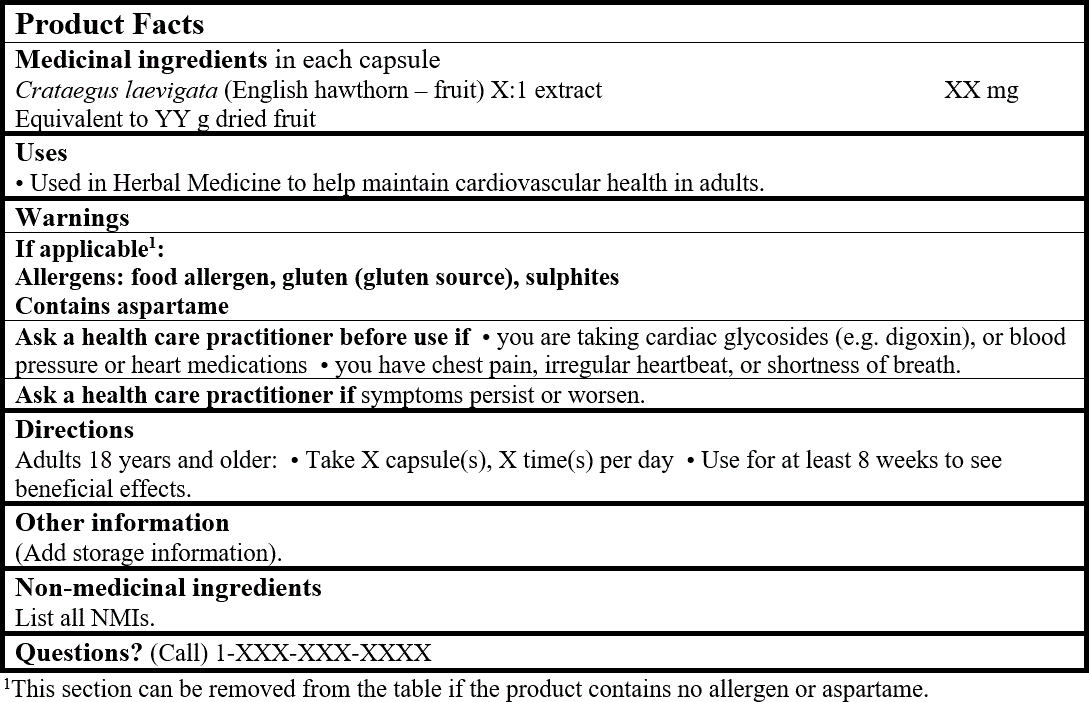
EXAMPLE OF PRODUCT FACTS:
Consult the Guidance Document, Labelling of Natural Health Products for more details.
References cited
- Belz GG, Loew D. Dose-response related efficacy in orthostatic hypotension of a fixed combination of D-camphor and an extract from fresh Crataegus berries and the contribution of the single components. Phytomedicine 2003;10(Supplement 4):61-67.
- Blumenthal M, Goldberg A, Brinkmann J, editors. Herbal Medicine: Expanded Commission E Monographs. Boston (MA): Integrative Medicine Communications; 2000.
- Bradley PR, editor. British Herbal Compendium: A Handbook of Scientific Information on Widely Used Plant Drugs, Volume 2. Bournemouth (GB): British Herbal Medicine Association; 2006.
- Brinker F. Herb Contraindications and Drug Interactions, 4th edition. Sandy (OR): Eclectic Medical Publications; 2010.
- Degenring FH, Suter A, Weber M, Saller R. A randomised double blind placebo controlled clinical trial of a standardised extract of fresh Crataegus berries (Crataegisan) in the treatment of patients with congestive heart failure NYHA II. Phytomedicine 2003;10(5):363-369.
- EMA 2016: EMA/HMPC/159075/2014. European Union herbal monograph on Crataegus spp., folium cum flore. London (GB): European Medicines Agency: Committee on Herbal Medicinal Products (HMPC); 2016 April 5. [Accessed 2026 June 29]. Available from: https://www.ema.europa.eu/en/documents/herbal-monograph/final-european-union-herbal-monograph-crataegus-spp-folium-cum-flore_en.pdf
- ESCOP 2009: European Scientific Cooperative on Phytotherapy Scientific Committee. ESCOP Monographs: The Scientific Foundation for Herbal Medicinal Products, 2nd edition, Supplement 2009. Exeter (GB): European Scientific Cooperative on Phytotherapy in collaboration with Thieme.
- ESCOP 2003: European Scientific Cooperative on Phytotherapy Scientific Committee. ESCOP Monographs: The Scientific Foundation for Herbal Medicinal Products, 2nd edition. Exeter (GB): European Scientific Cooperative on Phytotherapy in collaboration with Thieme.
- Gardner Z, McGuffin M, editors. American Herbal Products Association's Botanical Safety Handbook. 2nd edition. Boca Ration (FL): Taylor and Francis Group; 2013.
- Grieve M. A Modern Herbal, Volume 1. New York (NY): Dover Publications; 1971 [Reprint of 1931 Harcourt, Brace & Company publication].
- Mills S, Bone K. Principles and Practice of Phytotherapy. Toronto (ON): Churchill Livingstone; 2000.
- USDA 2025: United States Department of Agriculture Agricultural Research Service (USDA ARS), Germplasm Resources Information Network (GRIN) - Global. U.S. National Plant Germplasm System. [Accessed 2026 June 29]. Available from: https://npgsweb.ars-grin.gov/gringlobal/taxon/taxonomysearch
- WHO 2002: World Health Organization. WHO Monographs on Selected Medicinal Plants, Volume 2. Geneva (CH): World Health Organization; 2002.
- Wichtl M, editor. Herbal Drugs and Phytopharmaceuticals: A Handbook for Practice on a Scientific Basis, 3rd edition. Stuttgart (DE): Medpharm GmbH Scientific Publishers; 2004.
References reviewed
- Barnes J, Anderson LA, Philipson JD. Herbal Medicines, 3rd edition. London (GB): The Pharmaceutical Press; 2007.
- Ellingwood F. American Materia Medica, Therapeutics and Pharmacognosy. Sandy (OR): Eclectic Medical Publications; 1998 [Reprint of 1919 original].
- Felter HW, Lloyd JU. King's American Dispensatory, Volume 1, 18th edition. Sandy (OR): Eclectic Medical Publications; 1983 [Reprint of 1898 original].
- Godfrey A, Saunders PR, Barlow K, Gilbert C, Gowan M, Smith F. Principles and Practices of Naturopathic Botanical Medicine. Volume 1: Botanical Medicine Monographs. Toronto (ON): CCNM Press; 2010.
- Hoffmann D. Medical Herbalism: The Science and Practice of Herbal Medicine. Rochester (VT): Healing Arts Press; 2003.
Version History
| Publication date | Update type | Summary of main updates (from July 2026) |
|---|---|---|
| 2026-07-31 | Minor updates |
|
| 2021-07-30 | Validation | – |
| 2013-07-18 | Minor updates | – |
| 2010-04-16 | Initial release | – |