
DRIED CRANBERRY JUICE
 (PDF Version - 73.5 KB)
This monograph is intended to serve as a guide to industry for the preparation of Product Licence Applications (PLAs) and labels for natural health product market authorization. It is not intended to be a comprehensive review of the medicinal ingredient.
Notes
- Text in parentheses is additional optional information which can be included on the label at the applicant's discretion.
- The solidus (/) indicates that either term and/or statement may be selected on the label.
Date
March 27, 2026
Proper name(s), Common name(s), Source information
| Proper name(s) | Common name(s) | Source information | ||
|---|---|---|---|---|
| Source material(s) | Part(s) | Preparation(s) | ||
| Vaccinium macrocarpon |
|
Vaccinium macrocarpon | Fruit | Dry |
References: Proper name: USDA 2024; Gardner and McGuffin 2013; Common names: Jepson and Craig 2008; Mills and Bone 2005; Stothers 2002; Upton 2002; Siciliano 1996; Source information: Jepson and Craig 2008; Mills and Bone 2005; Stothers 2002; Upton 2002; Siciliano 1996.
Route of administration
Oral
Dosage form(s)
This monograph excludes foods or food-like dosage forms as indicated in the Compendium of Monographs Guidance Document.
Acceptable dosage forms for oral use are indicated in the dosage form drop-down list of the web-based Product Licence Application form for Compendial applications.
Use(s) or Purpose(s)
- Source of antioxidants/Provides antioxidants (Valentenova et al. 2007; Ruel et al. 2005; Upton 2002).
- Source of antioxidants/Provides antioxidants that help fight/protect (cell) against/reduce (the oxidative effect of/the oxidative damage caused by/cell damage caused by) free radicals (Valentenova et al. 2007; Ruel et al. 2005; Upton 2002).
- (Traditionally) used in Herbal Medicine to help prevent (recurrent) urinary tract infections (UTIs) (in women) (Barnes et al. 2007; Bruyère 2006; Mills and Bone 2005; Blumenthal et al. 2003; Bodel et al. 1959).
- Helps prevent (recurrent) urinary tract infections (UTIs) (in women) (Jepson and Craig 2008; Stothers 2002; Walker et al. 1997; Avorn et al. 1994).
Notes
- The above uses can be combined on the product label if from the same traditional or non-traditional system of medicine (e.g., Source of antioxidants and helps prevent recurrent urinary tract infections in women).
- For multi-ingredient products:
- To prevent the product from being represented as a "traditional medicine", any indicated traditional use claim must refer to the specific medicinal ingredient(s) and recognized traditional system of medicine from which the claim originates when 1) both traditional and modern claims are present or 2) when claims originate from multiple systems of traditional medicine (e.g., Dried cranberry juice is traditionally used in Herbal Medicine to help prevent urinary tract infections).
- When ALL of the medicinal ingredients (MIs) in the product are used within the SAME identified system of traditional medicine AND the product makes ONLY traditional claims, listing of MIs in the traditional claim(s) is not required.
Dose(s)
Subpopulation(s)
Adults 18 years and older
Quantity(ies)
Antioxidant
Method of preparation: Juice powdered
Not to exceed 1,200 milligrams of dried fruit juice, per day (Valentenova et al. 2007; Upton 2002).
(Recurrent) urinary tract infection
Method of preparation: Juice powdered
400 – 1,200 milligrams of dried fruit juice, per day (Mills and Bone 2005; Upton 2002; Walker et al. 1997).
Note: Applicants are not to provide a quantity of crude equivalent (QCE) and/or extract ratio.
Direction(s) for use
No statement required.
Duration(s) of use
Antioxidant
No statement required.
(Recurrent) urinary tract infection
Use for at least 4 weeks to see beneficial effects (Jepson and Craig 2008; Blumenthal et al. 2003; Walker et al. 1997; Avorn et al. 1994).
Risk information
Caution(s) and warning(s)
All products
- Ask a health care practitioner/health care provider/health care professional/doctor/physician before use if you have a history of kidney stones (Gettman et al. 2005; Terris et al. 2001).
- Ask a health care practitioner/health care provider/health care professional/doctor/physician before use if you are taking blood thinners (Brinker 2010; Aston et al. 2006; Rindone and Murphy 2005; Grant 2004).
(Recurrent) urinary tract infection
Ask a health care practitioner/health care provider/health care professional/doctor/physician if symptoms persist or worsen.
Contraindication(s)
No statement required.
Known adverse reaction(s)
No statement required.
Non-medicinal ingredients
Must be chosen from the current Natural Health Products Ingredients Database (NHPID) and must meet the limitations outlined in the database.
Storage conditions
Must be established in accordance with the requirements described in the Natural Health Products Regulations.
Specifications
- The finished product specification must be established in accordance with the requirements described in the Natural and Non-prescription Health Products Directorate (NNHPD) Quality of Natural Health Products.
- The medicinal ingredient must comply with the requirements outlined in the NHPID.
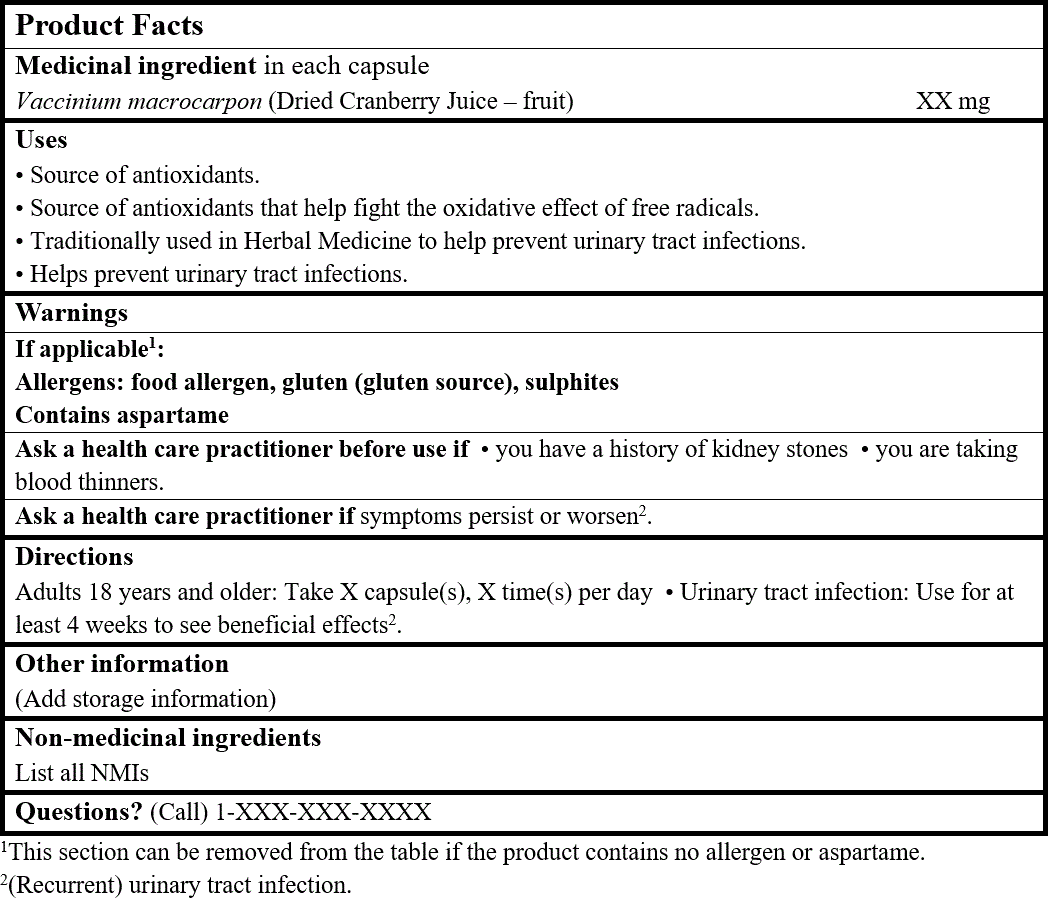
EXAMPLE OF PRODUCT FACTS:
Consult the Guidance Document, Labelling of Natural Health Products for more details.
References cited
- Aston JL, Lodolce AE, Shapiro NL. Interaction between warfarin and cranberry juice. Pharmacotherapy 2006;26(9):1314-1319.
- Avorn J, Monane M, Gurwitz JH, Glynn RJ, Choodnovskiy I, Lipsitz LA. Reduction of bacteriuria and pyuria after ingestion of cranberry juice. Journal of the American Medical Association 1994;271(10):751-754.
- Barnes J, Anderson LA, Phillipson JD. Herbal Medicines, 3rd edition. London (GB): Pharmaceutical Press; 2007.
- Blumenthal M, Hall T, Goldberg A, Kunz T, Kinda K, editors. The ABC Clinical Guide to Herbs. Austin (TX): American Botanical Council; 2003.
- Bodel PT, Cotron R, Kass EH. Cranberry juice and the antibacterial action of hippuric acid. The Journal of Laboratory and Clinical Medicine 1959;54(6):881-888.
- Brinker F. Herb Contraindications and Drug Interactions, 4th edition. Sandy (OR): Eclectic Medical Publications; 2010.
- Bruyère F. Utilisation de la canneberge dans les infections urinaires récidivantes. Médecine et Maladies Infectieuses 2006;36(7):358-363.
- Gardner Z, McGuffin M, editors. American Herbal Products Association's Botanical Safety Handbook. 2nd edition. Boca Ration (FL): Taylor and Francis Group; 2013.
- Gettman MT, Ogan K, Brinkley LJ, Adams-Huet B, Pak CYC, Pearle MS. Effect of cranberry juice consumption on urinary stone risk factors. The Journal of Urology 2005;174(2):590-594.
- Grant P. Warfarin and cranberry juice: an interaction? The Journal of Heart Valve Disease 2004;13(1):25-26.
- Jepson RG, Craig JC. Cranberries for preventing urinary tract infections. Cochrane Database of Systematic Reviews 2008;Issue 3. Art. No.: CD001321. DOI: 10.1002/14651858.CD001321.pub4.
- Mills S, Bone K. The Essential Guide to Herbal Safety. St Louis (MI): Elsevier Inc. Rindone JP, Murphy TW. 2005. Warfarin-cranberry juice interaction resulting in profound hypoprothrombinemia and bleeding. American Journal of Therapeutics 2005;13(3):283-284.
- Ruel G, Pomerleau S, Bouture P, Lamarche B, Couillard C. Changes in plasma antioxidant capacity and oxidized low-density lipoprotein levels in men after short-term cranberry juice consumption. Metabolism: Clinical and Experimental 2005;54(7):856-861.
- Siciliano A. Cranberry. Herbalgram 1996;38:51-54.
- Stothers L. A randomized trial to evaluate effectiveness and cost effectiveness of naturopathic cranberry products as prophylaxis against urinary tract infection in women. The Canadian Journal of Urology 2002;9(3):1558-1562.
- Terris MK, Issa MM, Tacker JR. Dietary supplementation with cranberry concentrate tablets may increase the risk of nephrolithiasis. Urology 2001;57(1):26-29.
- Upton R, editor. American Herbal Pharmacopoeia and Therapeutic Compendium: Cranberry Fruit (Vaccinium macrocarpon Aiton) – Standards of Analysis, Quality Control, and Therapeutics. Santa Cruz (CA): American Herbal Pharmacopoeia; 2002.
- USDA 2024: United States Department of Agriculture, Agricultural Research Service (USDA ARS), Germplasm Resources Information Network (GRIN) – Global. U.S. National Plant Germplasm System. [Accessed 2024 September 11]. Available from: https://npgsweb.ars-grin.gov/gringlobal/taxon/taxonomysearch
- Valentenova K, Stejskal D, Bednar P, Vostalova J, Cihalik C, Vecerova R, Koukalova D, Kolar M, Reichenbach R, Sknouril L, Ulrichova J, Simanek V. Biosafety, antioxidant status, and metabolites in urine after consumption of dried cranberry juice in healthy women: a pilot double blind placebo-controlled trial. Journal of Agricultural and Food Chemistry 2007;55(8):3217-3224.
- Walker EB, Barney DP, Mickelsen JN, Walton RJ, Mickelsen RA. 1997. Cranberry concentrate: UTI prophylaxis. The Journal of Family Practice 1997;45(2):167-168.
References reviewed
- Barnes J, Anderson LA, Philipson JD. Herbal Medicines: A Guide for Healthcare Professionals, 2nd edition. London (GB): The Pharmaceutical Press; 2002.
- Blatherwick NR, Long ML. Studies of urinary acidity. II. The increased acidity produced by eating prunes and cranberries. The Journal of Biological Chemistry 1923;57(3):815-818.
- Boon H, Smith MJ. The Complete Natural Medicine Guide to the 50 Most Common Medicinal Herbs, 2nd edition. Toronto (ON): Robert Rose Inc; 2004.
- Brown DJ. Herbal Prescriptions for Better Health. Rocklin (CA): Prima Publishing; 1996.
- Chandler F, editor. Cranberry. In: Herbs: Everyday Reference for Health Professionals. Ottawa (ON): Canadian Pharmacists Association and the Canadian Medical Association; 2000.
- Di Martino P, Agniel R, David K, Templer C, Gaillard JL, Denys P, Botto H. Reduction of Escherichia coli adherence to uroepithelial bladder cells after consumption of cranberry juice: a double-blind randomized placebo-controlled cross-over trial. World of Urology 2006;24(1):21-27.
- Fetrow CW, Avila JR. Professional's Handbook of Complementary and Alternative Medicines, 3rd edition. Philadelphia (PA): Lippincott Williams and Wilkins; 2004.
- Foster S, Tyler VE. Tyler's Honest Herbal: A Sensible Guide to the Use of Herbs and Related Remedies, 4th edition. Binghamton (NY): Haworth Herbal Press; 1999.
- Gibson L, Pike L, Kilbourn JP. Clinical study: effectiveness of cranberry juice in preventing urinary tract infections in Long-Term Care Facility patients. The Journal of Naturopathic Medicine 1991;2(1):45-47.
- Gotteland M, Andrews M, Toledo M, Munoz L, Caceres P, Anziani A, Wittig E, Speisky H, Salazar G. Modulation of Helicobacter pylori colonization with cranberry juice and Lactobacillus johnsonii La1 in children. Nutrition 2008;24(5):421-426.
- Greenblatt DJ, von Moltke LL, Perloff ES, Luo Y, Harmatz JS, Zinny MA. Interaction of flurbiprofen with cranberry juice, grape juice, tea, and fluconazole: in vitro and clinical studies. Clinical Pharmacology and Therapeutics 2006;79(1):125-133.
- Greenblatt DJ, von Moltke LL. Interaction of warfarin with drugs, natural substances, and foods. Journal of Clinical Pharmacology 2006;45(2):127-132.
- Griffiths J, Murty M, Pilon K. 2004. Suspected warfarin-cranberry juice interaction [online]. Ottawa (ON): Health Products and Food Branch, Marketed Health Products Directorate, Health Canada, Canadian Adverse Reaction Newsletter. 2004 [Accessed 2024 September 11]. Available from: http://www.hc-sc.gc.ca/dhp-mps/medeff/bulletin/carn-bcei_v14n3_e.html
- Haverkorn MJ, Mandigers J. Reduction of bacteriuria and pyuria using cranberry juice [letter]. Journal of the American Medical Association 1994;272(8):590.
- Henig YS, Leahy MM. Cranberry juice and urinary tract health: science supports folklore. Nutrition 2000;16(17/18):684-687.
- Jellin JM, Batz F, Hitchens K, editors. Pharmacist's Letter/Prescriber's Letter Natural Medicines Comprehensive Database. Stockton (CA): Therapeutic Research Faculty; 2003.
- Jepson RG, Milhaljevic L, Craig J. Cranberries for preventing urinary tract infections. Cochrane Database of Systematic Reviews 2004;Issue 2. Art. No.: CD001321. DOI: 10.1002/14651858.CD001321.pub3.
- Lavigne JP, Bourg G, Combescure C, Botto H, Sotto A. In-vitro and in-vivo evidence of dose-dependant decrease of uropathogenic Escherichia coli virulence after consumption of commercial Vaccinium macrocarpon (cranberry) capsules. Clinical Microbiology and Infection: The Official Publication of the European Society of Clinical Microbiology and Infectious Diseases 2008;14(4):350-355.
- Lilja JJ, Backman JT, Neuvonen PJ. Effects of daily ingestion of cranberry juice on the pharmacokinetics of warfarin, tizanidine, and midazolam – probes of CYP2C9, CYP1A2, and CYP3A4. Clinical Pharmacology and Therapeutics 2007;81(6):833-839.
- McHarg T, Rodgers A, Charlton K. Influence of cranberry juice on the urinary risk factors for calcium oxalate kidney stone formation. British Journal of Urology 2001;87(4):307-311.
- McMurdo ME, Bissett LY, Price RJ, Phillips G, Crombie IK. Does ingestion of cranberry juice reduce symptomatic urinary tract infections in older people in hospital? A double-blind, placebo-controlled trial. Age and Ageing 2005;34(3):256-261.
- Nowack R. Cranberry juice – a well-characterized folk-remedy against bacterial urinary tract infection. Wiener Medizinische Wochenschrift 2007;157(13/14):325-330.
- Pedersen CB, Kyle J, Jenkinson A McE, Gardner PT, McPhail DB, Duthie GG. Effects of blueberry and cranberry juice consumption on the plasma antioxidant capacity of health female volunteers. European Journal of Clinical Nutrition 2000;54(5):405-408.
- Shamseer L, Vohra S. Complementary, holistic, and integrative medicine: cranberry. Pediatrics in Review/American Academy of Pediatrics 2007;28(8):e43-e45.
- Shmuely H, Yahav J, Samra Z, Chodick G, Koren R, Niv Y, Ofek I. Effect of cranberry juice on eradication of Helicobacter pylori in patients treated with antibiotics and a proton pump inhibitor. Molecular Nutrition & Food Research 2007;51(6):746-751.
- Sobota AE. Inhibition of bacterial adherence by cranberry juice: potential use for the treatment of urinary tract infections. Journal of Urology 1984;131(5):1013-1016.
- Suvarna R, Pirmohamed M, Henderson L. Possible interaction between warfarin and cranberry juice. British Medical Journal 2003;327(7429):1454.
- Vinson JA, Bose P, Proch J, Al Kharrat H, Samman N. Cranberries and cranberry products: powerful in vitro, ex vivo, and in vivo sources of antioxidants. Journal of Agricultural and Food Chemistry 2008;56(14):5884-5891.
- Wiersema J, Léon B. World Economic Plants: A Standard Reference. Boca Raton (FL): CRC Press LLC; 1999.
- Yarnell E. Botanical medicine for cystitis. Alternative Complementary Therapy 1997;3(4):269- 275.
- Zhang L, Ma J, Pan K, Go VLW, Chen J, You W. Efficacy of cranberry juice on Helicobacter pylori infection: a double-blind, randomized placebo-controlled trial. Helicobacter 2005;10(2):139-145.
Version History
| Publication date | Update type | Summary of main updates (from March 2026) |
|---|---|---|
| 2026-03-27 | Minor updates |
|
| 2022-09-29 | Minor updates | – |
| 2018-12-18 | Validation (dried fruit juice) | – |
| 2009-06-19 | Minor updates (fruit, fruit juice and dried fruit juice) | – |