
CAYENNE - CAPSICUM ANNUUM/CAPSAICIN
Topical
 (PDF Version - 81 KB)
This monograph is intended to serve as a guide to industry for the preparation of Product Licence Applications (PLAs) and labels for natural health product market authorization. It is not intended to be a comprehensive review of the medicinal ingredient.
Notes
- Text in parentheses is additional optional information which can be included on the label at the applicant's discretion.
- The solidus (/) indicates that either term and/or statement may be selected on the label.
Restrictions when this monograph is combined with other monographs (Class II and III applications):
- Counterirritants such as capsaicin/cayenne cannot be combined with other ingredients if the conditions of use are not compatible between monographs (e.g., products to be applied to irritated skin such as hydroquinone, medicated skin care, diaper rash products). These products must be submitted as a Class III application along with evidence to support their safety and efficacy.
Date
March 27, 2026
Proper name(s), Common name(s), Source Information
| Proper name(s) | Common name(s) | Source information | |||
|---|---|---|---|---|---|
| Source ingredient(s) | Source material(s) | Part(s) | Preparation(s) | ||
| Capsicum annuum |
|
N/A | Capsicum annuum | Fruit | Dry |
|
Capsaicin | Capsaicin1 | Capsicum annuum | Fruit | N/A |
| Capsaicin2 | N/A | N/A | N/A | ||
References: Proper names: NIH 2024; USDA 2024; USP-NF 2024; Common names: NIH 2024; Gardner and McGuffin 2013; Blumenthal et al. 2000; Source information: USP-NF 2024; Bradley 2006; Felter and Lloyd 1983.
1Isolate
2Synthetic
Route of Administration
Topical
Dosage Form(s)
The following dosage forms are acceptable when used according to the requirements indicated in this monograph: Cream; Emulsion; Fluid extract; Foam; Gel; Liniment; Liquid; Oil; Ointment; Salve; Solution; Spray; Spray, suspension; Suspension; Tincture; Topical liquid; Wipe.
Use(s) or Purpose(s)
Cayenne powder or extracts
Used in Herbal Medicine (as a rubefacient/counterirritant) to help (temporarily) relieve the symptoms of rheumatism and/or muscle and joint pain (Blumenthal et al. 2000; Lust 1987; BHP 1983; Ellingwood 1983; Felter 1983; Felter and Lloyd 1983; BPC 1934).
Cayenne extracts or Capsaicin (isolate; synthetic)
- Temporarily relieves aches and pains/soreness of muscles and joints (associated with one or more of the following: simple backache, lumbago, strains and sprains (involving muscles, tendons, and/or ligaments), and arthritis) (US FDA 2023; McCarthy et al. 1992; Deal et al. 1991).
- Temporarily relieves skin (cutaneous) pain associated with conditions such as post-herpetic neuralgia and/or diabetic neuropathy (Hautkappe et al. 1998; Watson et al. 1993; Tandan et al. 1992; Scheffler et al. 1991; The Capsaicin Study Group 1991; Bernstein et al. 1989).
Note: The above uses can be combined on the product label (e.g., Temporarily relieves aches and pains of muscles and joints and skin pain associated with conditions such as post-herpetic neuralgia or diabetic neuropathy).
Dose(s)
Subpopulation(s)
Children 2 to 11 years; Adolescents 12 to 17 years; Adults 18 years and older
Quantity(ies)
Cayenne powder or extracts
Herbal Medicine use
Methods of preparation: Powdered standardized, Standardized Extracts (Dry extract, Tincture, Fluid extract, Decoction, Decoction concentrate, Infusion, Infusion concentrate)
The percentage of the medicinal ingredient in the product formulation and the percentage of the potency constituent, capsaicin, in the medicinal ingredient are not restricted as long as the concentration of capsaicin in the finished product is equivalent to:
0.01 - 0.05% capsaicin (BHP 1983)1.
Cayenne extracts
Relief of muscle and joint pain
Methods of preparation: Standardized Extracts (Dry extract, Tincture, Fluid extract, Decoction, Decoction concentrate, Infusion, Infusion concentrate)
The percentage of the medicinal ingredient in the product formulation and the percentage of the potency constituent, capsaicin, in the medicinal ingredient are not restricted as long as the concentration of capsaicin in the finished product is equivalent to:
0.025 - 0.25% capsaicin (US FDA 2023; McCarthy et al. 1992; Deal et al. 1991).1
Relief of skin (cutaneous) pain
Methods of preparation: Standardized Extracts (Dry extract, Tincture, Fluid extract, Decoction, Decoction concentrate, Infusion, Infusion concentrate)
The percentage of the medicinal ingredient in the product formulation and the percentage of the potency constituent, capsaicin, in the medicinal ingredient are not restricted as long as the concentration of capsaicin in the finished product is equivalent to:
0.075% capsaicin (Watson1993; Tandan et al. 1992; Scheffler et al. 1991; The Capsaicin Study Group 1991; Bernstein et al. 1989).1
Capsaicin (isolate; synthetic)
Relief of muscle and joint pain
Methods of preparation: Isolate, Synthetic
0.025 - 0.25% capsaicin (US FDA 2023; McCarthy et al. 1992; Deal et al. 1991).
Relief of skin (cutaneous) pain
Methods of preparation: Isolate, Synthetic
0.075% capsaicin (Watson1993; Tandan et al. 1992; Scheffler et al. 1991; The Capsaicin Study Group 1991; Bernstein et al. 1989).
1Note: For standardized Cayenne fruit powder or extract, the percentage of capsaicin in the finished product should also be included on the product label (e.g., Cayenne extract (Capsicum annuum - fruit) 30%, standardized to 0.1% capsaicin is equivalent to 0.03% capsaicin in the finished product).
Direction(s) for use
All products
- Apply thinly and evenly to affected area(s), up to 4 times per day (US FDA 2023).
- Rub and/or massage into skin until solution vanishes (US FDA 2023).
- Do not apply to wounds or damaged skin (US FDA 2023).
- Do not tightly bandage (US FDA 2023).
- Do not apply with external heat, such as an electric heating pad, as this may result in excessive skin irritation or skin burn (Pray 2006; APhA 2002).
- Supervise children when they use this product (Ragucci et al. 2007; Love et al. 2004).
Products in spray or spray, suspension dosage form
Avoid inhaling or exposing others to spray (APhA 2002).
Combination rule
No permitted combinations between the ingredients listed in Table 1.
Duration(s) of Use
Use for at least 1-2 weeks to see beneficial effects (APhA 2002; McCarthy et al. 1992; Deal et al.1991).
Risk Information
Caution(s) and warning(s)
All products
- For external use only (US FDA 2023).
- When using this product avoid contact with the eyes and mucous membranes. If contact occurs, rinse thoroughly with water (US FDA 2023).
- Stop use and ask a health care practitioner/health care provider/health care professional/doctor/physician if symptoms persist, worsen, or re-occur within a few days (US FDA 2023).
- Keep out of the reach of children. If swallowed, call a poison control centre or get medical help right away (CPS 2008).
Contraindication(s)
No statement required.
Known adverse reaction(s)
All products
Stop use if headache, redness, rashes, burning discomfort and/or hypersensitivity occur (Brayfield and Cadart 2024; Zhang et al. 2008; Hoffman 2003; APhA 2002; McCleane 2000).
Non-medicinal ingredients
Must be chosen from the current Natural Health Products Ingredients Database (NHPID) and must meet the limitations outlined in the database.
Storage conditions
Must be established in accordance with the requirements described in the Natural Health Product Regulations.
Specifications
- The finished product specifications must be established in accordance with the requirements described in the Natural and Non-prescription Health Products Directorate (NNHPD) Quality of Natural Health Products Guide.
- The medicinal ingredient must comply with the requirements outlined in the NHPID.
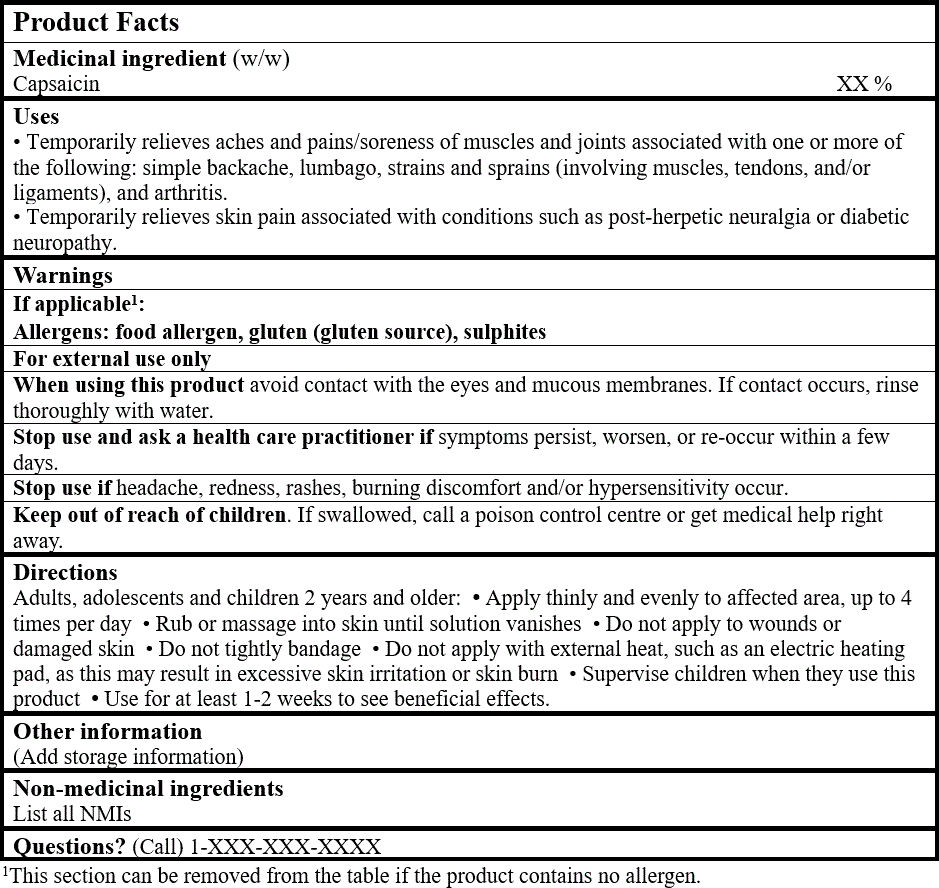
EXAMPLE OF PRODUCT FACTS:
Consult the Guidance Document, Labelling of Natural Health Products for more details.
References Cited
- APhA 2002: Berardi RR, DeSimone EM, Newton GGD, Oszko MA, Popovich NG, Rollins CJ, Shimp LA, Tietze KJ, editors. Handbook of Nonprescription Drugs: An interactive approach to self-care. 13th edition. Washington (DC): American Pharmaceutical Association; 2002.
- Bernstein JE, Korman NJ, Bickers DR, Dahl MV, Millikan LE. Topical capsaicin treatment of chronic postherpetic neuralgia. Journal of the American Academy of Dermatology 1989;21(2):265-270.
- BHP 1983: British Herbal Pharmacopoeia. Cowling (GB): British Herbal Medical Association; 1983.
- Blumenthal M, Goldberg A, Brinkmann J, editors. Herbal Medicine: Expanded Commission E Monographs. Boston (MA): Integrative Medicine Communications; 2000.
- BPC 1934: The British Pharmaceutical Codex: An imperial dispensatory for the use of medical practitioners and pharmacists. London (GB): The Pharmaceutical Press; 1934.
- Bradley PR, editor. British Herbal Compendium: A Handbook of Scientific Information on Widely Used Plant Drugs, Volume 2. Bournemouth (GB): British Herbal Medicine Association; 2006.
- Brayfield A, Cadart C, editors. Martindale: The Complete Drug Reference. London (GB): Pharmaceutical Press; 2024. [Accessed 2024 August 14]. Available from: https://www.medicinescomplete.com/#/browse/martindale
- CPS 2008: Repchinksy C, Welbanks L, Bhalla A, Fortin K, Jarvis B, Jovaisas B, Acharya S. Compendium of Pharmaceutical Specialties. Ottawa (ON): Canadian Pharmacists Association; 2008.
- Deal CL, Schnitzer TJ, Lipstein E, Seibold JR, Stevens RM, Levy MD, Albert D, Renold F.Treatment of arthritis with topical capsaicin: a double-blind trial. Clinical Therapeutics 1991;13(3):383-395.
- Ellingwood F. American Materia Medica, Therapeutics and Pharmacognosy. Sandy (OR): Eclectic Medical Publications; 1983 [Reprint of 1919 original].
- Felter HW. The Eclectic Materia Medica, Pharmacology and Therapeutics. Sandy (OR): Eclectic Medical Publications; 1983 [Reprint of 1922 original].
- Felter HW, Lloyd JU. King's American Dispensatory, Volume 1, 18th edition. Sandy (OR): Eclectic Medical Publications; 1983 [Reprint of 1898 original].
- Gardner Z, McGuffin M, editors. American Herbal Products Association's Botanical Safety Handbook. 2nd edition. Boca Raton (FL): Taylor and Francis Group; 2013.
- Hautkappe M, Roizen MF, Toledano A, Roth S, Jeffries JA, Ostermeier AM. Review of the effectiveness of capsaicin for painful cutaneous disorders and neural dysfunction. The Clinical Journal of Pain 1998;14(2):97-106.
- Hoffman D. Medical Herbalism: The Science and Practice of Herbal Medicine. Rochester (VT): Healing Arts Press; 2003.
- Lust J. The Herb Book. New York (NY): Bantam Books Incorporated, published by arrangement with Benedict Lust Publications; 1987.
- McCarthy GM, McCarty DJ. Effect of topical capsaicin in the therapy of painful osteoarthritis of the hands. Journal of Rheumatology 1992;19(4):604-607.
- McCleane G. Topical application of doxepin hydrochloride, capsaicin and a combination of both produces analgesia in chronic human neuropathic pain: a randomized, double-blind, placebo-controlled study. British Journal of Clinical Pharmacology 2000;49:574-579.
- Pray WS. Non-Prescription Product Therapeutics. 2nd edition. New York (NY): Lippincott Williams & Wilkins; 2006.
- NIH 2024: National Institutes of Health. PubChem. Bethesda (MD): National Library of Medicine, US Department of Health & Human Services. [Accessed 2024 October 30]. Available from: https://pubchem.ncbi.nlm.nih.gov/
- Scheffler NM, Sheitel PL, Lipton MN. Treatment of painful diabetic neuropathy with capsaicin 0.075%. Journal of the American Podiatric Medical Association 1991;81(6):288-293.
- Tandan R, Lewis GA, Krusinski PB, Badger GB, Fries TJ. Topical capsaicin in painful diabetic neuropathy. Controlled study with long-term follow-up. Diabetes Care 1992;15(1):8-14.
- The Capsaicin Study Group. Treatment of painful diabetic neuropathy with topical capsaicin. A multicenter, double-blind, vehicle-controlled study. Archives of Internal Medicine 1991;151(11):2225-2229.
- USDA 2024: United States Department of Agriculture, Agricultural Research Service (USDA ARS), Germplasm Resources Information Network (GRIN). Global. U.S. National Plant Germplasm System. [Accessed 2024 August 14]. Available from: https://npgsweb.ars-grin.gov/gringlobal/taxon/taxonomysearch
- US FDA 2023: United States Food and Drug Administration. Over-the-Counter Monograph M017: External Analgesics Drug Products for Over-the-Counter Human Use. Washington (DC): U.S. Food and Drug Administration, Department of Health and Human Services. [Accessed 2026 February 27]. Available from: https://www.accessdata.fda.gov/drugsatfda_docs/omuf/monographs/OTC%20Monograph_M017-External%20Analgesic%20Drug%20Products%20for%20OTC%20Human%20Use%2005.02.2023.pdf
- USP-NF 2024: United States Pharmacopeia and the National Formulary. Rockville (MD): United States Pharmacopeial Convention, Inc.; 2024.
- Watson CP, Tyler KL, Bickers DR, Millikan LE, Smith S, Coleman E. A randomized vehicle-controlled study of tropical capsaicin in the treatment of post-herpetic neuralgia. Clinical Therapeutics 1993;15(3):510-526.
- Zhang W, Moskowitz, RW, Nuki G, Abramson S, Altman RD, Arden N, Bierma-Zeinstra S, Brandt KD, Croft P, Doherty M, Dougados M, Hochberg M, Hunter DJ, Kwoh K, Lohmander LS, Tugwell P. OARSI recommendations for the management of hip and knee osteoarthritis, Part II: OARSI evidence-based, expert consensus guidelines. Osteoarthritis and Cartilage 2008;16:137-162.
References Reviewed
- Ahuja KDK, Robertson IK, Geraghty DP, Ball MJ. The effect of 4-week chilli supplementation on metabolic and arterial function in humans. European Journal of Clinical Nutrition 2007;61(3):326-333.
- Barnes J, Anderson LA, Philipson JD. Herbal Medicines, 3rd edition. London (GB): The Pharmaceutical Press; 2007.
- Bernstein JE, Bickers DR, Dahl MY, Roshal JY. Treatment of chronic post-herpetic neuralgia with topical capsaicin. A preliminary study. Journal of the American Academy of Dermatology 1987;17(1):93-96.
- Bortolotti M, Coccia G, Grossi G, Miglioli M. Treatment of functional dyspepsia with red pepper. Alimentary Pharmacology and Therapeutics 2002;16(6):1075-1082.
- Charkoudian N, Fromy B, Saumet JL. Reflex control of the cutaneous circulation after acute and chronic local capsaicin. Journal of applied physiology 2001;90(5):1860-1864.
- Deng PY, Li YJ. Calcitonin gene-related peptide and hypertension. Peptides 2005;26(9):1676-1685.
- Desai HG, Venugopalan K, Anita FP. Effect of red chilli powder on the DNA content of gastric aspirates. Gut 1973;14:974-976.
- Ferrell WR, Wong BB, Lockhart JC, Ramsay JE. Gender differences in regional cutaneous microcirculatory responses to capsaicin. Fundamentals of Clinical Pharmacology 2004;18(2):195-200.
- Gupta S, Lozano-Cuenca J, Villalón CM, de Vries R, Garrelds IM, Avezaat CJ, van Kats JP, Saxena PR, MaassenVanDenBrink A. Pharmacological characterisation of capsaicin induced relaxations in human and porcine isolated arteries. Naunyn-Schmiedeberg's archives of pharmacology 2007;375(1):29-38.
- Heck AM, DeWitt BA, Lukes AL. Potential interactions between alternative therapies and warfarin. American Journal of Health-System Pharmacy 2000;57(13):1221-1227.
- Helme RD, McKernan S. Neurogenic flare responses following topical application of capsaicin in humans. Annals of Neurology 1985;18(4):505-509.
- Hogaboam CM, Wallace JL. Inhibition of platelet aggregation by capsaicin. An effect unrelated to actions in sensory afferent neurons. European Journal of Pharmacology 1991;202(1):129-131.
- Johnson W. Final report on the safety assessment of Capsicum Annuum extract, Capsicum Annuum fruit extract, capsicum Annuum Resin, Capsicum Annuum fruit powder, Capsicum Frutescens resin, and Capsaicin. International Journal of Toxicology 2007;26(Supplement 1):3-106.
- Joliffe VA, Anand P, Kidd BL. Assessment of cutaneous sensory and autonomic axon reflexes in rheumatoid arthritis. Annals of the Rheumatic Diseases 1995;54(4):251-255.
- Kumar N, Vij JC, Sarin SK, Anand BS. Do chillies influence healing of duodenal ulcer? British Medical Journal 1984;288(6433):1803-1804.
- Lee YS, Kho HS, Kim YK, Chung SC. Influence of topical capsaicin on facial sensitivity in response to experimental pain. Journal of Oral Rehabilitation 2007;34(1):9-14.
- Matucci-Cerinic M, Marabini S, Jantsch S, Cagnoni M, Partsch G. Effects of capsaicin on the metabolism of rheumatoid arthritis synoviocytes in vitro. Annals of the Rheumatic Diseases 1990;49(8):598-602.
- Morris VH, Cruwys SC, Kidd BL. Characterization of capsaicin induced mechanical hyperalgesia as a marker for altered nociceptive processing in patients with rheumatoid arthritis. Pain 1997;71(2):179-186.
- Rodriguez-Stanley S, Collings KL, Robinson M, Owen W, Miner PB. The effects of capsaicin on reflux, gastric emptying and dyspepsia. Alimentary Pharmacology and Therapeutics 2000;14(1):129-134.
- Satyanarayana MN. Capsaicin and gastric ulcers. Critical Reviews of Food Science and Nutrition 2006;46(4):275-328.
- Schnitzer TJ, Morton C, Coker S, Flynn P. Effectiveness of reduced applications of topical capsaicin (0.025%) cream in osteoarthritis. Arthritis and Rheumatism 1992;35:S132.
- Shalansky S, Lynd L, Richardson K, Ingaszewski A, Kerr C. Risk of warfarin-related bleeding events and supratherapeutic international normalized ratios associated with complementary and alternative medicine: a longitudinal analysis. Pharmacotherapy 2007;27(9):1237-1247.
- Simone DA, Ochoa J. Early and late effects of prolonged topical capsaicin on cutaneous sensibility and neurogenic vasodilation in humans. Pain 1991;47(3):285-294.
- Tsuchiya H. Biphasic membrane effects of capsaicin, an active component in capsicum species. Journal of Ethnopharmacology 2001;75(2-3):295-299.
- US FDA 1983: United States Food and Drug Administration. External Analgesics Drug Products for Over-the-Counter Human Use; Tentative Final Monograph. Federal Register, Volume 48, Number 27, February 8, 1983, Proposed Rules. Rockville (MD): United States Department of Health and Human Services, U.S. Food and Drug Administration. [Accessed 2024 August 14]. Available from: http://cdn.loc.gov/service/ll/fedreg/fr048/fr048027/fr048027.pdf#page=138
- US FDA 1979: The USA Department of Health and Human Services: Food and Drug Administration. 21 CHR Part 348. External analgesics drug products for over-the-counter human use: establishment of a monograph and notice of proposed rulemaking, 1979. [Accessed 2024 August 14]. Available from: http://cdn.loc.gov/service/ll/fedreg/fr044/fr044234/fr044234.pdf#page=168
- Van der Schueren BJ, de Hoon JN, Vanmolkot FH, Van Hecken A, Depre M, Kane SA, De Lepeleire I, Sinclair SR. Reproducibility of the capsaicin-induced dermal blood flow response as assessed by laser Doppler perfusion imaging. British Journal of Clinical Pharmacology 2007;64(5):580-590.
- Visudhiphan S, Poolsuppasit S, Piboonnukarintr O, Tumliang S. The relationship between high fibrinolytic activity and daily capsicum ingestion in Thais. American Journal of Clinical Nutrition 1982;35(6):1452-1458.
- Wang DH. The vanilloid receptor and hypertension. Acta Pharmacologica Sinica 2005;26(3):286-294.
- Westerterp-Plantenga MS, Smeets A, Lejeune MPG. Sensory and gastrointestinal satiety effects of capsaicin on food intake. International Journal of Obesity 2005;29(6):682-688.
- Willams SR, Clark RF, Dunford JV. Contact dermatitis associated with capsaicin: Human hand syndrome. Annals of Emergency Medicine 1995;25(5):713-715.
- Yoshioka M, St-Pierre S, Drapeau V, Dionne I, Doucer E, Suzuki M, Tremblay A. Effects of red pepper on appetite and energy intake. British Journal of Nutrition 1999;82(2):115-123.
Version History
| Publication date | Update type | Summary of main updates (from March 2026) |
|---|---|---|
| 2026-03-27 | Minor updates |
|
| 2021-03-19 | Minor updates | – |
| 2018-10-30 | Validation (only includes topical) | – |
| 2013-09-13 | Minor updates (includes both oral/topical) | – |
| 2013-05-13 | Minor updates (includes both oral/topical) | – |
| 2008-01-21 | Initial release (includes both oral/topical) | – |