
CARROT - DAUCUS CAROTA SUBSP. SATIVUS
 (PDF Version - 131 KB)
This monograph is intended to serve as a guide to industry for the preparation of Product Licence Applications (PLAs) and labels for natural health product market authorization. It is not intended to be a comprehensive review of the medicinal ingredient.
Notes
- Text in parentheses is additional optional information which can be included on the label at the applicant's discretion.
- The solidus (/) indicates that either term and/or statement may be selected on the label.
Date
January 30, 2026
Proper name(s), Common name(s), Source information
| Proper name(s) | Common name(s) | Source information | ||
|---|---|---|---|---|
| Source material(s) | Part(s) | Preparation(s) | ||
| Daucus carota subsp. sativus | Carrot | Daucus carota subsp. sativus | Root | Dry |
References: Proper name: USDA 2024; Gardner and McGuffin 2013; Common name: USDA 2024; Gardner and McGuffin 2013; Source information: CNF 2024; USDA 2024.
Route of Administration
Oral
Dosage Form(s)
This monograph excludes foods or food-like dosage forms as indicated in the Compendium of Monographs Guidance Document.
Acceptable dosage forms by age group:
Children 1-2 years: The acceptable dosage forms are limited to emulsion/suspension and solution/liquid preparations (Giacoia et al. 2008; EMA/CHMP 2006).
Children 3-5 years: The acceptable dosage forms are limited to chewables, emulsion/suspension, powders and solution/liquid preparations (Giacoia et al. 2008; EMA/CHMP 2006).
Children 6-11 years, Adolescents 12-17 years, and Adults 18 years and older: The acceptable dosage forms for oral use are indicated in the dosage form drop-down list of the web-based Product Licence Application form for Compendial applications.
Use(s) or Purpose(s)
General
- Provitamin A/Source of vitamin A for the maintenance of good health (IOM 2006).
- Source of vitamin A.
Specific
- Helps to prevent vitamin A deficiency1 (IOM 2006; Shils et al. 2006; Groff and Gropper 2000).
- (Provitamin A/Source of vitamin A to) help(s) in the development and maintenance of bones (IOM 2006; Shils et al. 2006; Groff and Gropper 2000).
- (Provitamin A/Source of vitamin A to) help(s) in the development and maintenance of night vision (IOM 2006; Shils et al. 2006; Groff and Gropper 2000).
- (Provitamin A/Source of vitamin A to) help(s) in the development and maintenance of teeth (Shils et al. 2006).
- (Provitamin A/Source of vitamin A to) help(s) maintain eyesight, skin, membranes and immune function (IOM 2006; Shils et al. 2006; Groff and Gropper 2000).
Notes
- The above uses can be combined on the product label (e.g., Source of vitamin A to help maintain eyesight, skin, membranes and immune function and to help in the development and maintenance of night vision, bones and teeth).
- 1Vitamin A deficiency claim: Refer to Table 3 for the dose requirements.
Dose(s)
Subpopulation(s)
As specified below.
Quantity(ies)
Methods of preparation: Powdered standardized; Standardized extracts
In addition to the quantity of carrot powder/extract, the potency information must be expressed as the quantity of beta-carotene.
All uses except vitamin A deficiency
| Subpopulation(s) | beta-carotene (µg/day)1,2 | ||
|---|---|---|---|
| Minimum | Maximum | ||
| Children | 1-3 years | 180 µg | 3,600 µg |
| 4-8 years | 180 µg | 5,400 µg | |
| Adolescents | 9-13 years | 180 µg | 10,200 µg |
| 14-18 years | 390 µg | 16,800 µg | |
| Adults | 19 years and older | 390 µg | 18,000 µg |
1Values were derived from the conversion factor of 6 μg of beta-carotene = 1 μg all-trans retinol; hence, a ratio of 6:1 beta-carotene: vitamin A, on a weight to weight basis (HC 1990; FAO/WHO 1967).
2Minimum doses based on approximately 5% of the highest AI or RDA for vitamin A, and the maximum doses based on the UL for vitamin A (IOM 2006).
Vitamin A deficiency claim
| Subpopulation(s) | beta-carotene (µg/day)1 | ||
|---|---|---|---|
| Minimum | Maximum | ||
| Children | 1-3 years | 1,800 µg | 3,600 µg |
| 4-8 years | 2,400 µg | 5,400 µg | |
| Adolescent males | 9-13 years | 3,600 µg | 10,200 µg |
| 14-18 years | 5,400 µg | 16,800 µg | |
| Adult males | 19 years and older | 5,400 µg | 18,000 µg |
| Adolescent females | 9-13 years | 3,600 µg | 10,200 µg |
| 14-18 years | 4,200 µg | 16,800 µg | |
| Adult females | 19 years and older | 4,200 µg | 18,000 µg |
| Pregnancy | 14-18 years | 4,500 µg | 16,800 µg |
| 19-50 years | 4,620 µg | 18,000 µg | |
| Breastfeeding | 14-18 years | 7,200 µg | 16,800 µg |
| 19-50 years | 7,800 µg | 18,000 µg | |
1These values are based on the RDA and AI values for vitamin A based on subpopulations (IOM 2006) and were derived from the conversion factor of 6 µg of beta-carotene = 1 µg all-trans retinol; hence, a ratio of 6:1 beta-carotene:vitamin A, on a weight to weight basis (HC 1990; FAO/WHO 1967).
Direction(s) for use
No statement required.
Duration(s) of Use
No statement required.
Risk Information
Caution(s) and warning(s)
Products providing more than 6,000 μg of beta-carotene, per day
Ask a health care practitioner/health care provider/health care professional/doctor/physician before use if you are a tobacco smoker (Touvier et al. 2005; Omenn et al. 1996; ATBC 1994).
Contraindication(s)
No statement required.
Known adverse reaction(s)
No statement required.
Non-medicinal ingredients
Must be chosen from the current Natural Health Products Ingredients Database (NHPID) and must meet the limitations outlined in the database.
Storage conditions
Must be established in accordance with the requirements described in the Natural Health Products Regulations.
Specifications
- The finished product specifications must be established in accordance with the requirements described in the Natural and Non-prescription Health Products Directorate (NNHPD) Quality of Natural Health Products Guide.
- The medicinal ingredient must comply with the requirements outlined in the NHPID.
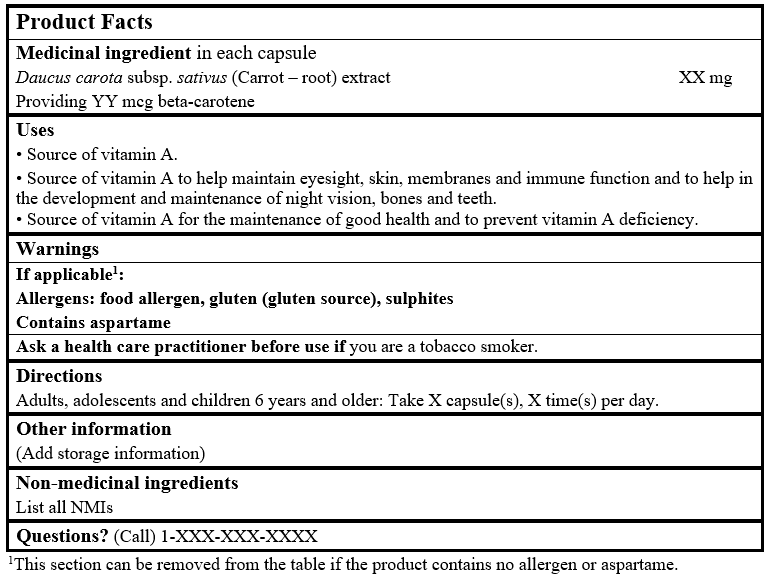
EXAMPLE OF PRODUCT FACTS:
Consult the Guidance Document, Labelling of Natural Health Products for more details.
References cited
- ATBC (Alpha-tocopherol, beta-carotene cancer prevention) study group. The effect of vitamin E and beta carotene on the incidence of lung cancer and other cancers in male smokers. The New England Journal of Medicine1994;330(15):1029-1035.
- CNF 2024: Canadian Nutrient File, Food and Nutrition, Health Canada. [Accessed 2025 December 29]. Available from: https://food-nutrition.canada.ca/cnf-fce
- EMA/CHMP 2006: European Medicines Agency: Pre-authorization Evaluation of Medicines for Human Use. Committee for Medicinal Products for Human Use. Reflection Paper: Formulations of choice for the paediatric population. Adopted September 2006. EMA/CHMP/PEG/194810/2005. [Accessed 2024 June 10]. Available from: https://www.ema.europa.eu/en/documents/scientific-guideline/reflection-paper-formulations-choice-paediatric-population_en.pdf
- FAO/WHO 1967: Food and Agricultural Organization of the United Nations / World Health Organization. 1967. Requirements of vitamin A, thiamine, riboflavine and niacin: report of a joint FAO/WHO Expert Group. Geneva (CH): WHO Technical Report Series 362.
- Gardner Z, McGuffin M, editors. American Herbal Products Association's Botanical Safety Handbook. 2nd edition. Boca Ration (FL): Taylor and Francis Group; 2013.
- Giacoia GP, Taylor-Zapata P, Mattison D. Eunice Kennedy Shriver National Institute of Child Health and Human Development Pediatric Formulation Initiative: selected reports from working groups. Clinical Therapeutics 2008;30(11):2097-2101.
- Groff J, Gropper S. Advanced Nutrition and Human Metabolism. 3rd edition. Belmont (CA): Wadsworth/Thomson Learning; 2000.
- HC 1990: Nutrition Recommendations. The Report of the Scientific Review Committee. Ottawa: Minister of Supply and Services, Health Canada; 1990.
- IOM 2006: Institute of Medicine. Otten JJ, Pitzi Hellwig J, Meyers LD, editors. Institute of Medicine. Dietary Reference Intakes: The Essential Guide to Nutrient Requirements.
- Omenn GS, Goodman GE, Thornquist MD, Balmes J, Cullen MR, Glass A, Keogh JP, Meyskens FL, Valanis B, Williams JH, Barnhart S, Hammar S. Effects of a combination of beta carotene and vitamin A on lung cancer and cardiovascular disease. New England Journal of Medicine 1996;334(18):1150-1155.
- Shils ME, Olson JA, Shike M, Ross AC, Caballero B, Cousins RJ, editors. Modern Nutrition in Health and Disease. 10th edition. Philadelphia (PA): Lippincott Williams & Wilkins; 2006.
- Touvier M, Kess E, Clavel-Chapelon F, and Boutron-Rualt MC. Dual association of beta- carotene with risk of tobacco-related cancers in a cohort of French women. Journal of the National Cancer Institute 2005;97(18):1338-1344.
- USDA 2024: United States Department of Agriculture Agricultural Research Service (USDA ARS), Germplasm Resources Information Network (GRIN) - Global. U.S. National Plant Germplasm System. [Accessed 2024 May 31]. Available from: https://npgsweb.ars-grin.gov/gringlobal/taxon/taxonomysearch
References reviewed
- Burri BJ, Clifford AJ. Carotenoid and retinoid metabolism: insights from isotope studies. Archives of Biochemistry and Biophysics 2004;430(1):110-119.
- Dueker SR, Lin Y, Buchholz BA, Schneider PD, Lame MW, Segall HJ, Vogel JS, Clifford AJ. Long-term kinetic study of β;-carotene, using acceleratory mass spectrometry in an adult volunteer. Journal of Lipid Research 2000;41:1790-1800.
- Expert Group on Vitamins and Minerals. 2003. Safe Upper Levels for Vitamins and Minerals. United Kingdom Food Standards Agency. [Accessed 2024 June 10]. Available from: https://cot.food.gov.uk/sites/default/files/vitmin2003.pdf
- Furr HC, Green MH, Haskell M, Mokhtar N, Nestel P, Newton S, Ribaya-Mercado JD, Tang G, Tanumihardjo S, Wasantwisut E. Stable isotope dilution techniques for assessing vitamin A status and bioefficacy of provitamin A carotenoids in humans. Public Health Nutrition 2005;8(6):596-607.
- Haskell MJ, Brown KH. Reply to M van Lieshout and S de Pee. American Journal of Clinical Nutrition 2005;81(4):945-946.
- Hickenbottom SJ, Follett JR, Lin Y, Dueker SR, Burri BJ, Neidlinger TR, Clifford AJ. Variability in conversion of β;-carotene to vitamin A in men as measured by using a double-tracer study design. American Journal of Clinical Nutrition 2002;75(5):900-907.
- Hickenbottom SJ, Lemke SL, Dueker SR, Lin Y, Follett JR, Carkeet C, Buchholz BA, Vogel JS, Clifford AJ. Dual isotope test for assessing β;-carotene cleavage to vitamin A in humans. European Journal of Nutrition 2002;41(4):141-147.
- Institute of Medicine. Panel on Micronutrients, Subcommittees on Upper Reference Levels of Nutrients and Interpretation and Uses of Dietary Reference Intakes, and the Standing Committee on the Scientific Evaluation of Dietary Reference Intakes, Food and Nutrition Board, Institute of Medicine. Dietary Reference Intakes for Vitamin A, Vitamin K, Arsenic, Boron, Chromium, Copper, Iodine, Iron, Manganese, Molybdenum, Nickel, Silicon, Vanadium, and Zinc. Washington (DC): National Academy Press; 2001.
- Institute of Medicine. Committee on Food Chemicals Codex, Food and Nutrition Board, Institute of Medicine. Food Chemicals Codex, 5th edition. Washington (DC): National Academies Press; 2003.
- Lemke SL, Dueker SR, Follett JR, Lin Y, Carkeet C, Buchholz BA, Vogel JS, Clifford AJ. Absorption and retinol equivalence of β;-carotene in humans is influenced by dietary vitamin A intake. Journal of Lipid Research 2003;44(8):1591-1600.
- Lin Y, Dueker SR, Burri BJ, Neidlinger TR, Clifford AJ. Variability of the conversion of β;- carotene to vitamin A in women measured by using a double-tracer study design. American Journal of Clinical Nutrition 2000;71(6):1545-1554.
- Ribaya-Mercado JD, Solon FS, Solon MA, Cabal-Barza MA, Perfecto CS, Tang G, Solon JAA, Fjeld CR, Russell RM. Bioconversion of plant carotenoids to vitamin A in Filipino school-aged children varies inversely with vitamin A status. American Journal of Clinical Nutrition 2000;72(2):455-465.
- Russell RM, Ross AC, Trumbo PR, West KP. Retinol equivalency ratio of β;-carotene. Journal of Nutrition 2003;133(9):2915-2916.
- Tang G, Qin J, Dolnikowski GG, Russell RM. Vitamin A equivalence of β;-carotene in a woman as determined by a stable isotope reference method. European Journal of Nutrition 2000;39(1):7- 11.
- Tang G, Qin J, Dolnikowski GG, Russell RM. Short-term (intestinal) and long-term (postintestinal) conversion of β;-carotene to retinol in adults as assessed by a stable-isotope reference method. American Journal of Clinical Nutrition 2003;78(2):259-266.
- van Lieshout M, de Pee S. Vitamin A equivalency estimates: understanding apparent differences. American Journal of Clinical Nutrition 2005;81(4):943-945.
- van Lieshout M, West CE, Muhilal, Permaesih D, Wang Y, Xu X, van Breemen RB, Creemers AFL, Verhoeven MA, Lugtenburg J. Bioefficacy of β;-carotene dissolved in oil studied in children in Indonesia. American Journal of Clinical Nutrition 2001;73(5):949-958.
- Van Loo-Bouwman CA, West CE, van Breeman RB, Zhu D, Siebelink E, Versloot P, Hulshof PJM, van Lieshout M, Russel FGM, Schaafsma G, Naber THJ. Vitamin A equivalency of β;- carotene in healthy adults: limitations of the extrinsic dual-isotope dilution technique to measure matrix effect. British Journal of Nutrition 2009;101(12):1837-1845.
- Wang Z, Yin S, Zhao X, Russell RM, Tang G. β;-Carotene - vitamin A equivalence in Chinese adults assessed by an isotope dilution technique. British Journal of Nutrition 2004;91(1):121- 131.
- West CE, Eilander A, van Lieshout M. Consequences of revised estimates of carotenoid bioefficacy for dietary control of vitamin A deficiency in developing countries. Journal of Nutrition 2002;132(9S):2920S-2926S.
- West CE, Eilander A, van Lieshout M. Reply to Russel et al. Journal of Nutrition 2003; 133(9):2917.
- World Health Organization / Food and Agricultural Organization of the United Nations. 2004. Vitamin and mineral requirements in human nutrition, 2nd edition. [Accessed 2024 June 10]. Available from: https://www.who.int/publications/i/item/9241546123