
HOLY BASIL - OCIMUM TENUIFLORUM - SEED
 (PDF Version - 135 KB)
This monograph is intended to serve as a guide to industry for the preparation of Product Licence Applications (PLAs) and labels for natural health product market authorization. It is not intended to be a comprehensive review of the medicinal ingredient.
Notes
- Text in parentheses is additional optional information which can be included on label at the applicant's discretion.
- The solidus (/) indicates that either term and/or statement may be selected on the label.
Date
February 27, 2026
Proper name(s), Common name(s), Source information
| Proper name(s) | Common name(s) | Source information | ||
|---|---|---|---|---|
| Source material(s) | Part(s) | Preparation(s) | ||
| Ocimum tenuiflorum |
|
Ocimum tenuiflorum | Seed | Dry |
References: Proper name: USDA 2024; Gardner and McGuffin 2013; Common names: USDA 2024; Gardner and McGuffin 2013; API 1999; Source information: API 1999.
Route of administration
Oral
Dosage form(s)
This monograph excludes foods or food-like dosage forms as indicated in the Compendium of Monographs Guidance Document.
Acceptable dosage forms for oral use are indicated in the dosage form drop-down list of the web-based Product Licence Application form for Compendial applications.
Use(s) or Purpose(s)
- Traditionally used in Ayurveda (as a demulcent) to help relieve cough (, such as Kasa) (Mishra 2004; Kapoor 2001; API 1999).
- Traditionally used in Ayurveda (as Hrdya,) a cardiotonic (API 1999).
- Traditionally used in Ayurveda (as Dipan,) to aid digestion (Dipani) (API 1999).
Notes
- The above uses can be combined on the product label if from the same traditional or non-traditional system of medicine (e.g., Traditionally used in Ayurveda as a demulcent to help relieve cough, such as Kasa, and as Hrdya, a cardiotonic).
- For multi-ingredient products:
- To prevent the product from being represented as a “traditional medicine”, any indicated traditional use claim must refer to the specific medicinal ingredient(s) and recognized traditional system of medicine from which the claim originates when 1) both traditional and modern claims are present or 2) when claims originate from multiple systems of traditional medicine (e.g., Holy basil is traditionally used in Ayurveda as Dipan, to aid digestion).
- When ALL of the medicinal ingredients (MIs) in the product are used within the SAME identified system of traditional medicine AND the product makes ONLY traditional claims, listing of MIs in the traditional claim(s) is not required.
Dose(s)
Subpopulation(s)
Adults 18 years and older
Quantity(ies)
Methods of preparation: Dry, Powdered, Non-Standardized Ethanolic Extracts (Dry extract, Tincture, Fluid extract)
1 – 2 grams of dried seed, per day (Williamson 2002; Kapoor 2001; API 1999).
Direction(s) for use
No statement required.
Duration(s) of use
No statement required.
Risk information
Caution(s) and warning(s)
All products
- Ask a health care practitioner/health care provider/health care professional/doctor/physician before use if you are pregnant or breastfeeding.
- Ask a health care practitioner/health care provider/health care professional/doctor/physician before use if you have a cardiovascular condition (Rai et al. 1997; Agrawal et al. 1996).
- Ask a health care practitioner/health care provider/health care professional/doctor/physician before use if you are taking any heart or blood pressure medication (Rai et al. 1997; Agrawal et al. 1996).
Relief of cough; Digestive aid
Ask a health care practitioner/health care provider/health care professional/doctor/physician if symptoms persist or worsen.
Contraindication(s)
No statement required.
Known adverse reaction(s)
No statement required.
Non-medicinal ingredients
Must be chosen from the current Natural Health Products Ingredients Database (NHPID) and must meet the limitations outlined in the database.
Storage conditions
Must be established in accordance with the requirements described in the Natural Health Products Regulations.
Specifications
- The finished product specifications must be established in accordance with the requirements described in the Natural and Non-Prescription Health Products Directorate (NNHPD) Quality of Natural Health Products Guide.
- The medicinal ingredient must comply with the requirements outlined in the NHPID.
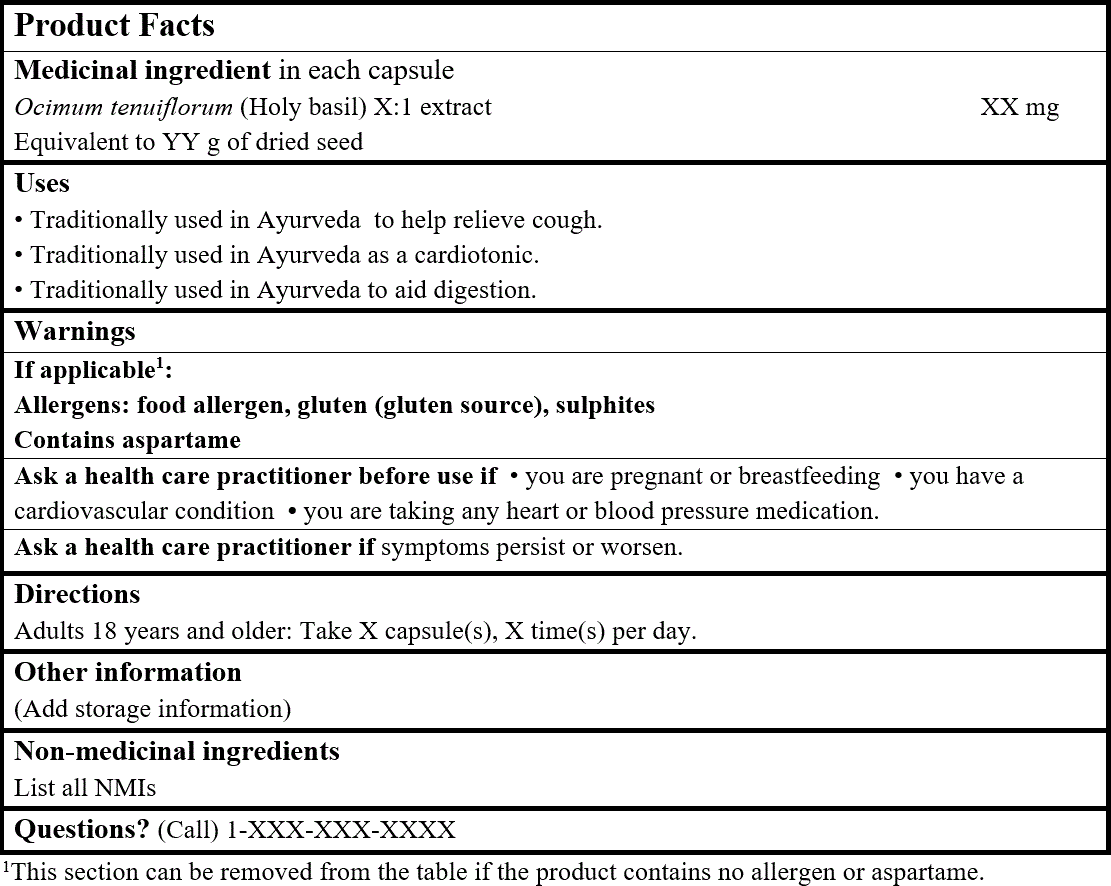
EXAMPLE OF PRODUCT FACTS:
Consult the Guidance Document, Labelling of Natural Health Products for more details.
References cited
- Agrawal P, Rai V, Singh RB. Randomized placebo-controlled, single blind trial of holy basil leaves in patients with noninsulin-dependent diabetes mellitus. International Journal of Clinical Pharmacology and Therapeutics 1996;34(9):406-409.
- API 1999: The Ayurvedic Pharmacopoeia of India. 1st edition, Part I, Volume I. Delhi (IN): The Controller of Publications; 1999.
- Gardner Z, McGuffin M, editors. American Herbal Products Association's Botanical Safety Handbook. 2nd edition. Boca Ration (FL): Taylor and Francis Group; 2013.
- Kapoor LD. Handbook of Ayurvedic Medicinal Plants. Baton Roca (FL): CRC Press LLC; 2001.
- Mishra LC, editor. Scientific Basis for Ayurvedia Therapies. Baton Roca (FL): CRC Press LLC; 2004.
- Rai V, Iyer U, Mani UV. Effect of Ocimum sanctum leaf powder on blood lipoproteins, glycated proteins and total amino acids in patients with non-insulin-dependent diabetes mellitus. Journal of Nutritional and Environmental Medicine. 1997;7(2):133-118.
- USDA 2024: United States Department of Agriculture Agricultural Research Service (USDA ARS), Germplasm Resources Information Network (GRIN) – Global. U.S. National Plant Germplasm System. [Accessed 2024 May 28]. Available from: https://npgsweb.ars-grin.gov/gringlobal/taxon/taxonomysearch
- Williamson EM, editor. Major Herbs of Ayurveda. Edinburgh (GB): Churchill Livingstone; 2002.
References reviewed
- Ahmed A, Ahamed RN, Aladakatti RH, Ghoseawar MG. Reversible antifertility effect of benzene extract of Ocimum sanctum on sperm parameters and fructose content in rats. Journal of basic and clinical physiology and pharmacology. 2002;13:51-59.
- American Society of Health-System Pharmacists. American Hospital Formulary Service (AHFS) Drug Information. Philadelphia (PA): Lippincott Williams and Wilkins; 2005.
- Bhattacharyya D, Sur TK, Jana U, Debnath PK. Controlled programmed trial of Ocimum sanctum leaf on generalized anxiety disorders. Nepal Medical College Journal 2008;10(3):176-179.
- Bradley P. British Herbal Compendium – A handbook of scientific information on widely used plant drugs. (Volume 2) Bournemouth (GB): British Herbal Medicine Association; 2006.
- Brinker F. Herb Contraindications and Drug Interactions, 4th edition. Sandy (OR): Eclectic Medical Publications; 2010.
- Brinker F. The Toxicology of Botanical Medicines. Sandy, Oregon: Eclectic Medical Publications; 2000.
- Dr. Duke's Phytochemical and Ethnobotanical Databases. [Accessed 2024 Juin 04]. Available from: https://phytochem.nal.usda.gov/
- Faccolia S. Cornucopia II A source book of edible plants. Vista (CA): Kampong Publications; 1998.
- Gogte VVM. Ayurvedic Pharmacology and Therapeutic Uses of Medicinal Plants. Mubai (IN): Bharatiya Vidya Bhavan; 2000.
- Grover JK, Yadav S, Vats V. Medicinal plants of India with anti-diabetic potential. Journal of Ethnopharmacology. 2002;82(1):81-100.
- Jain SK. DeFillips RA. Medicinal Plants of India. Volume 1. Algonac (MI): Reference Publications, Inc; 1991.
- Kapoor S. Ocimum sanctum: A therapeutic role in diabetes and the metabolic syndrome. Hormone and Metabolic Research 2008;40:296.
- Khory RN, Katrak NN. Materia Medica of India and their Therapeutics. Delhi (IN): Komal Prakashan; 1999 [Reprint of 1903 publication].
- Liu JP, Zhang M, Wang M, Grimsgaard S. Chinese herbal medicines for type 2 diabetes mellitus (Review). Cochrane Database of Systemic Reviews 2002, Issue 3. Art. No.: CD003642. DOI: 10.1002/14651858.CD003642.pub2.
- Miller R, Miller S. Tulsi Queen of Herbs: India's Holy Basil. The Green Isle Enterprise: Salt Spring Island (BC); 2003.
- Mills S, Bone K. The Essential Guide to Herbal Safety. St. Louis (MO): Elsevier Churchill Livingstone; 2005.
- Mondal S, Mirdha BR, Mahapatra SC. The science behind sacredness of Tulsi (Ocimum sanctum Linn). Indian Journal of Physiology and Pharmacology 2009;53(4):291-306.
- Murthy KRS. Bhāvaprakāśa of Bhāvamiśra. Volume 1. Varanasi (IN): Chowkhamba Krishnadas Academy; 2004.
- Paranjpe P. Indian Medicinal Plants: Forgotten Healers: A Guide to Ayurvedic Herbal Medicine. Delhi (IN): Chaukhamba Sanskrit Pratishthan; 2005.
- Prakash P, Gupta N. Therapeutic uses of Ocimum sanctum Linn (Tulsi) with a note on eugenol and its pharmacological actions: A short review. Indian Journal of Physiology and Pharmacology 2005;49(2):125-131.
- Premila MS. Ayurvedic herbs: A clinical guide to the healing plants of traditional Indian medicine. New York (NY): The Haworth Press Inc; 2006.
- Rosenbaum CC, O'Mathúna DP, Chavez M, Shields K. Antioxidants and anti-inflammatory dietary supplements for osteoarthritis and rheumatoids arthritis. Alternative Therapies in Health and Medicine 2010;16(2):32-40.
- Shekelle PG, Hardy M, Morton SC, Coulter I, Venuturupalli S, Favreau J, Hilton LK. Are Ayurvedic herbs for diabetes effective? The Journal of Family Practice 2005;54(10):876-886.
- Singh N. A new concept on the possible therapy of stress diseases with “adaptogen” (anti-stress drugs) of indigenous plant origin. Current Medical Practice 1981;25:1-50.
- Sudarshan SR. Encyclopaedia of Indian Medicine, Materia Medica - Herbal Drugs. Volume 4. Banglore (IN): Popular Prakashan; 2005.
- Summary of Evaluations Performed by the Joint FAO/WHO Expert Committee on Food Additives. Eugenol. [Accessed 2024 Juin 04]. Available from: http://www.inchem.org/documents/jecfa/jeceval/jec_841.htm
- Summary of Evaluations Performed by the Joint FAO/WHO Expert Committee on Food Additives. Beta-Caryophyllene. [Accessed 2024 Juin 04]. Available from http://www.inchem.org/documents/jecfa/jeceval/jec_389.htm
- Summary of Evaluations Performed by the Joint FAO/WHO Expert Committee on Food Additives. Eugenyl Methyl Ether. [Accessed 2024 Juin 04]. Available from http://www.inchem.org/documents/jecfa/jeceval/jec_846.htm
- Ulbricht C, Basch E, Weissner W, Hackman D. An evidence-based systematic review of herbs and supplement interactions by the Natural Standard Research Collaboration. Expert Opinion on Drug Safety 2006; 5(5):719-728.
- Warrier PK, Nambiar VPK, Ramankutty C, editors. Indian Medicinal Plants: a compendium of 500 species. Volume 4. Chennai (IN): Orient Longman Private Limited; 2003.
- Winston D, Maimes S. Adaptogens: Herbs for strength, stamina and stress relief. Healing Arts Press; Rochester (VT); 2007.
- WHO 2002: World Health Organization (WHO). Monographs on Selected Medicinal Plants, Volume 2. Geneva (CH): World Health Organization; 2002.
- Wohlmuth H. Sacred basil – an Ayurvedic adaptogen. Botanical Pathways, 2002; Issue 11.
- Yeh GY, Eisenberg DM, Kaptchuk TJ, Phillips RS. Systematic review of herbs and dietary supplements for glycemic control in diabetes. Diabetes Care 2003;26(4):1277-1294.
Version History
| Publication date | Update type | Summary of main updates (from Feb 2026) |
|---|---|---|
| 2026-02-27 | Minor updates |
|
| 2018-12-18 | Validation | – |
| 2013-03-22 | Minor updates | – |
| 2012-08-10 | Initial release | – |