
ALOE - ALOE VERA/ALOE FEROX - Oral
 (PDF Version - 57 K)
This monograph is intended to serve as a guide to industry for the preparation of Product Licence Applications (PLA) and labels for natural health product market authorization. It is not intended to be a comprehensive review of the medicinal ingredient.
Notes
- Text in parentheses is additional optional information which can be included on the label at the applicant's discretion.
- The solidus (/) indicates that the terms and/or statements are synonymous. Either term or statement may be selected by the applicant on the label.
Date
March 28, 2025
Proper name(s), Common name(s), Source information
| Proper name(s) | Common name(s) | Source information | |
|---|---|---|---|
| Source material(s) | Part(s) | ||
| Aloe ferox | Cape aloe | Aloe ferox | Latex |
| Aloe Vera |
|
Aloe Vera | Latex |
References: Proper names: USDA 2024; Common names: USDA 2024; Gardner and McGuffin 2013; Source information: Barnes et al. 2007; Williamson 2003.
Route(s) of administration
Oral
Dosage form(s)
This monograph excludes foods or food-like dosage forms as indicated in the Compendium of Monographs Guidance Document.
Acceptable dosage forms for oral use are indicated in the dosage form drop-down list of the web-based Product Licence Application form for Compendial applications.
Use(s) or Purpose(s)
- [(Traditionally) used in Herbal Medicine as a] stimulant laxative (Williamson 2003; Bradley 1992; Felter and Lloyd 1983; Grieve 1971).
- (Used in Herbal Medicine for the) short-term relief of occasional constipation (EMA 2016).
- (Used in Herbal Medicine to) promote(s) bowel movement (by direct action on the large intestine) (EMA 2016; Sweetman 2007; WHO 1999).
Notes
- The above uses can be combined on the product label if from the same traditional or non-traditional system of medicine (e.g., Used in Herbal Medicine as a stimulant laxative for short-term relief of occasional constipation).
- For multi-ingredient products (when combined with other medicinal ingredients outside this monograph):
- To prevent the product from being represented as a "traditional medicine", any indicated traditional use claim must refer to the specific medicinal ingredient(s) and recognized traditional system of medicine from which the claim originates when 1) both traditional and modern claims are present or 2) when claims originate from multiple systems of traditional medicine (e.g. Aloe is traditionally used in Herbal Medicine as a stimulant laxative).
- When ALL of the medicinal ingredients (MIs) in the product are used within the SAME identified system of traditional medicine AND the product makes ONLY traditional claims, listing of MIs in the traditional claim(s) is not required.
Dose(s)
Subpopulation(s)
Adolescents 12-17 years, Adults 18 years and older (EMA 2016; Brinker 2010).
Quantity(ies)
Methods of preparation: Dry, Powdered, Non-Standardized (Dry extract, Tincture, Fluid extract, Decoction, Decoction concentrate, Infusion, Infusion concentrate)
50 - 300 milligrams dried latex, per day; and providing at least 50 mg of dried latex per single dose (Williamson 2003; Bradley 1992).
Methods of preparation: Standardized extracts (Dry extract, Tincture, Fluid extract, Decoction, Decoction concentrate, Infusion, Infusion concentrate)
10 - 30 milligrams hydroxyanthracene derivatives (calculated as barbaloin/aloin), per day; and providing at least 10 mg of hydroxyanthracene derivatives (calculated as barbaloin/aloin) per single dose (EMA 2016; Barnes st al, 2007; Blumenthal et al. 1998)
Direction(s) for use
All products
- Start with 1 dose, 2 to 3 times per week and increase up to once daily if results are not observed (EMA 2016; Gardner and McGuffin 2013; Bradley 1992).
- Take a few hours before or after taking other medications or health products (EMA 2016; Gardner and McGuffin 2013; Bradley 1992).
- Allow at least 6 to 12 hours for laxative effect to occur (EMA 2016; Berardi et al. 2002).
- Stimulant laxatives should only be used if occasional constipation cannot be improved by a change of diet or the administration of bulk forming laxatives (EMA 2016).
Optional (for products which provide a dosage range)
The optimal dosage is the smallest dose required to produce a soft-formed stool (EMA 2016).
Combination rule
When the medicinal ingredients listed in Table 1 are combined, the total quantity of the ingredients must not exceed the quantities listed above.
Duration of use
Ask a health care practitioner/health care provider/health care professional/doctor/physician for use beyond 7 days (EMA 2016; Brinker 2010).
Risk information
Caution(s) and warning(s)
- Ask a health care practitioner/health care provider/health care professional/doctor/physician if symptoms persist or worsen.
- Ask a health care practitioner/health care provider/health care professional/doctor/physician before use if you have a kidney disorder or a lazy bowel (EMA 2016; Gardner and McGuffin 2013; Brinker 2010).
- Ask a health care practitioner/health care provider/health care professional/doctor/physician before use if you are taking heart medications, corticosteroids, diuretics, or other health products that may contribute to electrolyte imbalance (EMA 2016; Gardner and McGuffin 2013; Brinker 2010).
Contraindication(s)
- Do not use if you are pregnant or breastfeeding (Gardner and McGuffin 2013; Brinker 2010).
- Do not use if you have inflammatory bowel disease, fever or any undiagnosed gastrointestinal trouble (EMA 2016; Gardner and McGuffin 2013; Brinker 2010).
Known adverse reaction(s)
Stop use if hypersensitivity/allergy or diarrhea occurs (EMA 2016; Brinker 2010).
Non-medicinal ingredients
Must be chosen from the current Natural Health Products Ingredients Database (NHPID) and must meet the limitations outlined in the database.
Storage conditions
Must be established in accordance with the requirements described in the Natural Health Products Regulations.
Specifications
- The finished product specifications must be established in accordance with the requirements described in the Natural and Non-prescription Health Products Directorate (NNHPD) Quality of Natural Health Products Guide.
- The medicinal ingredient must comply with the specifications outlined in the NHPID.
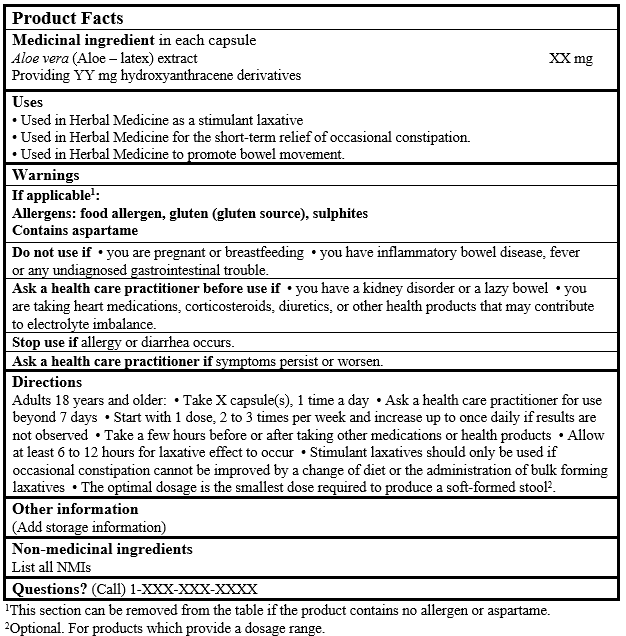
EXAMPLE OF PRODUCT FACTS:
Consult the Guidance Document, Labelling of Natural Health Products for more details.
References cited
- Barnes J, Anderson LA, Philipson JD. Herbal Medicines, 3rd edition. London (UK): The Pharmaceutical Press; 2007.
- Berardi RR, DeSimone EM, Newton GD, Oszko MA, Popovich NG, Rollins CJ, Shimp LA, Tietze KJ, editors. Handbook of Nonprescription Drugs: An Interactive Approach to SelfCare, 13th edition. Washington (DC): American Pharmaceutical Association; 2002.
- Blumenthal M, Busse W, Goldberg A, Gruenwald J, Hall T, Riggins C, Rister R, editors. The Complete German Commission E Monographs: Therapeutic Guide to Herbal Medicines. Austin (TX): American Botanical Council; 1998.
- Bradley PR, editor. British Herbal Compendium: A Handbook of Scientific Information on Widely Used Plant Drugs, Volume 1. Bournemouth (UK): British Herbal Medicine Association; 1992.
- Brinker F. Herb Contraindications and Drug Interactions, 4th edition. Sandy (OR): Eclectic Medical Publications; 2010.
- EMA 2016. European Medicines Agency. Community Herbal Monograph on Aloe Barbadensis Miller and on Aloe (Various Species, Mainly Aloe Ferox Miller And Its Hybrids). London (UK): EMA Committee on Herbal Medicinal Products (HMPC), 22 Novembre 2016. [Accessed 2025 March 14]. Available from: https://www.ema.europa.eu/en/documents/herbal-monograph/final-european-union-herbal-monograph-aloe-barbadensis-mill-and-aloe-various-species-mainly-aloe-ferox-mill-and-its-hybrids-folii-succus-siccatus_en.pdf
- Felter HW, Lloyd JU. King's American Dispensatory, Volume 1, 18th edition. Sandy (OR): Eclectic Medical Publications; 1983 [Reprint of 1898 original].
- Gardner Z, McGuffin M. editors. American Herbal Products Association's Botanical Safety Handbook, 2nd edition. Boca Raton (FL): CRC Press; 2013.
- Grieve M. A Modern Herbal, Volume 1. New York (NY): Dover Publications; 1971 [Reprint of 1931 Harcourt, Brace & Company publication].
- Sweetman SC, editor. Martindale: The Complete Drug Reference, 35th edition. London (UK): Pharmaceutical Press; 2007.
- USDA 2024: United States Department of Agriculture, Agricultural Research Service (USDA ARS), Germplasm Resources Information Network (GRIN) - Global. U.S. National Plant Germplasm System. [Accessed 2024 June 18]. Available from: https://npgsweb.ars-grin.gov/gringlobal/taxon/taxonomysearch
- WHO 1999: World Health Organization. WHO Monographs on Selected Medicinal Plants, Volume 1. Geneva (CHE): World Health Organization; 1999.
- Williamson EM. Potter's Herbal Cyclopaedia: The Authoritative Reference work on Plants with a Known Medical Use. Saffron Walden (UK): The C.W. Daniel Company Limited; 2003.
References reviewed
- Felter HW. The Eclectic Materia Medica, Pharmacology and Therapeutics. Sandy (OR): Eclectic Medical Publications; 1983 [Reprint of 1922 original].
- Gallagher J, Gray M. Is aloe vera effective for healing chronic wounds? Journal of Wound, Ostomy and Continence Nursing 2003;30(2):68-71.
- Gerard J. The Herbal or General History of Plants. The Complete 1633 Edition as Revised and Enlarged by Thomas Johnson. NY (NY): Dover Publications; 1975.
- Hoffmann D. Medical Herbalism: The Science and Practice of Herbal Medicine. Rochester (VT): Healing Arts Press; 2003.
- MacKay D, Miller AL. Nutritional support for wound healing. Alternative Medicine Review 2003;8(4):359-377.
- Maenthaisong R, Chaiyakunapruk N, Niruntraporn S, Kongkaew C. The efficacy of aloe vera used for burn wound healing: a systematic review. Burns 2007;33(6):713-718.
- Mills S. The Dictionary of Modern Herbalism. Wellingborough (UK): Thorsons Publishers Ltd; 1985.
- Mills S, Bone K. The Essential Guide to Herbal Safety. St. Louis (MO): Elsevier Churchill Livingstone; 2005.
- Mills S, Bone K. Principles and Practice of Phytotherapy. Toronto (ON): Churchill Livingstone; 2000.
- Schilcher H. Phytotherapy in Paediatrics: Handbook for Physicians and Pharmacists. Stuttgart (D): Medpharm Scientific Publishers; 1997.
- Vogler BK, Ernst E. Aloe vera: a systematic review of its clinical effectiveness. British Journal of General Practice 1999;49(447):823-828.